


Predicting progression to type 1 diabetes from ages 3 to 6 in islet autoantibody positive TEDDY children
- PMID: 30628751
- PMCID: PMC6456374
- DOI: 10.1111/pedi.12812
Predicting progression to type 1 diabetes from ages 3 to 6 in islet autoantibody positive TEDDY children
Abstract
Objective: The capacity to precisely predict progression to type 1 diabetes (T1D) in young children over a short time span is an unmet need. We sought to develop a risk algorithm to predict progression in children with high-risk human leukocyte antigen (HLA) genes followed in The Environmental Determinants of Diabetes in the Young (TEDDY) study.
Methods: Logistic regression and 4-fold cross-validation examined 38 candidate predictors of risk from clinical, immunologic, metabolic, and genetic data. TEDDY subjects with at least one persistent, confirmed autoantibody at age 3 were analyzed with progression to T1D by age 6 serving as the primary endpoint. The logistic regression prediction model was compared to two non-statistical predictors, multiple autoantibody status, and presence of insulinoma-associated-2 autoantibodies (IA-2A).
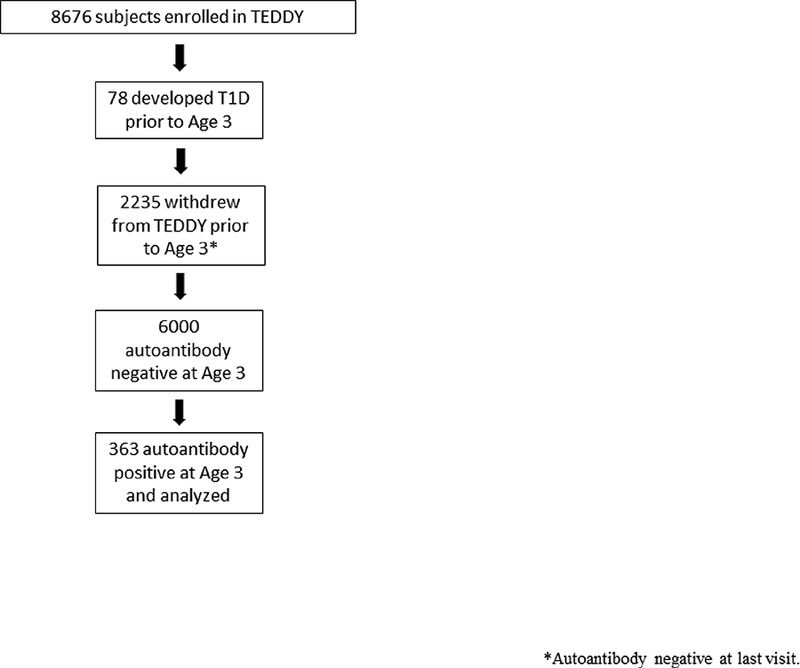
Results: A total of 363 subjects had at least one autoantibody at age 3. Twenty-one percent of subjects developed T1D by age 6. Logistic regression modeling identified 5 significant predictors - IA-2A status, hemoglobin A1c, body mass index Z-score, single-nucleotide polymorphism rs12708716_G, and a combination marker of autoantibody number plus fasting insulin level. The logistic model yielded a receiver operating characteristic area under the curve (AUC) of 0.80, higher than the two other predictors; however, the differences in AUC, sensitivity, and specificity were small across models.
Conclusions: This study highlights the application of precision medicine techniques to predict progression to diabetes over a 3-year window in TEDDY subjects. This multifaceted model provides preliminary improvement in prediction over simpler prediction tools. Additional tools are needed to maximize the predictive value of these approaches.
Keywords: autoantibodies; metabolic; pediatric; prediction; type 1 diabetes.
© 2019 John Wiley & Sons A/S. Published by John Wiley & Sons Ltd.
Conflict of interest statement
The authors have no relevant conflicts of interest to disclose.
Figures
References
-
- Steck AK, Vehik K, Bonifacio E, Lernmark A, Ziegler AG, Hagopian WA, She J, Simell O, Akolkar B, Krischer J, Schatz D, Rewers MJ; TEDDY Study Group. Predictors of Progression From the Appearance of Islet Autoantibodies to Early Childhood Diabetes: The Environmental Determinants of Diabetes in the Young (TEDDY). Diabetes Care. 2015. May;38(5):808–13. - PMC - PubMed
-
- Orban T, Sosenko JM, Cuthbertson D, Krischer JP, Skyler JS, Jackson R, Yu L, Palmer JP, Schatz D, Eisenbarth G; Diabetes Prevention Trial-Type 1 Study Group. Pancreatic islet autoantibodies as predictors of type 1 diabetes in the Diabetes Prevention Trial-Type 1. Diabetes Care. 2009. December;32(12):2269–74. - PMC - PubMed
-
- Sosenko JM, Krischer JP, Palmer JP, Mahon J, Cowie C, Greenbaum CJ, Cuthbertson D, Lachin JM, Sklyer JS, The Diabetes Prevention Trial- Type 1 Study Group. A risk score for Type 1 diabetes derived from autoantibody-positive participants in the diabetes prevention trial-Type 1. Diabetes Care. 2008; 31, 528–533. - PubMed
Publication types
MeSH terms
Substances
Grants and funding
- U01 DK063821/DK/NIDDK NIH HHS/United States
- UC4 DK063863/DK/NIDDK NIH HHS/United States
- UC4 DK112243/DK/NIDDK NIH HHS/United States
- HHSN267200700014C/DK/NIDDK NIH HHS/United States
- U01 DK063861/DK/NIDDK NIH HHS/United States
- UL1 TR001427/TR/NCATS NIH HHS/United States
- U01 DK063790/DK/NIDDK NIH HHS/United States
- UL1 TR001082/TR/NCATS NIH HHS/United States
- P30 DK017047/DK/NIDDK NIH HHS/United States
- UL1 TR000064/TR/NCATS NIH HHS/United States
- U01 DK063836/DK/NIDDK NIH HHS/United States
- U01 DK063829/DK/NIDDK NIH HHS/United States
- U01 DK063865/DK/NIDDK NIH HHS/United States
- UC4 DK095300/DK/NIDDK NIH HHS/United States
- UC4 DK063861/DK/NIDDK NIH HHS/United States
- UC4 DK063829/DK/NIDDK NIH HHS/United States
- UC4 DK063821/DK/NIDDK NIH HHS/United States
- UC4 DK117483/DK/NIDDK NIH HHS/United States
- UC4 DK063865/DK/NIDDK NIH HHS/United States
- U01 DK063863/DK/NIDDK NIH HHS/United States
- UC4 DK106955/DK/NIDDK NIH HHS/United States
- UC4 DK100238/DK/NIDDK NIH HHS/United States
LinkOut - more resources
Full Text Sources
Other Literature Sources
Medical
Research Materials
