Early motor abilities in infants at heightened versus low risk for ASD: A Baby Siblings Research Consortium (BSRC) study
- PMID: 30628809
- PMCID: PMC6338079
- DOI: 10.1037/abn0000390
Early motor abilities in infants at heightened versus low risk for ASD: A Baby Siblings Research Consortium (BSRC) study
Abstract
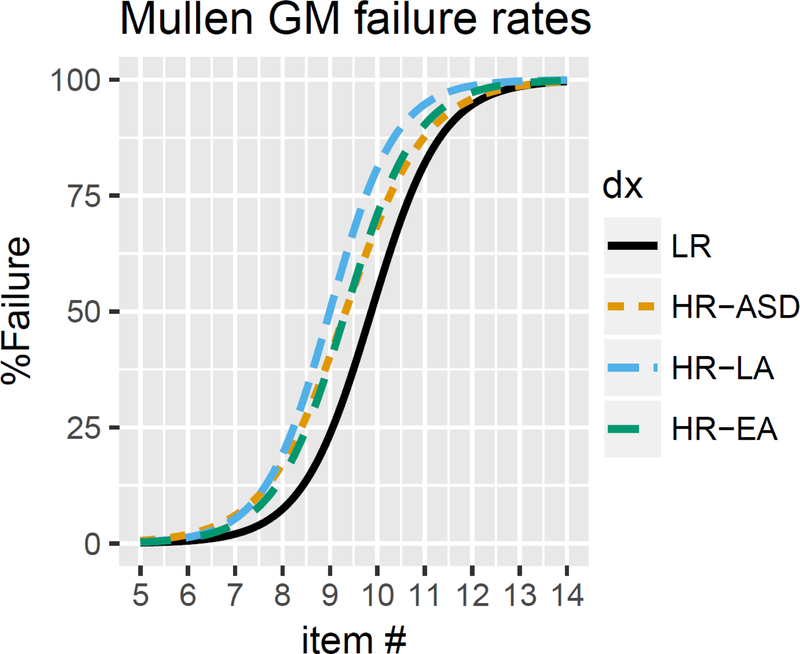
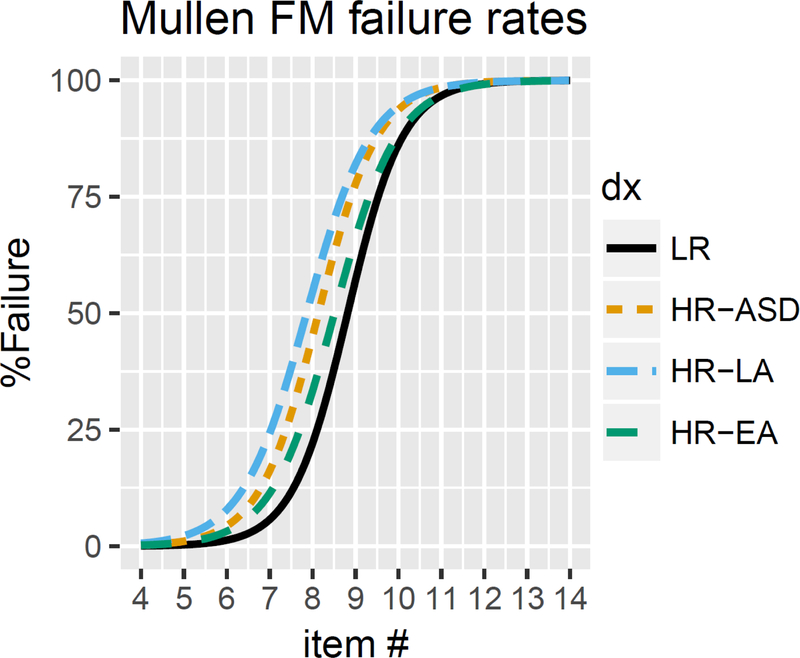
Research has identified early appearing differences in gross and fine motor abilities in infants at heightened risk (HR) for autism spectrum disorder (ASD) because they are the younger siblings of children with ASD, and it suggests that such differences may be especially apparent among those HR infants themselves eventually diagnosed with ASD. The present study examined overall and item-level performance on the gross (GM) and fine motor (FM) subscales of the Mullen Scales of Early Learning (MSEL) administered at 6 months to a large, geographically diverse sample of HR infants with varying developmental outcomes (ASD, elevated ADOS without ASD, low ADOS without ASD) and to infants with low ASD risk (low risk [LR]). We also explored whether motor abilities assessed at 6 months predicted ASD symptom severity at 36 months. FM (but not GM) performance distinguished all 3 HR groups from LR infants with the weakest performance observed in the HR-Elevated ADOS children, who exhibited multiple differences from both LR and other HR infants in both gross and fine motor skills. Finally, 6-month FM (but not GM) scores significant predicted 36-month ADOS severity scores in the HR group; but no evidence was found of specific early appearing motor signs associated with a later ASD diagnosis. Vulnerabilities in infants' fine and gross motor skills may have significant consequences for later development not only in the motor domain but in other domains. (PsycINFO Database Record (c) 2019 APA, all rights reserved).
Figures
References
-
- Adolph KE & Berger SE (2015). Physical and motor development. In Bornstein MH & Lamb ME (Eds.), Developmental science: An advanced textbook, (7th ed., pp. 261–333). New York: Psychology Press/Taylor & Francis.
-
- American Psychiatric Association (2000). Diagnostic and statistical manual of mental disorders-text revision (DSM-IV-TR). Washington, DC: American Psychiatric Association.
-
- Baranek GT (1999). Autism during infancy: A retrospective video analysis of sensory-motor and social behaviors at 9–12 months of age. Journal of Autism and Developmental Disorders, 29(3), 213–224. - PubMed
MeSH terms
Grants and funding
- U54 HD083091/HD/NICHD NIH HHS/United States
- The Simons Foundation
- R01 MH068398
- nih
- R01 HD057284/HD/NICHD NIH HHS/United States
- R21 DC008637/DC/NIDCD NIH HHS/United States
- R01 DC010290/DC/NIDCD NIH HHS/United States
- R01 GM105004/GM/NIGMS NIH HHS/United States
- P50 HD055784/HD/NICHD NIH HHS/United States
- R01 MH059630/MH/NIMH NIH HHS/United States
- R01 HD072018/HD/NICHD NIH HHS/United States
- U54 MH068172/MH/NIMH NIH HHS/United States
- ASF/Autism Science Foundation/United States
- AS/Autism Speaks/United States
- R01 MH087554/MH/NIMH NIH HHS/United States
- R01 HD055741/HD/NICHD NIH HHS/United States
- K01 MH104739/MH/NIMH NIH HHS/United States
- R01 MH068398/MH/NIMH NIH HHS/United States
- NH/NIH HHS/United States
- R01 HD054979/HD/NICHD NIH HHS/United States
- U54 HD090255/HD/NICHD NIH HHS/United States
LinkOut - more resources
Full Text Sources
Other Literature Sources
Medical