


Does prey encounter and nutrient content affect prey selection in wolf spiders inhabiting Bt cotton fields?
- PMID: 30629650
- PMCID: PMC6328153
- DOI: 10.1371/journal.pone.0210296
Does prey encounter and nutrient content affect prey selection in wolf spiders inhabiting Bt cotton fields?
Abstract
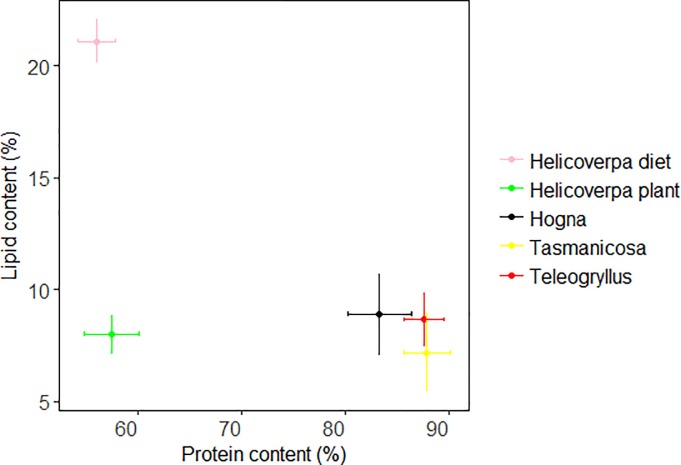
Wolf spiders are abundant and voracious predators at the soil-plant interface in cotton crops. Among other prey, they attack late-instar larvae of the cotton bollworm Helicoverpa spp., an economically important pest. Consequently, wolf spiders in transgenic Bt cotton could provide significant biological control of Bt-resistant Helicoverpa larvae that descend to the soil to pupate. The predator-prey interactions between wolf spiders and Helicoverpa could, however, be constrained by the presence of alternative prey and intraguild predators. This study used laboratory enclosures to analyse the effect of alternative prey on predatory selection of the wolf spider Tasmanicosa leuckartii Thorell. The prey included another wolf spider Hogna crispipes Koch (potential intraguild predator), the ground cricket Teleogryllus commodus Walker (minor pest), and Helicoverpa armigera larvae (major pest). We tested if encounter rates, prey vulnerability, and prey nutritional content influenced the likelihood that a prey was attacked. In three-way food webs, Tasmanicosa encountered and attacked Teleogryllus and Helicoverpa in similar frequencies. However, in the presence of a competing intraguild predator and potential prey (Hogna) in a four-way food web, Tasmanicosa did not always attack Teleogryllus at first encounter, but still attacked Helicoverpa at each encounter. Helicoverpa (protein-poor) and Hogna (protein-rich) were consumed by Tasmanicosa in similar proportions, suggesting that Tasmanicosa might benefit from nutrient balance as an outcome of diverse prey in this food web. As Teleogryllus (protein rich) escapes quicker than Helicoverpa and Hogna, Hogna may be an easier protein-rich option than Teleogryllus. Field surveys showed that while Teleogryllus was the most common prey, wolf spiders feed on diverse insect taxa, as well as other spiders. That Tasmanicosa readily attacked Helicoverpa larvae in the presence of alternative prey is an encouraging result that supports the potential of Tasmanicosa predation to assist in the control of Bt-resistant Helicoverpa larvae and thereby inhibit the proliferation and spread of resistance.
Conflict of interest statement
The authors have declared that no competing interests exist.
Figures


References
-
- Sih A, Christensen B. Optimal diet theory: when does it work, and when and why does it fail? Anim Behav. 2001;61:379–90.
-
- Pastorok RA. Prey vulnerability and size selection by chaoborus larvae. Ecology. 1981;62(5):1311–24.
-
- Endler JA. A predator's view of animal colour patterns. Evol Biol. 1978;11:319–64.
-
- Lang A, Gsodl S. Prey vulnerability and active predator choice as determinants of prey selection: a carabid beetle and its aphid prey. J Appl Entomol. 2001;125(1–2):53–61.
-
- Provost C, Lucas E, Coderre D. Prey preference of Hyaliodes vitripennis as an intraguild predator: Active predator choice or passive selection? Biol Control. 2006;37(2):148–54.
Publication types
MeSH terms
Substances
Associated data
LinkOut - more resources
Full Text Sources
Other Literature Sources
Research Materials
Miscellaneous
