Review
. 2019 Feb:158:9-13.
doi: 10.1016/j.nlm.2019.01.006. Epub 2019 Jan 7.

A role for N-acetylaspartylglutamate (NAAG) and mGluR3 in cognition

Affiliations
Review

A role for N-acetylaspartylglutamate (NAAG) and mGluR3 in cognition

Joseph H Neale et al. Neurobiol Learn Mem. 2019 Feb.

Abstract

The peptide transmitter N-acetylaspartylglutamate (NAAG) and its receptor, the type 3 metabotropic glutamate receptor (mGluR3, GRM3), are prevalent and widely distributed in the mammalian nervous system. Drugs that inhibit the inactivation of synaptically released NAAG have procognitive activity in object recognition and other behavioral models. These inhibitors also reverse cognitive deficits in animal models of clinical disorders. Antagonists of mGluR3 block these actions and mice that are null mutant for this receptor are insensitive to the actions of these procognitive drugs. A positive allosteric modulator of this receptor also has procognitive activity. While some data suggest that drugs acting on mGluR3 achieve their procognitive action by increasing arousal during acquisition training, exploration of the procognitive efficacy of NAAG is in its early stages and thus substantial opportunities exist to define the breadth and nature of this activity.

Keywords: Glutamate carboxypeptidase II; Memory; Metabotropic receptors; N-acetylaspartylglutamate; NAAG; mGluR3.


Figures

Figure 1.
Figure 1.
NAAG as a peptide co-transmitter. In this figure, NAAG is co-released with a primary amine transmitter, such as glutamate, under conditions of elevated neuronal activity. NAAG is released into the perisynaptic space where it activates presynaptic and glial type 3 metabotropic glutamate receptors (mGluR3). NAAG is inactivated by glutamate carboxypeptidases II (GCPII) and III (GCPIII), forming N-acetylaspartate (NAA) and glutamate (Glu), which are rapidly transported into glial cells. Inhibition of these peptidases by a NAAG peptidase inhibitor, such as ZJ43, reduces inactivation of NAAG and increaases perisynaptic NAAG levels. In animal models, the NAAG peptidase inhibitor-mediated elevation of peptide levels increases the activation of mGluR3 receptors on axon endings, reducing subsequent transmitter release. The consequences of NAAG activation of mGluR3 receptors on glial cells have not been well established beyond the observation that NAAG inhibits adenylate cyclase and stimulates the release of transforming growth factor β (TGF-β). Figure reproduced with permission: Neale et al., (2011) Journal of Neurochemistry, 118(4), 490-498.
Figure 2.
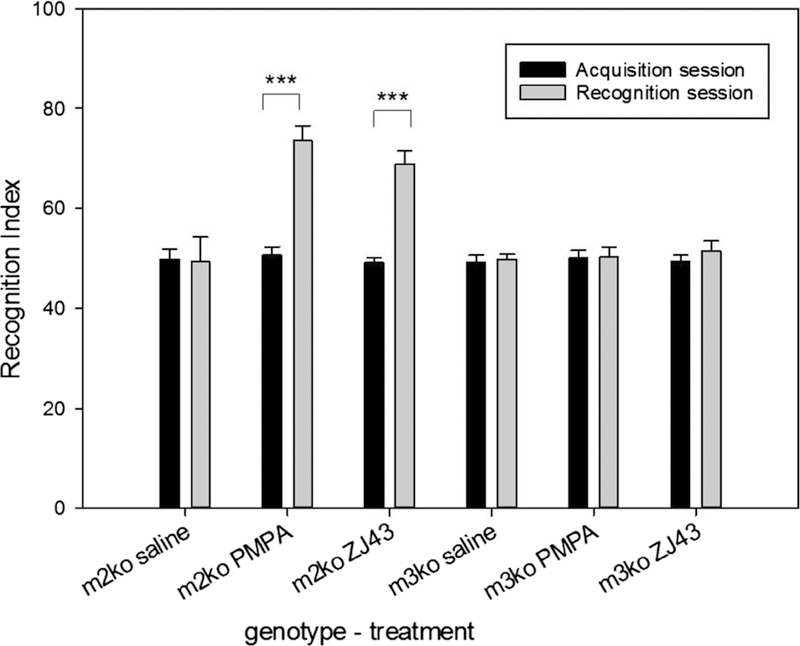
Figure 2.
Long-term novel object recognition memory test in mGluR2 and mGluR3 KO mice. During the acquisition session, mice were individually placed in a chamber for 10 minutes with two identical objects and the amount of time exploring each object was recorded. In the recognition session 24 hours after acquisition, mice were returned to the chamber with one of the original objects and a novel object. For the acquisition session, the recognition index (RI) was calculated as [time exploring one of the objects/the time exploring both objects] × 100. For the recognition session, the RI was calculated as [time exploring the novel object/the time exploring both the familiar and novel object] × 100. During the acquisition phase, mice explored each of the two identical objects about the same amount of time (recognition index ~50). During the recognition phase 24 h later, the mGluR2 KO mice (m2ko) treated with saline explored the novel and familiar object similar amounts of time while those treated with 2-PMPA (100 mg/kg) or ZJ43 (150 mg/kg) explored the novel object twice as often as the original object (recognition index ~70). The NAAG peptidase inhibitors had no procognitive effect in the mGluR3 ko mice (m3ko) supporting the conclusion that NAAG acts via mGluR3. ***p < 0.001 for comparison between acquisition session and recognition session within treatment group. Figure reproduced with permission: Olszewski et al., (2017) Neurochemical Research, 42, 2646–2657,.

References

    1. Allen K,D, Regier M,J, Hsieh C, Tsokas P, Barnard M, Phatarpekar S, Wolk J, Sacktor T,C, Fenton A,A & Hernández A,I (2018) Learning-induced ribosomal RNA is required for memory consolidation in mice-Evidence of differentially expressed rRNA variants in learning and memory. PLoS One, 13(10), e0203374. - PMC - PubMed
    1. Altinbilek B & Manahan-Vaughan D (2009) A specific role for group II metabotropic glutamate receptors in hippocampal long-term depression and spatial memory. Neuroscience, 158(1), 149–158. - PubMed
    1. Antunes M, & Biala G (2012) The novel object recognition memory: neurobiology, test procedure, and its modifications. Cognitive Processing, 13(2), 93–110. - PMC - PubMed
    1. Barker G,R, Bashir Z,I, Brown M,W & Warburton E,C (2006) A temporally distinct role for group I and group II metabotropic glutamate receptors in object recognition memory. Learn Mem, 13(2), 178–186. - PMC - PubMed
    1. Bishop JR, Reilly JL, Harris MS, Patel SR, Kittles R, Badner JA, Prasad KM, Nimgaonkar VL, Keshavan MS & Sweeney JA (2015) Pharmacogenetic associations of the type-3 metabotropic glutamate receptor (GRM3) gene with working memory and clinical symptom response to antipsychotics in first-episode schizophrenia. Psychopharmacology (Berl), 232(1), 145–154. - PMC - PubMed

Publication types

MeSH terms

Substances