


Comment
doi: 10.1073/pnas.1817880116.
Epub 2019 Jan 10.
Navigability evaluation of complex networks by greedy routing efficiency
Affiliations
- PMID: 30630863
- PMCID: PMC6358708
- DOI: 10.1073/pnas.1817880116
Item in Clipboard
Comment
Navigability evaluation of complex networks by greedy routing efficiency
Proc Natl Acad Sci U S A.
.
No abstract available
Conflict of interest statement
The authors declare no conflict of interest.
Figures
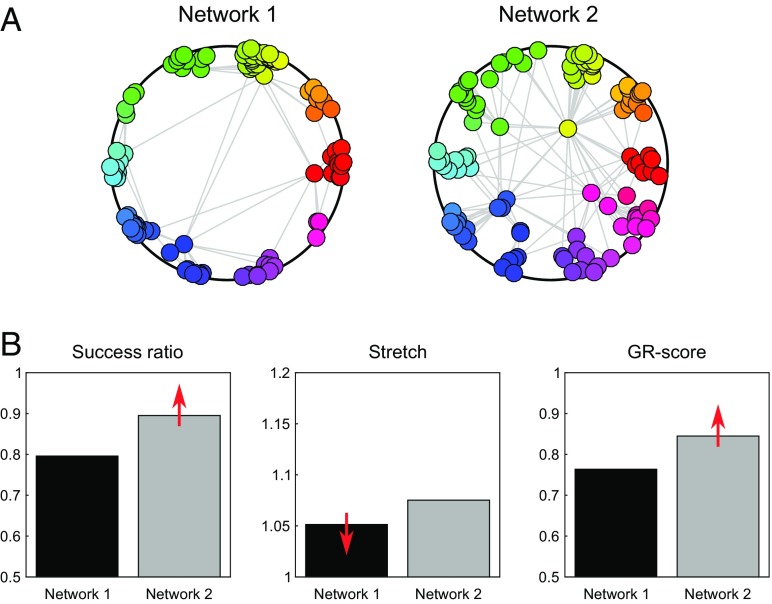
(A) Two artificial networks generated in the hyperbolic space using the nonuniform popularity-similarity optimization (nPSO) model (8), with the following parameters: network 1 n = 100, m = 2, T = 0.1, γ = 5, and C = 10; network 2 n = 100, m = 2, T = 0.3, γ = 2.5, and C = 10. N is the network size, m is approximately half of the average node degree, T is the network temperature (inversely related to the clustering), γ is the exponent of the scale-free degree distribution, and C is the number of communities. (B) Bar plots comparing the success ratio, stretch, and GR-score for the two networks; the red arrow indicates which network has a better result for each evaluation measure. Due to the high γ, network 1 is lacking hubs that act as bridges in the navigation between nodes far from each other, and therefore it has a lower success ratio than network 2. However, the successful GR paths of network 1 have a lower stretch than the more numerous ones of network 2, since they are mostly local paths and the higher clustering (lower temperature) facilitates the navigation between nearby nodes. The GR-score provides a unique solution to the conflicting results of the other two measures, suggesting that network 2 has higher navigability, which is reasonable since the success ratio in network 2 is ∼12% higher than in network 1, whereas the stretch decrement of network 1 on network 2 is ∼2%.
Comment in
-
Reply to Muscoloni and Cannistraci: Navigation performance measures.Proc Natl Acad Sci U S A. 2019 Jan 29;116(5):1470. doi: 10.1073/pnas.1820315116. Epub 2019 Jan 10. Proc Natl Acad Sci U S A. 2019. PMID: 30630947 Free PMC article. No abstract available.
Comment on
-
Navigation of brain networks.Proc Natl Acad Sci U S A. 2018 Jun 12;115(24):6297-6302. doi: 10.1073/pnas.1801351115. Epub 2018 May 30. Proc Natl Acad Sci U S A. 2018. PMID: 29848631 Free PMC article.
References
-
- Kleinberg JM. Navigation in a small world. Nature. 2000;406:845. - PubMed
-
- Boguñá M, Krioukov D, Claffy KC. Navigability of complex networks. Nat Phys. 2008;5:74–80.
-
- Boguñá M, Papadopoulos F, Krioukov D. Sustaining the Internet with hyperbolic mapping. Nat Commun. 2010;1:62. - PubMed
-
- Papadopoulos F, Psomas C, Krioukov D. Network mapping by replaying hyperbolic growth. IEEE/ACM Trans Netw. 2015;23:198–211.
-
- Papadopoulos F, Aldecoa R, Krioukov D. Network geometry inference using common neighbors. Phys Rev E Stat Nonlin Soft Matter Phys. 2015;92:022807. - PubMed
Publication types
MeSH terms
LinkOut - more resources
Full Text Sources
