Comparative Study
. 2019 Jan 10;9(1):46.
doi: 10.1038/s41598-018-37118-0.

Pangenome of Serratia marcescens strains from nosocomial and environmental origins reveals different populations and the links between them

Affiliations
Comparative Study

Pangenome of Serratia marcescens strains from nosocomial and environmental origins reveals different populations and the links between them

Eduardo Abreo et al. Sci Rep. .

Abstract

Serratia marcescens is a Gram-negative bacterial species that can be found in a wide range of environments like soil, water and plant surfaces, while it is also known as an opportunistic human pathogen in hospitals and as a plant growth promoting bacteria (PGPR) in crops. We have used a pangenome-based approach, based on publicly available genomes, to apply whole genome multilocus sequence type schemes to assess whether there is an association between source and genotype, aiming at differentiating between isolates from nosocomial sources and the environment, and between strains reported as PGPR from other environmental strains. Most genomes from a nosocomial setting and environmental origin could be assigned to the proposed nosocomial or environmental MLSTs, which is indicative of an association between source and genotype. The fact that a few genomes from a nosocomial source showed an environmental MLST suggests that a minority of nosocomial strains have recently derived from the environment. PGPR strains were assigned to different environmental types and clades but only one clade comprised strains accumulating a low number of known virulence and antibiotic resistance determinants and was exclusively from environmental sources. This clade is envisaged as a group of promissory MLSTs for selecting prospective PGPR strains.


Conflict of interest statement

The authors declare no competing interests.

Figures
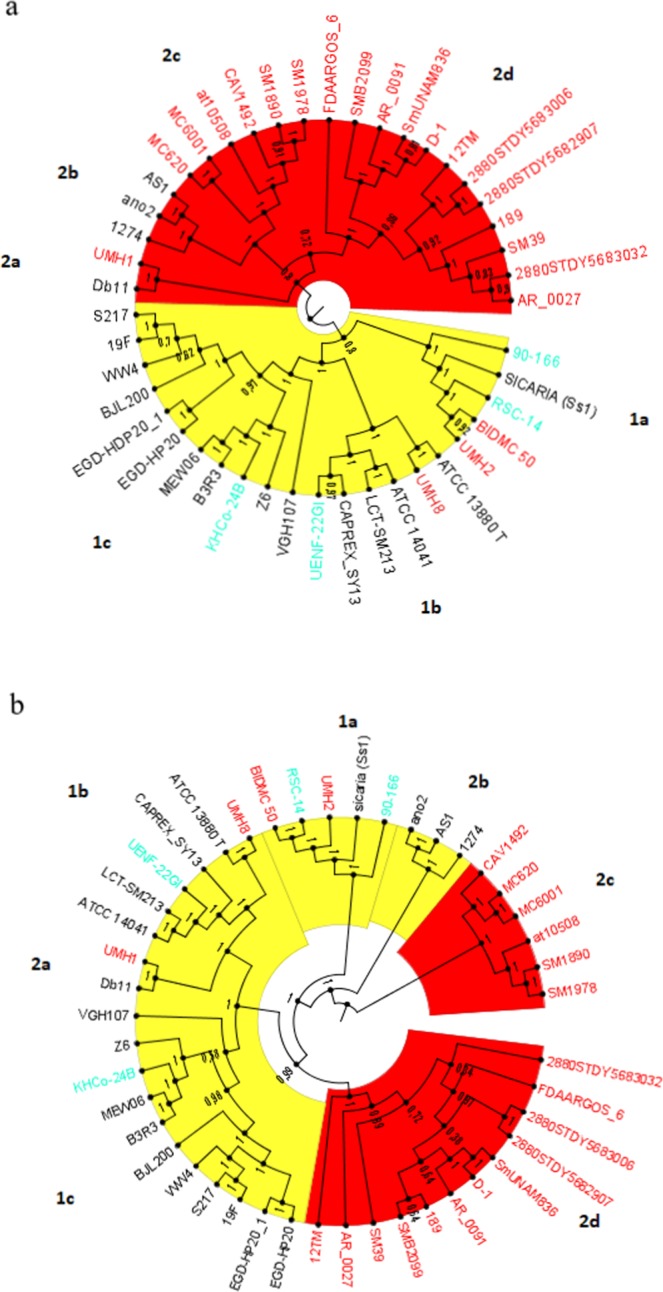
Figure 1
Figure 1
Dendrograms based on genetic distance between allelic sequences of 1a core genes and 1b whole genome genes of 45 Serratia marcescens strains representing nosocomial, environmental and PGPR strains. Taxa were colored according to the origin of the strain: clinical (red), environmental (black), PGPR (green) while clades were numbered and colored according to the assigned genomic type in the cgMLSTs: clinical (red), environmental/PGPR (yellow).
Figure 2
Figure 2
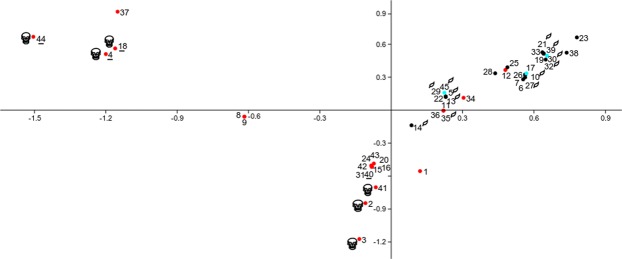
Correspondence analysis based on the presence/absence of 21 known virulence-related genes of Serratia marcescens strains of clinical (red) and environmental (black) origin, including strains reported as PGPR (green). Strains that accumulated higher numbers of known virulence, antibiotic resistance and PGP-related genes are indicated by skulls, underline and a leaf respectively.

References

    1. Altemeier WA, Culbertson WR, Fullen WD, Mc Donough JJ. Serratia marcescens septicemia. A new threat in surgery. Arch. Surg. 1969;99:232–238. doi: 10.1001/archsurg.1969.01340140104015. - DOI - PubMed
    1. Maki DG, Hennekens CG, Phillips CW, Shaw WV, Bennett JV. Nosocomial urinary tract infection with Serratia marcescens: an epidemiologic study. J. Infect. Dis. 1973;128:579–587. doi: 10.1093/infdis/128.5.579. - DOI - PubMed
    1. Okuda T, Endo N, Osada Y, Zen-Yoji H. Outbreak of nosocomial urinary tract infections caused by Serratia marcescens. J. Clin. Microbiol. 1984;20:691–695. - PMC - PubMed
    1. Su LH, et al. Extended epidemic of nosocomial urinary tract infections caused by Serratia marcescens. J. Clin. Microbiol. 2003;41:4726–4732. doi: 10.1128/JCM.41.10.4726-4732.2003. - DOI - PMC - PubMed
    1. Templeton WC, Eiferman MRA, Snyder JW, Melo JC, Raff MJ. Serratia keratitis transmitted by contaminated eyedroppers. Am. J. Ophthalmol. 1982;93:723–726. doi: 10.1016/0002-9394(82)90467-6. - DOI - PubMed

Publication types

LinkOut - more resources