. 2019 Jan 10;9(1):24.
doi: 10.1038/s41598-018-37208-z.

Characterizing both bacteria and fungi improves understanding of the Arabidopsis root microbiome

Affiliations

Characterizing both bacteria and fungi improves understanding of the Arabidopsis root microbiome

Joy Bergelson et al. Sci Rep. .

Abstract

Roots provide plants mineral nutrients and stability in soil; while doing so, they come into contact with diverse soil microbes that affect plant health and productivity. Despite their ecological and agricultural relevance, the factors that shape the root microbiome remain poorly understood. We grew a worldwide panel of replicated Arabidopsis thaliana accessions outdoors and over winter to characterize their root-microbial communities. Although studies of the root microbiome tend to focus on bacteria, we found evidence that fungi have a strong influence on the structure of the root microbiome. Moreover, host effects appear to have a stronger influence on plant-fungal communities than plant-bacterial communities. Mapping the host genes that affect microbiome traits identified a priori candidate genes with roles in plant immunity; the root microbiome also appears to be strongly affected by genes that impact root and root hair development. Our results suggest that future analyses of the root microbiome should focus on multiple kingdoms, and that the root microbiome is shaped not only by genes involved in defense, but also by genes involved in plant form and physiology.


Conflict of interest statement

The authors declare no competing interests.

Figures
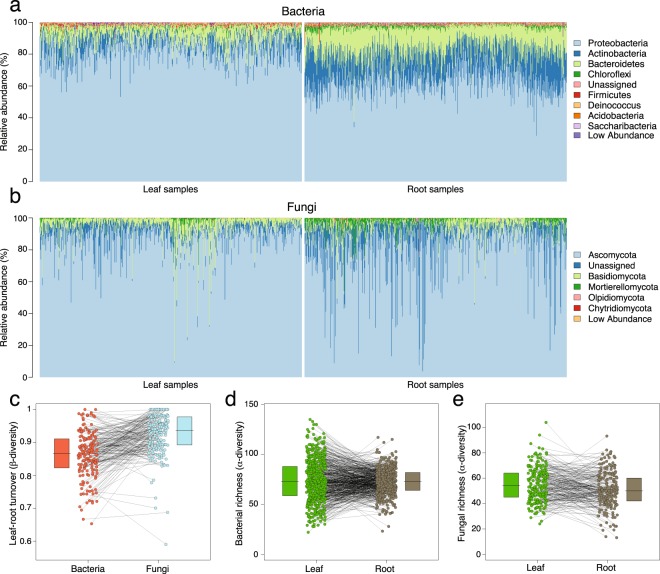
Figure 1
Figure 1
The leaf and root microbiota of worldwide Arabidopsis accessions. (a) The relative abundances of major bacterial phyla are shown for each leaf and root sample; samples are plotted in columns along the x-axis. (b) The relative abundances of fungal phyla are shown for leaf and root samples. (c) β diversity in the leaf and root bacterial and fungal microbiome, independent of taxonomic assignments; the lines between points connect samples collected from the same host-plants. The leaf microbial communities of these plants were described earlier. (d) Bacterial and (e) fungal richness (α diversity) in the leaves and roots. As is the case in (c), the lines in (d,e) connect samples collected from the same host plants.
Figure 2
Figure 2
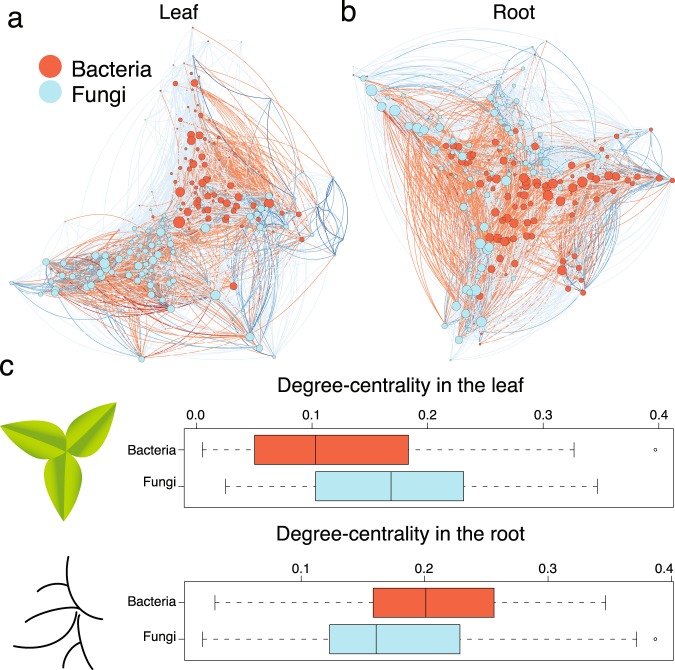
Network analyses of the root and leaf microbiome. Network analyses of Pearson correlation coefficients reveal that both bacteria and fungi are key taxa in the (a) leaf and (b) root microbiome. The size of each node represents its degree; its color represents its kingdom (blue for fungi, red for bacteria). Edges (lines) between nodes are colored blue for positive correlations between taxa; negative correlations are colored red. The networks are plotted using a Davidson-Harel layout. (c) Fungi have more connections (measured by degree centrality) than bacteria in the leaf microbiome, but a similar number of connections in the root microbiome.
Figure 3
Figure 3
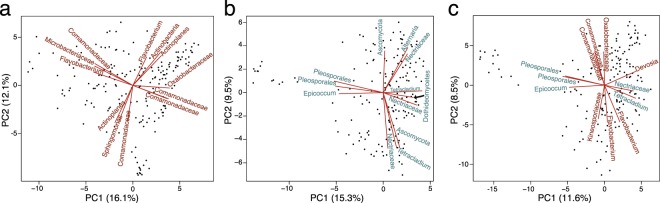
PCA reveals the structure of the root microbiome. (a) A plot of principal component 1 (PC1) and PC2 from PCA of the bacterial community. (b) A plot of PC1 and PC2 from PCA of the fungal community. (c) A plot of PC1 and PC2 from PCA of the combined bacterial and fungal community. In each panel, the labels list the top 3 taxa that separate the samples along each axis (the lines represent their PC loadings).
Figure 4
Figure 4
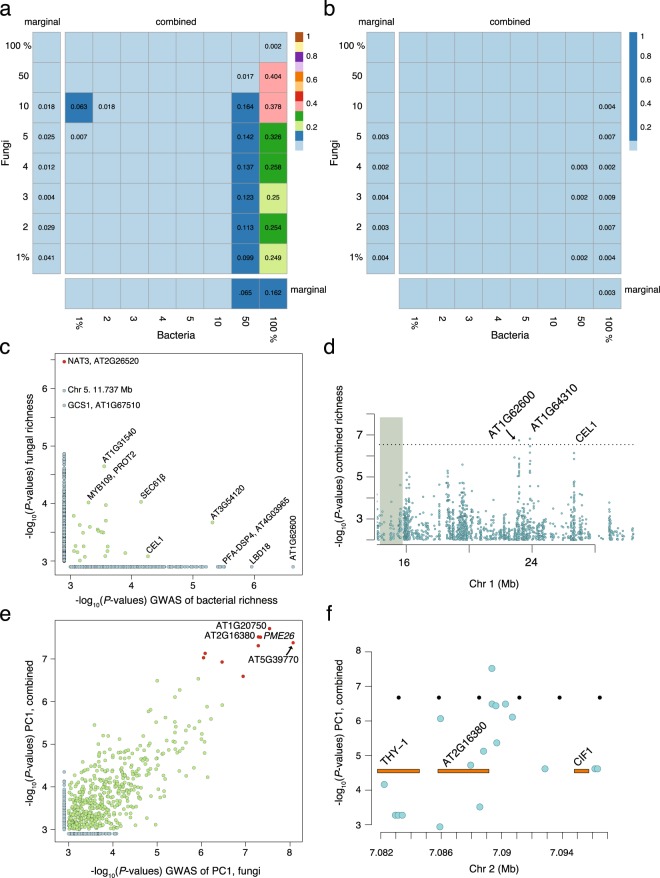
Evidence that hosts shape their microbiome is stronger when taking into account cross-kingdom correlations. (a,b) The color and number in each square represents the P-value from (n = 999) permutation tests that investigate whether genetic differences among accessions shape the bacterial and fungal communities independently or as a combined microbiome (see Methods). The labels along the margins indicate how much of the community was considered in each analysis (e.g. top 1% refers to the top 1% best-sequenced taxa) and is sorted in decreasing abundance. The bars along the margins report the results from single-kingdom (marginal) analyses, while the grids in each panel show the results from the combined (bacteria + fungi) community analyses. The P-values in each square are shown when P > 0.001 (that is, empty squares occur when P = 0.001). The plot in (a) shows the results from analyzing the first three PCs, while (b) shows the results from analyzing the first five PCs. (c) The overlap in the results (10-kb windows) from GWAS of bacterial and fungal richness. (d) The results from GWAS of richness in the combined bacterial and fungal community along the lower arm of chromosome 1. (e) The overlap in the results (10-kb windows) from GWAS of PC1 from PCA of the fungal community (x-axis) and the combined fungal and bacterial community (y-axis). (f) The results from GWAS of PC1 from PCA of the combined microbiome include a peak on chromosome 2 that falls between AT2G16380 and CIF1. For (c,e) significant results are shown in red. All GWAS were performed using a linear mixed model in order to adjust/account for confounding due to population structure.

References

    1. Bodenhausen N, Bortfeld-Miller M, Ackermann M, Vorholt JA. A synthetic community approach reveals plant genotypes affecting the phyllosphere microbiota. PLoS Genetics. 2014;10:e1004283. doi: 10.1371/journal.pgen.1004283. - DOI - PMC - PubMed
    1. Horton MW, et al. Genome-wide association study of Arabidopsis thaliana leaf microbial community. Nature. Communications. 2014;5:5320. - PMC - PubMed
    1. Wagner MR, et al. Host genotype and age shape the leaf and root microbiomes of a wild perennial plant. Nature Communications. 2016;7:12151. doi: 10.1038/ncomms12151. - DOI - PMC - PubMed
    1. Agler MT, et al. Microbial Hub Taxa Link Host and Abiotic Factors to Plant Microbiome Variation. PLoS Biology. 2016;14:e1002352. doi: 10.1371/journal.pbio.1002352. - DOI - PMC - PubMed
    1. Edwards J, et al. Structure, variation, and assembly of the root-associated microbiomes of rice. Proc Natl Acad Sci USA. 2015;112:E911–920. doi: 10.1073/pnas.1414592112. - DOI - PMC - PubMed

Publication types