


Phase I and phase II clinical trials in sarcoma: Implications for drug discovery and development
- PMID: 30632291
- PMCID: PMC6382713
- DOI: 10.1002/cam4.1958
Phase I and phase II clinical trials in sarcoma: Implications for drug discovery and development
Abstract
Background: There has been limited progress in the development of novel therapeutics for the treatment of sarcomas. A review of phase I and II clinical trials for sarcomas may give insight into factors influencing sarcoma drug development.
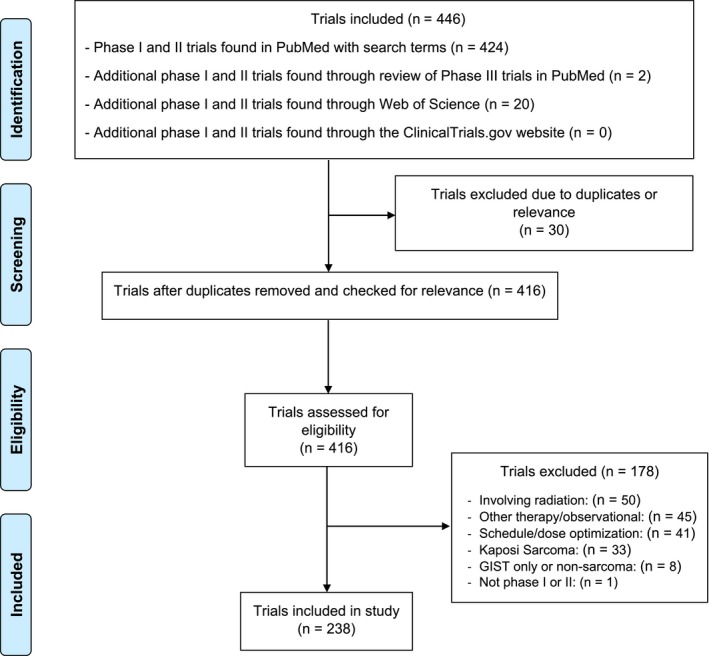
Methods: An exhaustive analysis of phase I and II clinical trials testing drugs for human sarcoma patients between 1 January 2000 and 1 June 2018 was performed using the PubMed search engine, the Thomson Web of Science, and the National Clinical Trials registry. Recorded outcomes included tested drugs, tested histological subtypes, whether the drug was initially developed for sarcoma, reported funding sources, and whether studies led to phase III trials.
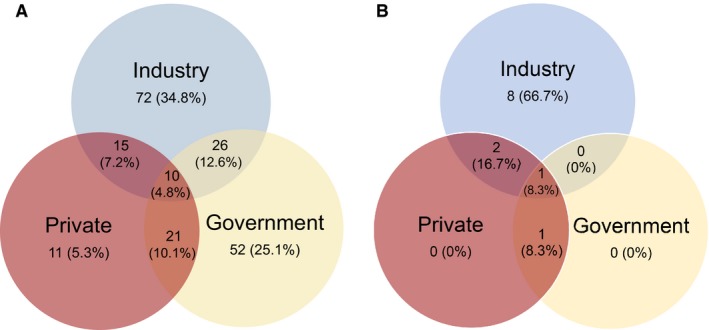
Results: Out of 238 studies meeting inclusion criteria, 87% (207 studies) reported funding sources. Of these, 59.9% (124/207) reported industry funding, 52.7% (109/207) reported government funding, and 27.5% (57/207) reported private funding. Only 5% (12/238) of phase I and II trials resulted in phase III trials, with 11 of 12 studies funded by industry. Approximately 90% (214/238) of studies tested drugs that were not initially tested in sarcoma, and 60.1% (143/238) of studies grouped different sarcoma histological subtypes together in the same study.
Conclusion: Industry has funded the majority of phase I and II sarcoma clinical trials that have led to phase III trials. There was a high rate of drugs approved for other cancers and then secondarily tested in sarcoma. Most trials tended to group different sarcoma subtypes rather than studying each subtype separately.
Keywords: clinical trial.
© 2019 The Authors. Cancer Medicine published by John Wiley & Sons Ltd.
Figures
References
-
- Hui J. Epidemiology and etiology of sarcomas. Surg Clin North Am. 2016;96(5):901‐914. - PubMed
-
- Sarcoma, Soft Tissue: Statistics. Cancer. Net. https://www.cancer.net/cancer-types/sarcoma-soft-tissue/statistics. Published June 25, 2012. Accessed August 2, 2018.
Publication types
MeSH terms
LinkOut - more resources
Full Text Sources
Medical
