. 2019 Jan;7(1):10.1128/microbiolspec.gpp3-0050-2018.
doi: 10.1128/microbiolspec.GPP3-0050-2018.

Capsular Polysaccharide of Group A Streptococcus

Affiliations

Capsular Polysaccharide of Group A Streptococcus

Michael R Wessels. Microbiol Spectr. 2019 Jan.

Abstract

Most clinical isolates of Streptococcus pyogenes elaborate a capsular polysaccharide, which is composed of hyaluronic acid, a high-molecular-mass polymer of alternating residues of N-acetyl glucosamine and glucuronic acid. Certain strains, particularly those of the M18 serotype, produce abundant amounts of capsule, resulting in formation of large, wet-appearing, translucent or "mucoid" colonies on solid media, whereas strains of M-types 4 and 22 produce none. Studies of acapsular mutant strains have provided evidence that the capsule enhances virulence in animal models of infection, an effect attributable, at least in part, to resistance to complement-mediated opsonophagocytic killing by leukocytes. The presence of the hyaluronic acid capsule may mask adhesins on the bacterial cell wall. However, the capsule itself can mediate bacterial attachment to host cells by binding to the hyaluronic-acid binding protein, CD44. Furthermore, binding of the S. pyogenes capsule to CD44 on host epithelial cells can trigger signaling events that disrupt cell-cell junctions and facilitate bacterial invasion into deep tissues. This article summarizes the biochemistry, genetics, regulation, and role in pathogenesis of this important virulence determinant.


Figures
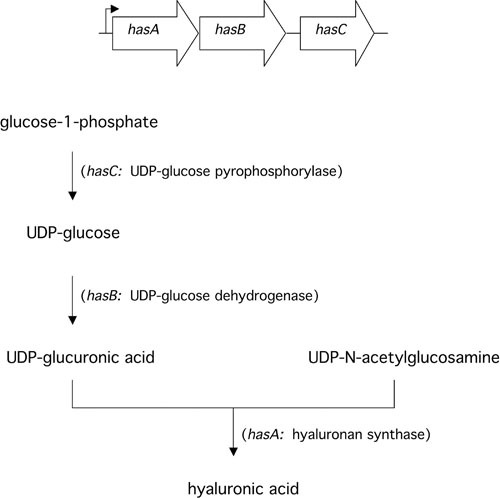
FIGURE 1
FIGURE 1
Schematic diagram of the has operon and the function of each gene product in the biosynthetic pathway for synthesis of hyaluronic acid in S. pyogenes.
FIGURE 2
FIGURE 2
Map of the region of the S. pyogenes chromosome that includes the has operon encoding enzymes required for hyaluronic acid synthesis. The other genes shown appear not to be involved in capsular polysaccharide synthesis or surface expression. In some strains insertion sequence IS1239′ is present approximately 50 nucleotides upstream of the has operon promoter (adapted from the genome sequence of M1 strain SF370, GenBank accession number AE004092 [93]).
FIGURE 3
FIGURE 3
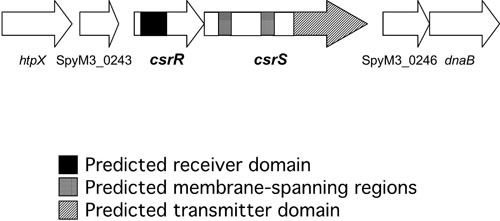
Diagram of the csrRS chromosomal locus encoding a two-component regulatory system that regulates hyaluronic acid synthesis. Sequences corresponding to regions of the predicted proteins with properties characteristic of the response regulator (CsrR) or sensor (CsrS) components are indicated (adapted from the genome sequence of M3 strain MGAS315, GenBank accession number AE014074 [94]).
FIGURE 4
FIGURE 4
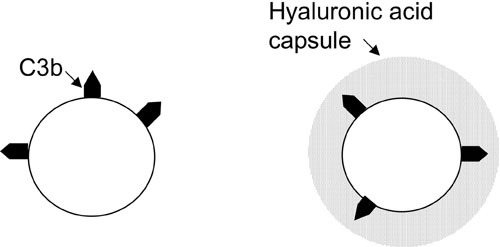
The hyaluronic acid capsule and resistance to complement-mediated phagocytosis. The capsule does not prevent deposition of C3b on the bacterial cell wall but, rather, interferes with the interaction of bound C3b with phagocyte receptors.

References

    1. Todd EW, Lancefield RC. 1928. Variants of hemolytic streptococci; their relation to type specific substance, virulence, and toxin. J Exp Med 48:751–767 10.1084/jem.48.6.751. [PubMed] - DOI - PMC - PubMed
    1. Lancefield RC. 1940. Type specific antigens, M and T, of matt and glossy variants of group A hemolytic streptococci. J Exp Med 71:521–537 10.1084/jem.71.4.521. [PubMed] - DOI - PMC - PubMed
    1. Wilson AT. 1959. The relative importance of the capsule and the M-antigen in determining colony form of group A streptococci. J Exp Med 109:257–270 10.1084/jem.109.3.257. [PubMed] - DOI - PMC - PubMed
    1. Rothbard S, Watson RF. 1948. Variation occurring in group A streptococci during human infection; progressive loss of M substance correlated with increasing susceptibility to bacteriostasis. J Exp Med 87:521–533 10.1084/jem.87.6.521. - DOI - PMC - PubMed
    1. Johnson DR, Stevens DL, Kaplan EL. 1992. Epidemiologic analysis of group A streptococcal serotypes associated with severe systemic infections, rheumatic fever, or uncomplicated pharyngitis. J Infect Dis 166:374–382 10.1093/infdis/166.2.374. - DOI - PubMed

MeSH terms

LinkOut - more resources