


Challenges and opportunities of school-based HPV vaccination in Canada
- PMID: 30633622
- PMCID: PMC6746476
- DOI: 10.1080/21645515.2018.1564440
Challenges and opportunities of school-based HPV vaccination in Canada
Abstract
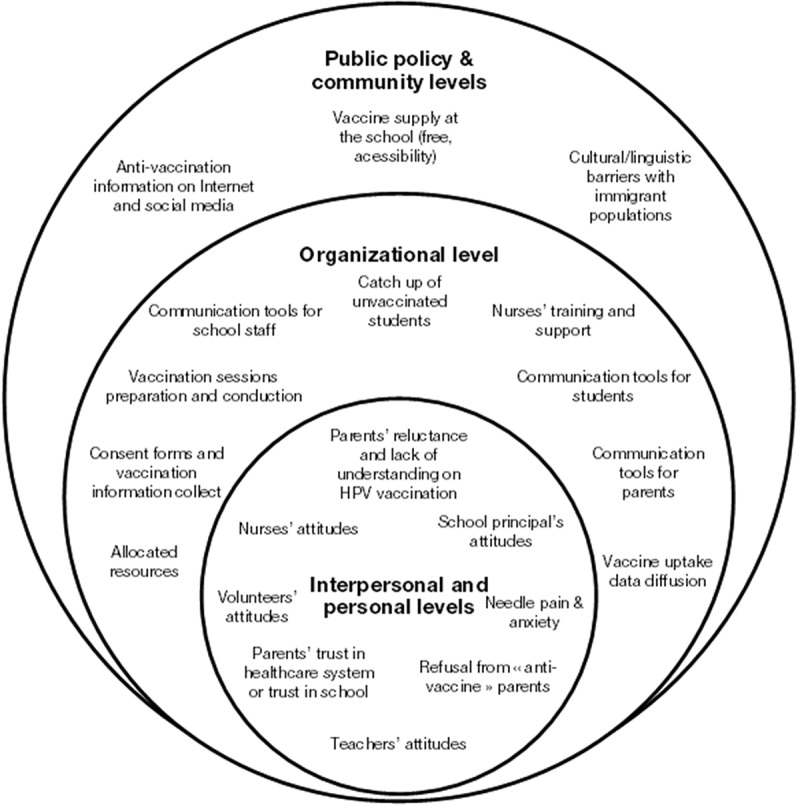
Primary prevention of human papillomavirus (HPV) through vaccination is a high priority in Canada's cancer prevention efforts. All Canadian provinces and territories have introduced publicly funded, school-based vaccination programs against HPV, but vaccine uptake remains suboptimal in some jurisdictions. We conducted a descriptive qualitative study to better understand the determinants of low HPV vaccine uptake and identify strategies to enhance vaccine acceptance using the socio-ecological model. In Quebec, interviews and focus groups were held in 2015-2016 with 70 key informants including immunization managers, school nurses, school principals, teachers and parents of Grade 4 students (9 years of age). Our findings showed that HPV vaccine uptake was dependent on many interrelated factors at the individual and interpersonal level (e.g. knowledge and attitudes of the different players involved in the vaccination system), at the community level (e.g. social group values and norms, media coverage around the HPV vaccine), at the organizational level (e.g. allocated resources, information provision, consent process, immunization setting and environment) and at the policy level (e.g. changes in provincial HPV vaccine program). We are using the data collection and interpretation tools and approaches developed by our team and used in Quebec to expand our study to four other provinces (British Columbia, Alberta, Ontario and Nova Scotia). We are conducting environmental scans, semi-structured interviews and a survey to better understand the determinants of low HPV vaccine uptake and identify strategies to enhance vaccine acceptance. Having an in-depth understanding of the determinants of HPV vaccination in school settings is critical in order to identify root causes of the suboptimal vaccine uptake and to develop tailored interventions to address these on both supply- and demand-side issues.
Keywords: HPV vaccine; determinants; immunization managers; interviews; school-based immunization programs; socio-ecological model.
Figures
References
-
- Canadian Immunization Committee Recommendations for human papillomavirus immunization programs. [Internet] Ontario, Canada: Public Health Agency of Canada; 2014. [accessed 2016 November 2]. http://publications.gc.ca/collections/collection_2014/aspc-phac/HP40-107.... - PMC - PubMed
-
- Statistics Canada Census Profile, 2016 Census. 2018. [accessed 2018 November 29]. https://www12.statcan.gc.ca/census-recensement/2016/dp-pd/prof/index.cfm....
Publication types
MeSH terms
LinkOut - more resources
Full Text Sources
Medical
