Review
. 2019 Jan 9;11(1):61.
doi: 10.3390/cancers11010061.

Reading Cancer: Chromatin Readers as Druggable Targets for Cancer Treatment

Affiliations
Review

Reading Cancer: Chromatin Readers as Druggable Targets for Cancer Treatment

Catia Mio et al. Cancers (Basel). .

Abstract

The epigenetic machinery deputed to control histone post-translational modifications is frequently dysregulated in cancer cells. With epigenetics being naturally reversible, it represents a good target for therapies directed to restore normal gene expression. Since the discovery of Bromodomain and Extra Terminal (BET) inhibitors, a great effort has been spent investigating the effects of chromatin readers' inhibition, specifically the class of proteins assigned to bind acetylated and methylated residues. So far, focused studies have been produced on epigenetic regulation, dissecting a specific class of epigenetic-related proteins or investigating epigenetic therapy in a specific tumor type. In this review, recent steps toward drug discovery on the different classes of chromatin readers have been outlined, highlighting the pros and cons of current therapeutic approaches.

Keywords: chromatin readers; druggable epigenome; small molecule inhibitors.


Conflict of interest statement

The authors declare no conflict of interest.

Figures
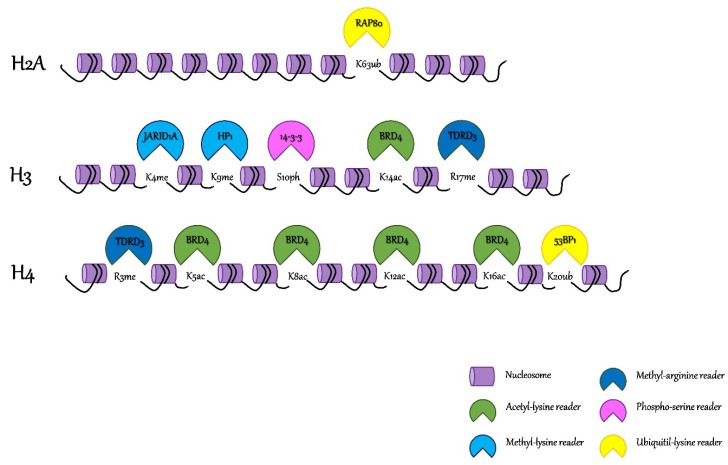
Figure 1
Figure 1
Post-translational modifications (PTMs) on histones tails and their related chromatin readers. Eukaryotic DNA is packaged and subdivided into functional units called nucleosomes (here represented by a purple cylinder). Readers of lysine acetylation (i.e., Bromodomain-containing protein 4 (BRD4)) are represented in green, readers of lysine methylation (i.e., heterochromatin protein 1 (HP1) and Lysine-specific demethylase 5A (JARID1A)) are represented in light blue, readers of arginine methylation (i.e., Tudor domain-containing protein 3 (TDRD3)) are represented in dark blue, readers of lysine ubiquitylation (i.e., Tumor suppressor p53-binding protein 1 (53BP1) and receptor associated protein 80 (RAP80)) are represented in yellow, and readers of serine phosphorylation (i.e., 14-3-3) are represented in pink.
Figure 2
Figure 2
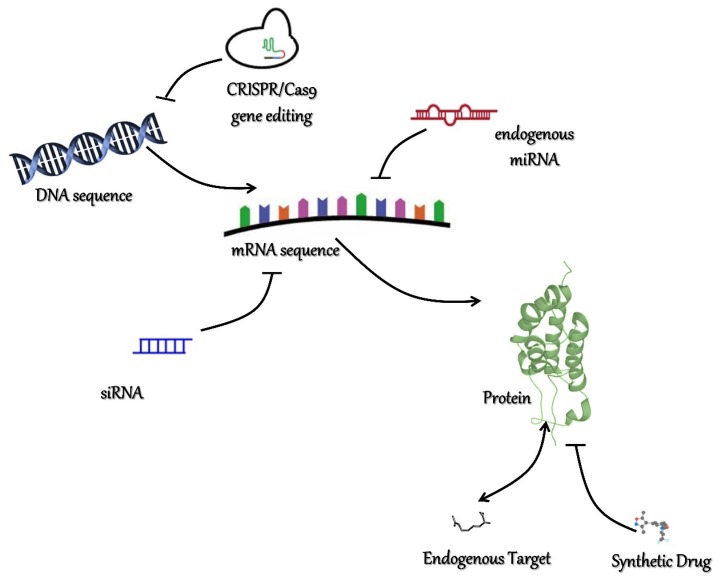
Strategies in chromatin readers’ inhibition. Schematic representation of the diverse methods in readers’ inhibition. Mutations involving readers’ coding sequence or promoters/enhancers’ sequence and causing its mis-regulation could be corrected by the CRISPR/Cas9 gene editing technique. Aberrant gene expression might be suppressed by RNA interference techniques, such as endogenous miRNA targeting or synthetic siRNA delivery. Deregulation could also be hindered at protein levels by means of small molecules acting as exogenous competitors or target mimicking.

References

    1. El Kennani S., Crespo M., Govin J., Pflieger D. Proteomic Analysis of Histone Variants and Their PTMs: Strategies and Pitfalls. Proteomes. 2018;6:29. doi: 10.3390/proteomes6030029. - DOI - PMC - PubMed
    1. Abedin S.M., Boddy C.S., Munshi H.G. BET inhibitors in the treatment of hematologic malignancies: Current insights and future prospects. Oncotargets. 2016;9:5943–5953. - PMC - PubMed
    1. Bowman G.D., Poirier M.G. Post-Translational Modifications of Histones That Influence Nucleosome Dynamics. Chem. Rev. 2015;115:2274–2295. doi: 10.1021/cr500350x. - DOI - PMC - PubMed
    1. Celano M., Mio C., Sponziello M., Verrienti A., Bulotta S., Durante C., Damante G., Russo D. Targeting post-translational histone modifications for the treatment of non-medullary thyroid cancer. Mol. Cell. Endocrinol. 2018;409:38–47. doi: 10.1016/j.mce.2017.05.036. - DOI - PubMed
    1. Bartke T., Borgel J., DiMaggio P.A. Proteomics in epigenetics: New perspectives for cancer research. Brief. Funct. Genom. 2013;12:205–218. doi: 10.1093/bfgp/elt002. - DOI - PMC - PubMed

LinkOut - more resources