


Cardiovascular Comorbidities in Chronic Obstructive Pulmonary Disease (COPD)-Current Considerations for Clinical Practice
- PMID: 30634565
- PMCID: PMC6352261
- DOI: 10.3390/jcm8010069
Cardiovascular Comorbidities in Chronic Obstructive Pulmonary Disease (COPD)-Current Considerations for Clinical Practice
Abstract
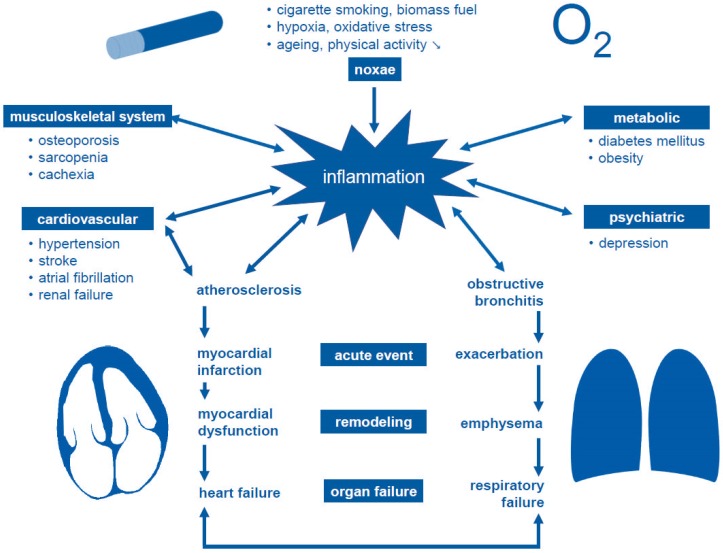
In patients with chronic obstructive pulmonary disease (COPD), cardiovascular comorbidities are highly prevalent and associated with considerable morbidity and mortality. This coincidence is increasingly seen in context of a "cardiopulmonary continuum" rather than being simply attributed to shared risk factors such as cigarette smoking. Overlapping symptoms such as dyspnea or chest pain lead to a worse prognosis due to missed concomitant diagnoses. Moreover, medication is often withheld as a result of unfounded concerns about side effects. Despite the frequent coincidence, current guidelines are still mostly restricted to the management of the individual disease. Future diagnostic and therapeutic strategies should therefore be guided by an integrative perspective as well as a refined phenotyping of disease entities.
Keywords: COPD; cardiovascular; comorbidities; diagnostics; therapy.
Conflict of interest statement
Frederik Trinkmann received travel support from Actelion, Boehringer Ingelheim, Chiesi, Novartis, Mundipharma, and TEVA as well as speaker/consultation fees from Boehringer Ingelheim, Bristol-Myers Squibb, Chiesi, GlaxoSmithKline, Roche, and Novartis. Joachim Saur received travel support and speaker fees from Boehringer Ingelheim, GlaxoSmithKline, Novartis, and Roche. Martin Borggrefe received speaker/consultation fees from Bayer, Boehringer Ingelheim, Daiichi Sankyo, Impulse Dynamics, and Zoll Medical. Ibrahim Akin received travel support as well as speaker/consultation fees Abiomed, Bayer, Boehringer Ingelheim, and St. Jude Medical.
Figures
References
-
- Camiciottoli G., Bigazzi F., Magni C., Bonti V., Diciotti S., Bartolucci M., Mascalchi M., Pistolesi M. Prevalence of comorbidities according to predominant phenotype and severity of chronic obstructive pulmonary disease. Int. J. Chronic Obstruct. Pulm. Dis. 2016;11:2229–2236. doi: 10.2147/COPD.S111724. - DOI - PMC - PubMed
Publication types
LinkOut - more resources
Full Text Sources
