


Abiotic Stresses Intervene with ABA Signaling to Induce Destructive Metabolic Pathways Leading to Death: Premature Leaf Senescence in Plants
- PMID: 30634648
- PMCID: PMC6359161
- DOI: 10.3390/ijms20020256
Abiotic Stresses Intervene with ABA Signaling to Induce Destructive Metabolic Pathways Leading to Death: Premature Leaf Senescence in Plants
Abstract
Abiotic stresses trigger premature leaf senescence by affecting some endogenous factors, which is an important limitation for plant growth and grain yield. Among these endogenous factors that regulate leaf senescence, abscisic acid (ABA) works as a link between the oxidase damage of cellular structure and signal molecules responding to abiotic stress during leaf senescence. Considering the importance of ABA, we collect the latest findings related to ABA biosynthesis, ABA signaling, and its inhibitory effect on chloroplast structure destruction, chlorophyll (Chl) degradation, and photosynthesis reduction. Post-translational changes in leaf senescence end with the exhaustion of nutrients, yellowing of leaves, and death of senescent tissues. In this article, we review the literature on the ABA-inducing leaf senescence mechanism in rice and Arabidopsis starting from ABA synthesis, transport, signaling receptors, and catabolism. We also predict the future outcomes of investigations related to other plants. Before changes in translation occur, ABA signaling that mediates the expression of NYC, bZIP, and WRKY transcription factors (TFs) has been investigated to explain the inducing effect on senescence-associated genes. Various factors related to calcium signaling, reactive oxygen species (ROS) production, and protein degradation are elaborated, and research gaps and potential prospects are presented. Examples of gene mutation conferring the delay or induction of leaf senescence are also described, and they may be helpful in understanding the inhibitory effect of abiotic stresses and effective measures to tolerate, minimize, or resist their inducing effect on leaf senescence.
Keywords: ABA biosynthesis; ABA signaling receptors; ABA-induced transcription factors; chlorophyll degradation; premature leaf senescence.
Conflict of interest statement
The authors declare no conflict of interest.
Figures
 indicate induction and
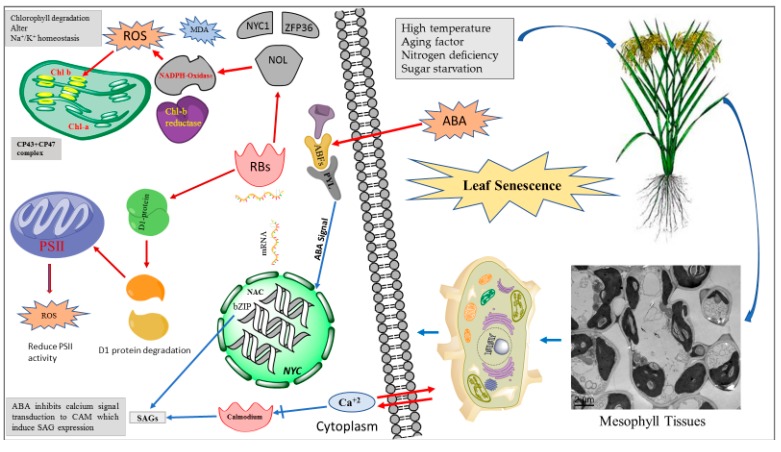
  indicates suppression). Abiotic stresses induce ABA production, which is sensed by ABA signaling receptors (ABF, PYL). ABA signal induce expression of NAC, bZIP and NYC TFs. The activated TFs induce expression of SAGs which are translated in RBs (ribosomes) to synthesize (NOL, NADPH oxidase, Chl-b reductase). NDPH oxidase increase ROS production and Chl b reductase reduce PSII (photosystem II) efficiency and induce the degradation of D1 protein.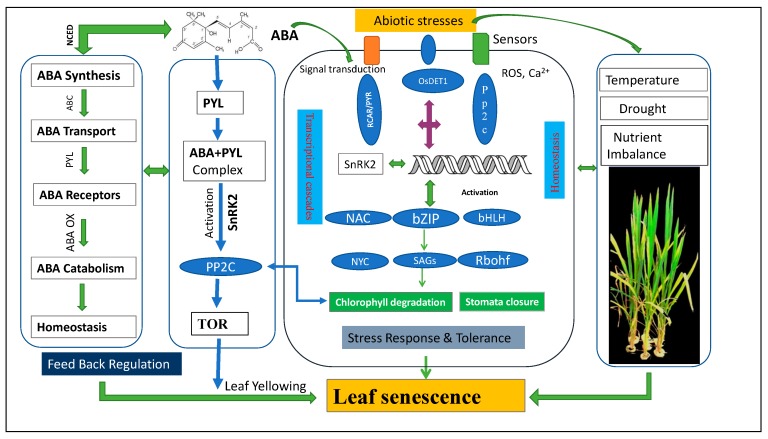
References
-
- Park D.-Y., Shim Y., Gi E., Lee B.-D., An G., Kang K., Paek N.-C. The MYB-related transcription factor RADIALIS-LIKE3 (OsRL3) functions in ABA-induced leaf senescence and salt sensitivity in rice. Environ. Exp. Bot. 2018;156:86–95. doi: 10.1016/j.envexpbot.2018.08.033. - DOI
-
- Xu X., Guo K., Liang W., Chen Q., Shi J., Shen B. Quantitative proteomics analysis of proteins involved in leaf senescence of rice (Oryza sativa L.) Plant Growth Regul. 2018;84:341–349. doi: 10.1007/s10725-017-0345-5. - DOI
-
- Wang F., Liu J., Zhou L., Pan G., Li Z., Zaidi S.-H.-R., Cheng F. Senescence-specific change in ROS scavenging enzyme activities and regulation of various SOD isozymes to ROS levels in psf mutant rice leaves. Plant Physiol. Biochem. 2016;109:248–261. doi: 10.1016/j.plaphy.2016.10.005. - DOI - PubMed
-
- Ali A., Gao X., Guo Y. Initiation, Progression, and Genetic Manipulation of Leaf Senescence. In: Guo Y., editor. Plant Senescence: Methods and Protocols. Springer; New York, NY, USA: 2018. pp. 9–31. - PubMed
Publication types
MeSH terms
Substances
Grants and funding
LinkOut - more resources
Full Text Sources
Other Literature Sources
