Review
. 2019:114:265-313.
doi: 10.1016/bs.apcsb.2018.11.002. Epub 2018 Dec 18.

The roles of cytosolic quality control proteins, SGTA and the BAG6 complex, in disease

Affiliations
Review

The roles of cytosolic quality control proteins, SGTA and the BAG6 complex, in disease

Rashi Benarroch et al. Adv Protein Chem Struct Biol. 2019.

Abstract

SGTA is a co-chaperone that, in collaboration with the complex of BAG6/UBL4A/TRC35, facilitates the biogenesis and quality control of hydrophobic proteins, protecting them from the aqueous cytosolic environment. This work includes targeting tail-anchored proteins to their resident membranes, sorting of membrane and secretory proteins that mislocalize to the cytoplasm and endoplasmic reticulum-associated degradation of misfolded proteins. Since these functions are all vital for the cell's continued proteostasis, their disruption poses a threat to the cell, with a particular risk of protein aggregation, a phenomenon that underpins many diseases. Although the specific disease implications of machinery involved in quality control of hydrophobic substrates are poorly understood, here we summarize much of the available information on this topic.

Keywords: BAG6; Chaperones; Co-chaperones; Hydrophobic proteins; Proteostasis; Quality control; SGTA; TRC35; Tail-anchored proteins; UBL4A.


Figures

Fig. 1
Fig. 1
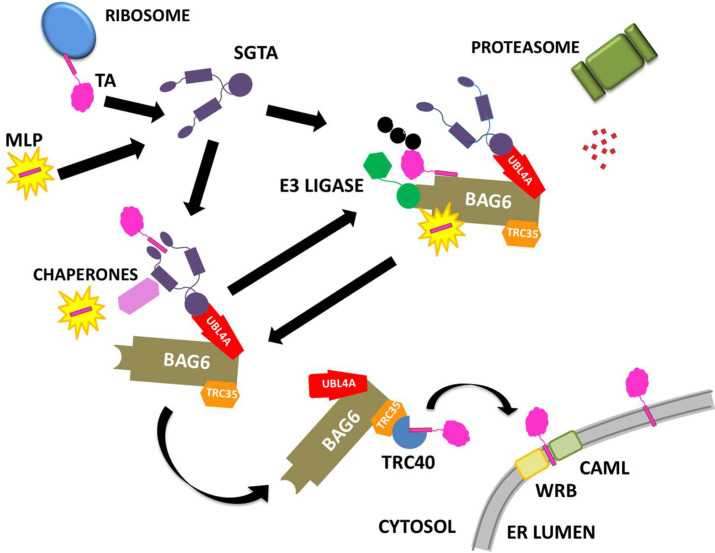
Current ideas on quality control pathways for hydrophobic proteins exposed to the aqueous cytoplasm. SGTA can catch the TMDs of newly translated TA proteins or exposed hydrophobic patches on MLPs, which bind to its C-terminal domain. In collaboration with the heterotrimeric BAG6 complex, which comprises BAG6, TRC35 and UBL4A, SGTA determines the fate of these proteins. Hydrophobic substrates bound to the BAG6 complex can be ubiquitinated by the actions of the E3 ligase RNF126 and thus targeted for proteasomal degradation. SGTA can interact with the RPN13 subunit of the 19S regulatory particle of the proteasome through its TPR domain, which has led to the proposal of an SGTA/BAG6 cycle operating at the proteasome. SGTA hands tail-anchored (TA) proteins over to TRC40 facilitating their post-translational integration into the ER by means of the transmembrane proteins WRB and CAML. Furthermore, SGTA has been implicated in hormone receptor signaling and has been associated with viral lifecycles. SGTA's interactions with Hsp70/Hsp90 chaperones via its TPR domain likely provide substrate access to additional branches of the global cellular quality control network.
Fig. 2
Fig. 2
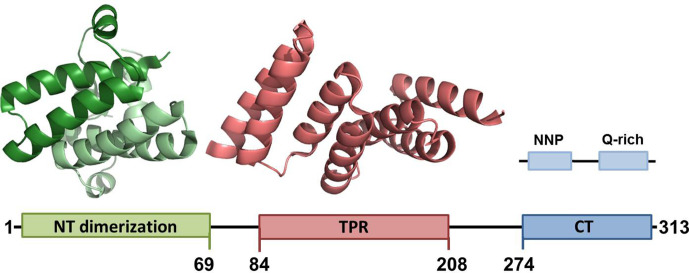
Schematic representation of SGTA showing domain boundaries and solved structures. N-Terminal dimerization domain (monomer chains in two shades of green) residues 1–69 from PDB: 4CPG (Darby et al., 2014); TPR domain (red) residues 84–210 from PDB: 2VYI (Dutta & Tan, 2008). There is currently no solved structure for the C-terminal domain (blue) which encompasses NNP and Q-rich regions (Martinez-Lumbreras et al., 2018).
Fig. 3
Fig. 3
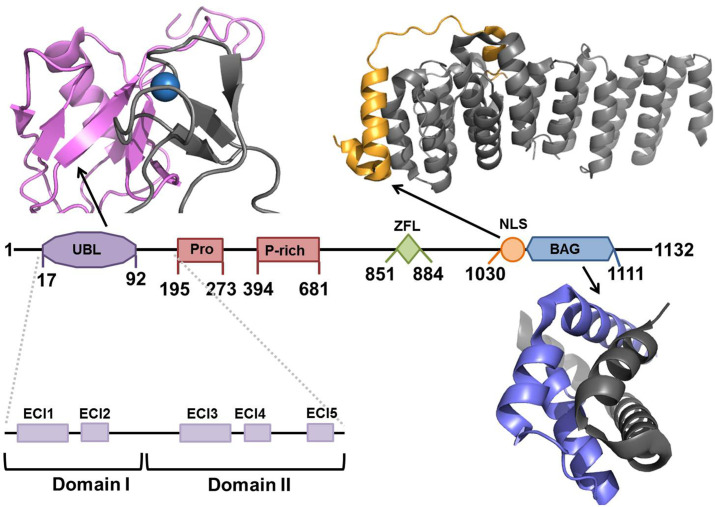
Schematic representation of BAG6 showing domain boundaries and solved structures. UBL domain (residues 17–92, purple) in complex with E3 ligase RNF126 (residues 1–40, gray) from PDB: 2N9P (Krysztofinska et al., 2016); NLS (residues 1008–1050, orange) and TRC35 (residues 23–305, gray) from PDB: 6AU8 (Mock, Xu, Ye, & Clemons, 2017); BAG domain (blue) in complex with UBL4A (residues 95–147, gray), from PDB: 4X86 (Kuwabara et al., 2015).

References

    1. Amm I., Sommer T., Wolf D.H. Protein quality control and elimination of protein waste: The role of the ubiquitin-proteasome system. Biochimica et Biophysica Acta. 2014;1843(1):182–196. doi: 10.1016/j.bbamcr.2013.06.031. - DOI - PubMed
    1. Ast T., Cohen G., Schuldiner M. A network of cytosolic factors targets SRP-independent proteins to the endoplasmic reticulum. Cell. 2013;152(5):1134–1145. doi: 10.1016/j.cell.2013.02.003. - DOI - PubMed
    1. Azziz R., Woods K.S., Reyna R., Key T.J., Knochenhauer E.S., Yildiz B.O. The prevalence and features of the polycystic ovary syndrome in an unselected population. The Journal of Clinical Endocrinology and Metabolism. 2004;89(6):2745–2749. doi: 10.1210/jc.2003-032046. - DOI - PubMed
    1. Banerji J., Sands J., Strominger J.L., Spies T. A gene pair from the human major histocompatibility complex encodes large proline-rich proteins with multiple repeated motifs and a single ubiquitin-like domain. Proceedings of the National Academy of Sciences of the United States of America. 1990;87(6):2374–2378. - PMC - PubMed
    1. Binici J., Hartmann J., Herrmann J., Schreiber C., Beyer S., Guler G. A soluble fragment of the tumor antigen BCL2-associated athanogene 6 (BAG-6) is essential and sufficient for inhibition of NKp30 receptor-dependent cytotoxicity of natural killer cells. The Journal of Biological Chemistry. 2013;288(48):34295–34303. doi: 10.1074/jbc.M113.483602. - DOI - PMC - PubMed