. 2018 Dec 28;6(4):350-361.
doi: 10.14218/JCTH.2018.00040. Epub 2018 Nov 16.

Aliphatic Halogenated Hydrocarbons: Report and Analysis of Liver Injury in 60 Patients

Affiliations

Aliphatic Halogenated Hydrocarbons: Report and Analysis of Liver Injury in 60 Patients

Rolf Teschke. J Clin Transl Hepatol. .

Abstract

Background and Aims: Intoxications by aliphatic halogenated hydrocarbons (AHH), used as effective solvents, are rare and may cause life-threatening liver injury. Patients with acute intoxications by AHH received an innovative treatment. Methods: Analyzed were data of 60 patients intoxicated by AHH, such as dichloromethane (n = 3), chloroform (n = 2), carbon tetrachloride (n = 12), 1,2-dichloroethane (n = 18), 1,1,2-trichloroethane (n = 2), trichloroethylene (n = 2), tetrachloroethylene (n = 13) or mixed AHH chemicals (n = 8), who received a new treatment consisting of CO2-induced hyperventilation to accelerate toxin removal via the lungs. Results: Added to the inspiration air at a flow rate of 2-3 Liter min-1, CO2 increased the respiratory volume up to 25-30 Liter min-1, ensuring forced AHH exhalation. This CO2-induced hyperventilation therapy was commonly well tolerated by the 60 patients and lasted for 106.0±10.5 hours. In most cases, initially increased liver test results of aminotransferases normalized quickly under the therapy, and liver histology obtained at completion of the therapy revealed, in the majority of patients, normal findings or fatty changes, and rarely severe single cell necrosis but no confluent liver cell necrosis. Despite therapy, clinical outcome was unfavorable for 4/60 patients (6.7%) of the study cohort, due to single or combined risk factors. These included late initiation of the CO2-induced hyperventilation therapy, intentional intoxication, uptake of high amounts of AHH, concomitant ingestion of overdosed drugs, consumption of high amounts of alcohol, and history of alcohol abuse. Conclusions: For intoxications by AHH, effective therapy approaches including forced hyperventilation to increase toxin removal via the lungs are available and require prompt initiation.

Keywords: 1,2-dichloroethane; Aliphatic halogenated hydrocarbons; Carbon tetrachloride; Chloroform; Dichloromethane.


Conflict of interest statement

The author has no conflict of interests related to this publication.

Figures
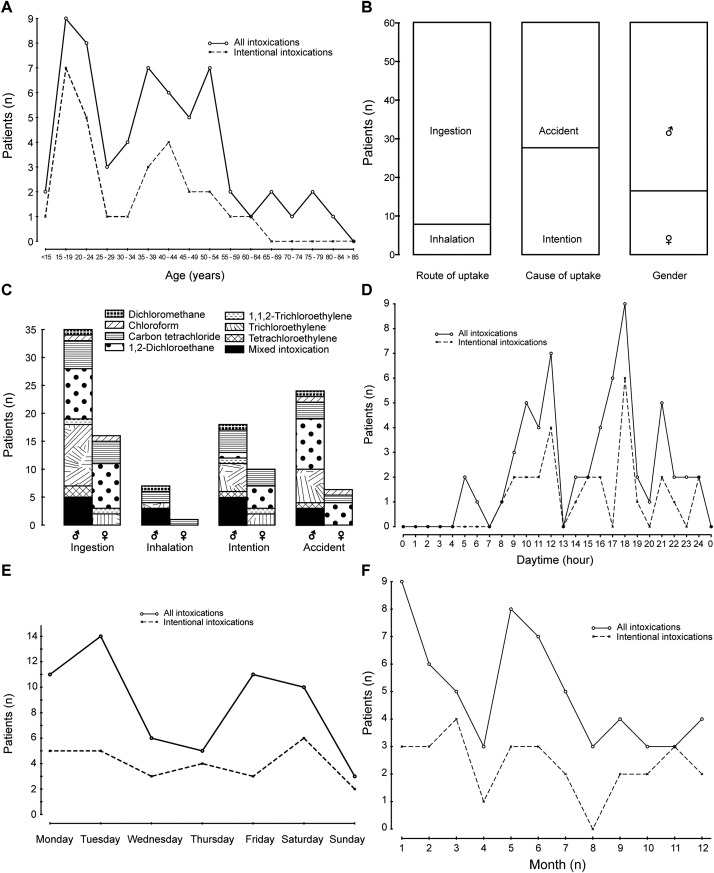
Fig. 1.
Fig. 1.. (A) Age distribution of the 60 patients with intoxication by AHH. (B) Route of AHH uptake, cause of intoxication, and sex distribution among the 60 patients of the study cohort. (C) Sex distribution in relation of the criteria ingestion, inhalation, and background of intoxication among the 60 patients included in the study cohort. (D) Day time of AHH intoxication among the 60 patients of the study cohort. (E) Weekday of intoxication among the study cohort comprising 60 patients with AHH intoxication. (F) Month of intoxication in the study cohort of 60 patients.
Abbreviation: AHH, aliphatic halogenated hydrocarbons.
Fig. 2.
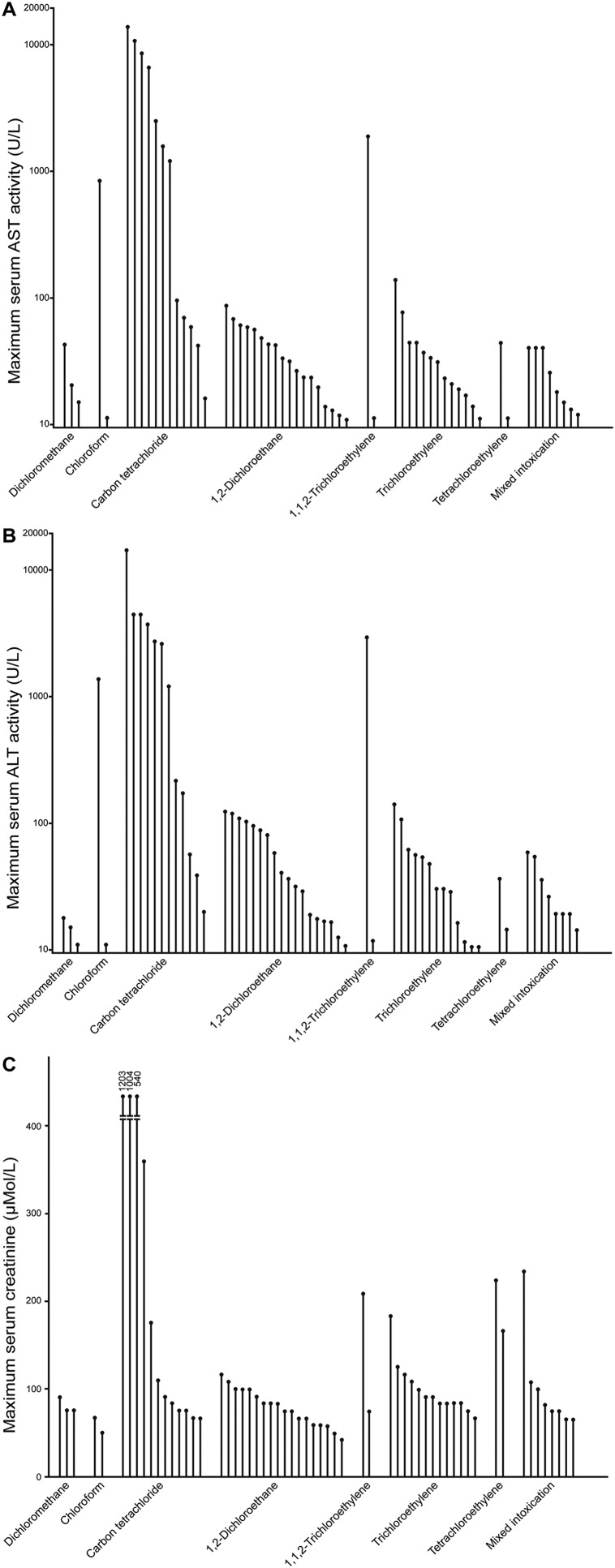
Fig. 2.. (A) Maximum serum activities of AST of the study cohort comprising 60 patients with AHH intoxication.
Normal range of AST was <35 U/L. (B) Maximum serum activities of ALT of the study cohort comprising 60 patients with AHH intoxication. Normal range of ALT was <45 U/L. (C) Maximum serum creatinine values of the study cohort comprising 60 patients with AHH intoxication. Normal range of creatinine was 45–90 μM/L. Abbreviations: AHH, aliphatic halogenated hydrocarbons; ALT, alanine transaminase; AST, aspartate transaminase.
Fig. 3.
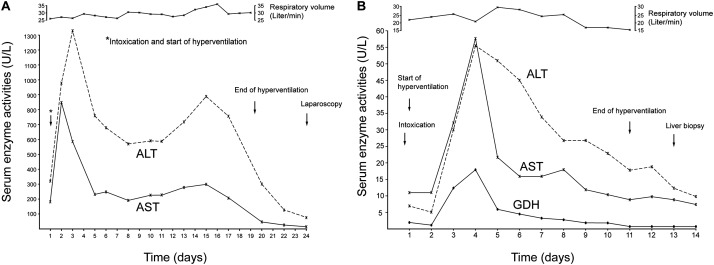
Fig. 3.. (A) Serum activities of AST and ALT after intoxication by ingested chloroform.
The patient (case 4 in Table 2) was a house painter and had stored chloroform in a beer bottle, from which he erroneously ingested 50 mL chloroform. Prior to intoxication, he had drank 1.5 L beer contained in other beer bottles. Narcosis requiring endotracheal intubation for gastrointestinal lavage and short-term artificial ventilation. The CO2-induced hyperventilation was started 6 hours after ingestion, whereby a respiratory volume between 24 and 34 Liter min-1 was achieved as shown at the top of the figure. Via a nasal tube, CO2 was provided at a flow rate of 3 to 6 Liter min−1. Blood showed pH that was between 7.36 and 7.46, PO2 between 83 and 110 mmHg, PCO2 between 35 and 55, and HCO3 between 21 and 31, and respiratory frequency between 15 and 30 min−1. The therapy using hyperventilation was well tolerated by the cooperative patient and had to be extended for 19 days because serum activities of AST and ALT declined slowly. Serum activities of liver enzymes showed two peaks. On day 2, AST was 850 U/L and ALT was 1330 U/L on day 3. Both enzymes declined and had a second peak on day 15, with AST of 300 U/L and ALT of 890 U/L. Total bilirubin was in a range between 0.8 and 2.1 mg/dL. Hemoglobin was between 11.8 and 15.5, erythrocytes between 3800 and 4800, leucocytes between 5.100 and 11500. Serum creatinine remained in the normal range, considering that forced diuresis was provided for prophylactic reasons. Liver biopsy obtained at laparoscopy on day 24 revealed a striking proliferation of stellate cells, no fatty changes of the hepatocytes, and no necrosis by light microscopy. (B) Serum activities of AST, ALT, and GDH after intoxication by ingested CCl4. The patient (case 6 in Table 2) intentionally swallowed 30 mL CCl4, vomited twice, and received a gastrointestinal lavage. CO2-induced hyperventilation was started 9 hours after intoxication and continued for 11 days. CO2 was applied via a nasal tube at a flow rate of 2–4 Liter min−1 and resulted in a respiratory volume of up to 30 Liter min−1, as shown on the top of the figure. CO2 was given at a flow rate between 3.5 and 5.0 Liter min−1 that resulted in a respiratory frequency ranging from 28 to 36 per minute. Blood showed pH of 7.31 to 7.33, PO2 of around 111, HCO3 of around 21.3, and PCO2 of around 43.9. On day 3 after intoxication, serum activities of liver enzymes increased and reached a maximum on day 4 (AST of 59 U/L, ALT of 56 U/L, GDH of 18 U/L) and normalized during the next days until day 14 after intoxication. Other laboratory test were in the normal range, except leucocytes (at 14400). Liver biopsy on day 13 showed no abnormalities. The patient was discharged on day 15. Abbreviations: ALT, alanine transaminase; AST, aspartate transaminase; CCl4, carbon tetrachloride; GDH, glutamate dehydrogenase.
Fig. 4.
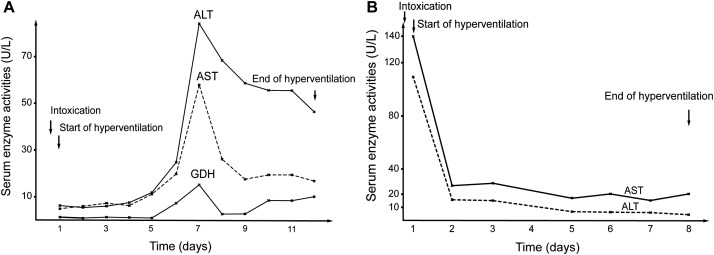
Fig. 4.. (A) Serum activities of ALT, AST, and GDH after intoxication by ingested 1,2-dichloroethane.
The patient (case 30 in Table 2) intentionally ingested 80 mL dichloroethane. After vomiting and gastrointestinal lavage 4 hours after ingestion, the usual CO2-induced hyperventilation was started using for CO2 application by the nasal tube approach to achieve a respiratory volume between 20 and 33 Liter min−1 and a respiratory frequency between 20 and 31 per minute. Treatment was for 12 days, prolonged due to slow decline of the liver values. At day 7 after intoxication, maximum serum activities were as follows: AST of 58 U/L; ALT of 85 U/L; and, GDH of 15 U/L. (B) Serum activities of ALT and AST in a patient with ingested trichloroethylene. Presented are data beginning at time of intoxication and during the subsequent clinical course. The patient (case 44 in Table 2) intentionally ingested 70 mL trichloroethylene together with Stroh rum. Known alcohol abuse. Vomiting, narcosis, endotracheal intubation prior to gastrointestinal lavage. Suspected shock in lungs, artificial ventilation combined with CO2-induced hyperventilation for 8 days, whereby CO2 was added to the inspiration air. Already at admission, the serum activities of AST (140 U/L) and of ALT (110 U/L) were slightly increased, followed by rapid normalization. At laparoscopy 1 month after intoxication, suspicion of fatty liver, confirmed by histology showing severe macrovesicular fatty liver without necrosis or infiltration considered compatible with alcoholic fatty liver but not with alcoholic steatohepatitis or alcoholic hepatitis. Shortly after admission, the patient experienced withdrawal symptoms requiring specific drug treatment. The initially increased AST and ALT activities were likely due to the preexisting alcohol abuse associated with alcoholic fatty liver, considering that AST values were higher than ALT values, providing a ratio of AST/ ALT of >1.0 that is highly suggestive for alcohol as cause. Such a ratio was not observed in any other patients intoxicated by AHH, who all had higher values of ALT than of AST. Abbreviations: ALT, alanine transaminase; AST, aspartate transaminase; GDH, glutamate dehydrogenase.

References

    1. Zimmerman HJ. Hepatotoxicity. Philadelphia: Lippincott Williams & Wilkins; 1999.
    1. Helmenstine AM. Aliphatic hydrocarbon definition. Available from: https://www.thoughtco.com/definition-of-aliphatic-hydrocarbon-604763 .
    1. Raucy JL, Kraner JC, Lasker JM. Bioactivation of halogenated hydrocarbons by cytochrome P4502E1. Crit Rev Toxicol. 1993;23:1–20. doi: 10.3109/10408449309104072. - DOI - PubMed
    1. Plaa GL. Chlorinated methanes and liver injury: highlights of the past 50 years. Annu Rev Pharmacol Toxicol. 2000;40:42–65. doi: 10.1146/annurev.pharmtox.40.1.43. - DOI - PubMed
    1. Recknagel RO, Glende EA, Jr, Dolak JA, Waller RL. Mechanisms of carbon tetrachloride toxicity. Pharmacol Ther. 1989;43:139–154. doi: 10.1016/0163-7258(89)90050-8. - DOI - PubMed