. 2019 Jan 12;7(1):3.
doi: 10.1186/s40345-018-0137-5.

Rumination related activity in brain networks mediating attentional switching in euthymic bipolar patients

Affiliations

Rumination related activity in brain networks mediating attentional switching in euthymic bipolar patients

Kallia Apazoglou et al. Int J Bipolar Disord. .

Abstract

Introduction: Mood disorder patients have a tendency to be more internally oriented, with difficulties in switching attentional focus, which might result in the generation of negative thoughts, such as rumination. The present study explored self-referential neural activity correlating with rumination tendency and attentional switching capacity in bipolar disorder.

Methods: Twenty euthymic bipolar patients and twenty matched healthy controls underwent a novel introspection task of switching between internally and externally focused attention during a word processing task, while their brain activity was assessed using functional MRI.

Results: During internal focus, higher activity in self-related regions (mPFC, PCC) was found in euthymic bipolar patients as compared to controls, verifying the hypothesis of exaggerated recruitment of self-referential processes in bipolar subjects. Switching from internal to external focus revealed higher parahippocampal activity in patients as compared to controls, additionally more pronounced when switching away from negative as compared to positive self-referential information. Furthermore, rumination traits correlated with activity in PCC, subgenual and pregenual ACC, and bilateral anterior insula during repetition of internal focus, specifically when evaluating negative words. Finally, we used ACC subregions that correlated with tendency to ruminate as seeds for a whole brain connectivity analysis. Patients showed stronger connectivity between sgACC (seed), pgACC, dPFC, and anterior insula during internal focus, whereas pgACC (seed) was more strongly connected to parahippocampal gyrus when switching from internal to external focus.

Conclusions: These findings reveal an overactive rumination-related network whose activity is enhanced by negative information in euthymic bipolar patients, which could possibly contribute to impaired switching of thoughts away from internal attention.

Keywords: Attentional switch; Bipolar disorder; RRS; Rumination; Self-reference; sgACC.


Figures
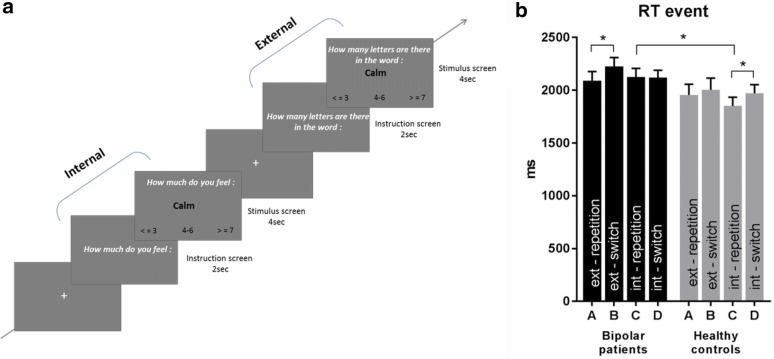
Fig. 1
Fig. 1
Introspection task and performance. a The fMRI task consists of two task conditions: internal and external attentional focus. Each trial begins with an instruction screen displayed during 2 s to indicate the task, followed by a word stimulus with a 3-option rating response displayed for 4 s. During internal trials, participants were asked to evaluate how much the word matched their current internal state. During external trials, they were asked to count how many letters the word included. Word meaning had either a negative or positive valence, and each item was presented in both task conditions. Across successive trials, the task conditions were either repeated or switched, thus yielding a 2 × 2 × 2 design overall l (condition*valence*sequence). b Average response times (RT) are shown for each event separately. Patients tend to have slower RTs overall with a marginal main effect of group (0.07), and switch trials were slower than repetition with a significant main effect of sequence (p < 0.01). See text for full statistical analyses of RTs
Fig. 2
Fig. 2
Euthymic Bipolar patients vs healthy controls. a The main effect of group (across all conditions) is shown in red at a FWE corrected threshold p = 0.05. Bipolar patients showed higher activity than controls in the vmPFC, PCC, and parietal cortex. The group*attention interaction (BD > HC*internal > external focus) is shown in yellow, revealing clusters associated with internal focus that are also hyperactive in patients. b Switching from an internal to an external condition (int.ext) as compared to repeating an external condition (ext.ext) revealed higher activity in the entorhinal cortex for patients as compared to controls (in red, BD > HC*int.ext > ext.ext). The group*valence interaction (BD > HC*int(neg).ext > int(pos).ext) for switching from internal to external focus is shown in yellow, indicating a modulation of switching due to the valence of the previous trial
Fig. 3
Fig. 3
Rumination-related activity in patients. Correlation of tendency to ruminate with brain activity during repeated trials in the internal focus condition (int.int), while patients evaluate their internal state in relation to a word with negative valence. Significant clusters (p = 0.001) were observed in ACC (sub and pre-genual), bilateral anterior Insula, vmPFC, as well as PCC
Fig. 4
Fig. 4
ACC connectivity in patients during internal focus and switch. Psycho-physiological interactions (PPI) in BD patients showing functional connectivity (i) between sgACC (seed region) and areas shown in blue (p = 0.05 FWE) during the internal as compared to the external focus condition; and (ii) between pgACC (seed region) and areas shown in red (p = 0.001 unc.) during attentional switching from an internal to an external focus relative to a repetition of external focus
Fig. 5
Fig. 5
pgACC mediates the link of rumination and entorhinal cortex. Mediation analysis of entorhinal cortex activity (independent variable, X) on rumination trait (dependent variable, Y) via the activity of pgACC (mediator, M). Unstandarized coefficients, standard errors and statistical p values are shown on the arrows indicating paths a (direct effect), b (direct effect), c (total effect) and c’ (indirect effect). Mediation effect (ME = a*b/c) indicates the percentage of the mediator (pgACC) effect to the total effect of entorhinal cortex-induced rumination

References

    1. Almeida JR, Mechelli A, Hassel S, Versace A, Kupfer DJ, Phillips ML. Abnormally increased effective connectivity between parahippocampal gyrus and ventromedial prefrontal regions during emotion labeling in bipolar disorder. Psychiatry Res. 2009;174(3):195–201. - PMC - PubMed
    1. Almeida JR, Mourao-Miranda J, Aizenstein HJ, Versace A, Kozel FA, Lu H, et al. Pattern recognition analysis of anterior cingulate cortex blood flow to classify depression polarity. Br J Psychiatry. 2013;203(3):310–311. - PMC - PubMed
    1. Araujo HF, Kaplan J, Damasio H, Damasio A. Neural correlates of different self domains. Brain Behav. 2015;5(12):e00409. - PMC - PubMed
    1. Bergeron J, Landry M, Bélanger D. The development and validation of a French form of the State-Trait Anxiety Inventory. Cross-Cultural Anxiety. 1976;1:41–50.
    1. Berman MG, Misic B, Buschkuehl M, Kross E, Deldin PJ, Peltier S, et al. Does resting-state connectivity reflect depressive rumination? A tale of two analyses. NeuroImage. 2014;103:267–279. - PubMed

LinkOut - more resources
