Review
. 2019 Sep 1:95:32-49.
doi: 10.1016/j.actbio.2019.01.009. Epub 2019 Jan 11.

Bioprinting functional tissues

Affiliations
Review

Bioprinting functional tissues

Ashley N Leberfinger et al. Acta Biomater. .

Abstract

Despite the numerous lives that have been saved since the first successful procedure in 1954, organ transplant has several shortcomings which prevent it from becoming a more comprehensive solution for medical care than it is today. There is a considerable shortage of organ donors, leading to patient death in many cases. In addition, patients require lifelong immunosuppression to prevent graft rejection postoperatively. With such issues in mind, recent research has focused on possible solutions for the lack of access to donor organs and rejections, with the possibility of using the patient's own cells and tissues for treatment showing enormous potential. Three-dimensional (3D) bioprinting is a rapidly emerging technology, which holds great promise for fabrication of functional tissues and organs. Bioprinting offers the means of utilizing a patient's cells to design and fabricate constructs for replacement of diseased tissues and organs. It enables the precise positioning of cells and biologics in an automated and high throughput manner. Several studies have shown the promise of 3D bioprinting. However, many problems must be overcome before the generation of functional tissues with biologically-relevant scale is possible. Specific focus on the functionality of bioprinted tissues is required prior to clinical translation. In this perspective, this paper discusses the challenges of functionalization of bioprinted tissue under eight dimensions: biomimicry, cell density, vascularization, innervation, heterogeneity, engraftment, mechanics, and tissue-specific function, and strives to inform the reader with directions in bioprinting complex and volumetric tissues. STATEMENT OF SIGNIFICANCE: With thousands of patients dying each year waiting for an organ transplant, bioprinted tissues and organs show the potential to eliminate this ever-increasing organ shortage crisis. However, this potential can only be realized by better understanding the functionality of the organ and developing the ability to translate this to the bioprinting methodologies. Considering the rate at which the field is currently expanding, it is reasonable to expect bioprinting to become an integral component of regenerative medicine. For this purpose, this paper discusses several factors that are critical for printing functional tissues including cell density, vascularization, innervation, heterogeneity, engraftment, mechanics, and tissue-specific function, and inform the reader with future directions in bioprinting complex and volumetric tissues.

Keywords: Cell density; Engraftment; Functional tissue bioprinting; Heterogeneity; Innervation; Mechanics; Transplant; Vascularization.


Figures

Figure 1.
Figure 1.
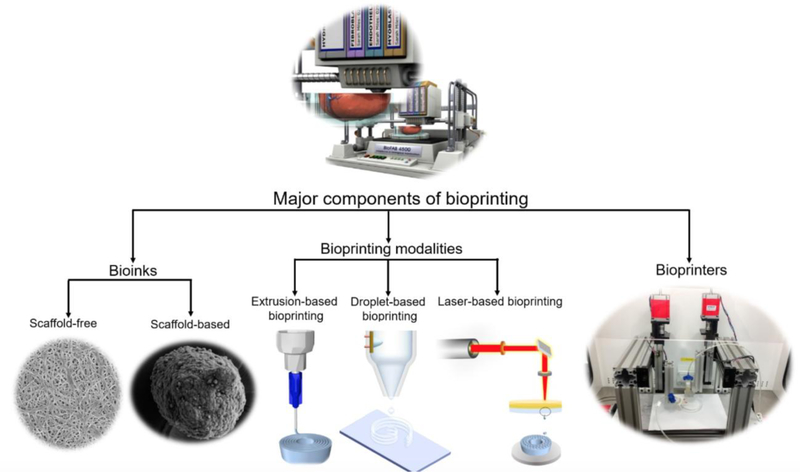
A schematic representation of the major components of bioprinting (Bioprinter concept image: courtesy of Christopher Barnatt.
Figure 2.
Figure 2.
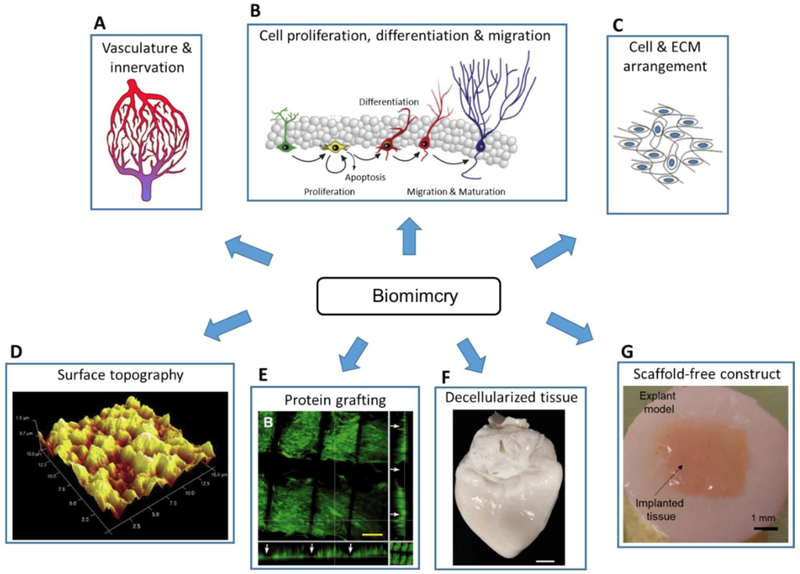
(A-C) Considerations for the biomimicry of bioprinted constructs including but not limited to (A) vasculature, innervation; adapted, with permission, from [189], (B) cell proliferation, differentiation, migration; adapted from [190] and (C) ECM arrangement; adapted, with permission, from [191]. (D-G) Strategies to induce biomimicry of tissue constructs, such as (D) modification of surface finish to promote cell attachment; adapted, with permission, from [192], (E) graphing of bioactive protein on polymer to enhance cell proliferation; adapted from [193], (F) utilization of decellularized tissue to induce cell differentiation; adapted, with permission, from [194], and (G) fabrication of scaffold-free constructs to imitate cell density of native tissue; adapted from [48].
Figure 3.
Figure 3.
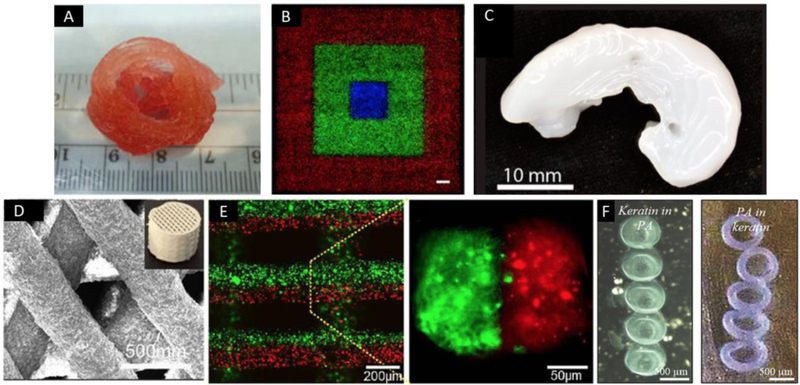
Examples of heterogeneous constructs generated by bioprinting. (A) 3D printed aortic valve conduit with smooth muscle cells and aortic valve leaflet interstitial cells encapsulated; adapted, with permission, from [19]. (B) Cell patterning with different fluorescence using direct inkjet printing (scale bar=1 mm); adapted from [87]. (C) 3D printed sheep meniscus with bioink of nanofibrillated cellulose and alginate (scale bar=2 mm); adapted, with permission, from [91]. (D) 3D printed scaffolds of calcium sulfate and mesoporous bioactive glass; adapted from [96]. (E) 3D construct with two separated bioinks which simultaneously extruded by a microfluidic system; adapted, with permission, from [97]. (F) Self-assembly of peptide-protein (peptide amphiphiles and keratin) bioinks after bioprinting; adapted, with permission, from [89].
Figure 4.
Figure 4.
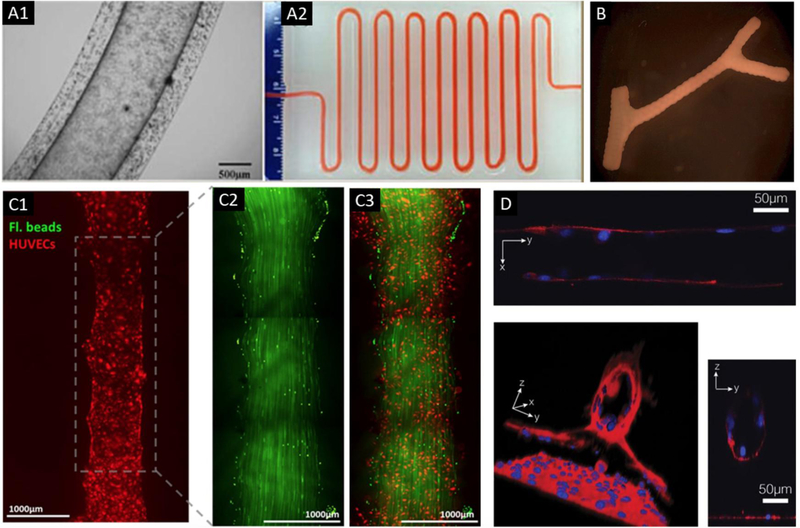
Bioprinting of vascular constructs. (A) A vascular conduit bioprinted by a coaxial nozzle (A1) with cell media perfused through a meter-long printed conduit (A2); adapted, with permission, from [106]. (B) A scaffold-free tubular construct which was built by printing and fusing multicellular spheroids with a branched construct; adapted, with permission, from [195]. (C) Fluorescent images of a bioprinted vascular channel system, in which HUVECs (red) seeded into a printed channel (C1). Laminar flow in the channel was represented by green fluorescent beads (C2), and a combined image of green fluorescent beads and seeded HUVECs (C3); adapted, with permission, from [196]. (D) Direct cell patterning in collagen hydrogels using a near-infrared femtosecond laser, where confocal microscopy images showed tube formation at day 14; adapted from [110].
Figure 5.
Figure 5.
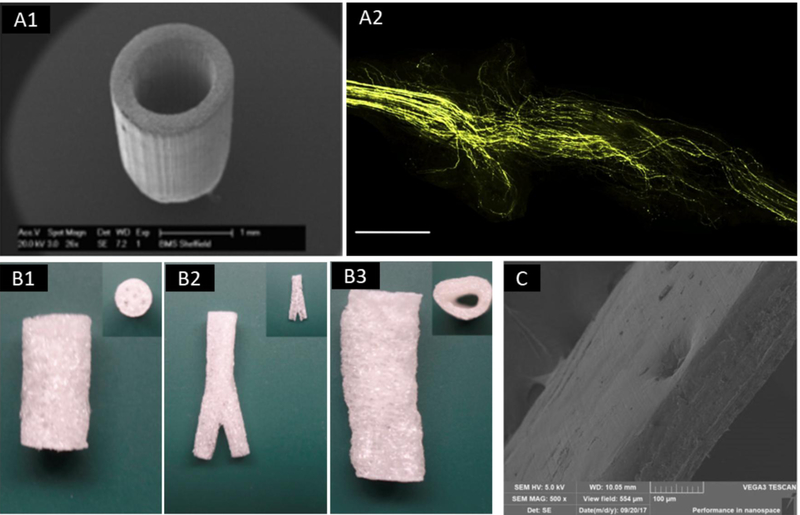
Bioprinting of constructs for innervation. (A) SEM image of a poly(ethylene glycol) (PEG) nerve guidance conduits (A1) and the implanted nerve guide showing the organization of regenerated axon paths (A2, scale bar = 1.0 mm); adapted, with permission, from [122]. (B) 3D-engineered cellularized conduits for peripheral nerve regeneration with complex geometries, including multichannel (B1), bifurcation (B2) and reconstruction of patient’s sciatic nerve (B3); adapted from [123]. (C) SEM image of a nanoporous and multi-layered 3D structure in graphene-based nanomaterials for peripheral nerve restoration; adapted from [131].
Figure 6.
Figure 6.
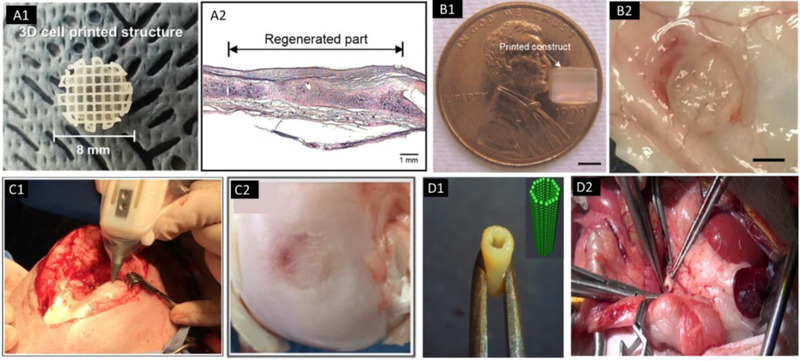
Implantation of bioprinted constructs. (A) Image of a 3D cell printed structure using polycaprolactone (PCL) and chondrocytes-laden alginate (A1) and the regenerated tissue in a rabbit ear (A2); adapted, with permission, from [138]. (B) A printed PEG hydrogel construct using DBB, with 4 mm in diameter and 4 mm in height (B1, scale bar=2 mm); adapted, with permission, from [197], and gross morphology of implanted scaffold in mice subcutaneous pockets for 21 days (B2); adapted, with permission, from [198]. (C) Intraoperative bioprinting using a “biopen” for treatment of a full-thickness chondral defect in a sheep (C1), and the macroscopic appearance of the treated defect at 8 weeks after implantation (C2); adapted, with permission, from [199]. (D) A scaffold-free vascular graft was generated from multicellular spheroids using a “Bio-3D printer” with the insert showing the computer-designed model (D1), and the graft was used in an end-to-end anastomosis in the abdominal aorta of the nude rat (D2); adapted from [140].
Figure 7.
Figure 7.
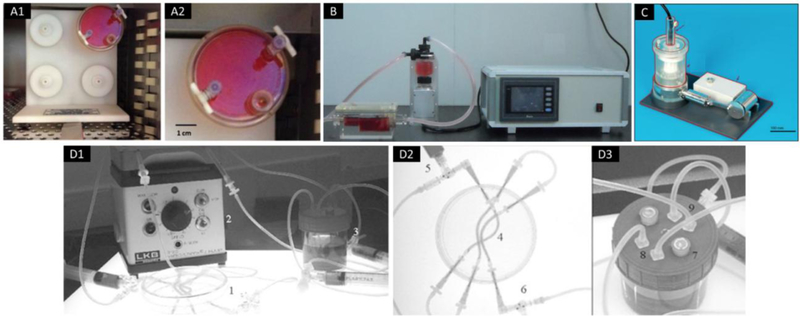
Examples of bioreactors. (A) A rotating cell culture system with four station rotator base; adapted from [200]. (B) A conventional non-computer-controlled culture system for culture of tissue-engineered vascular vessels; adapted from [185]. (C) A pulsatile conditioning bioreactor which consisted of a core unit with support, an actuation unit, and a monitoring unit; adapted, with permission, from [186]. (D) A bioreactor system for culturing nerve conduits, which consisted of (1) petri dish, (2) peristaltic pump, (3) medium reservoir, (4) silicone tubes containing aligned microfiber scaffold, (5) closable inlets, (6) closable outlets, (7) vent windows with an air permeable film, (8) medium inlets, and (9) medium outlets; adapted from [201].

References

    1. Hull CW, Apparatus for production of three-dimensional objects by stereolithography, US Pat. 4,575,330 (1986) 1–16. doi: 10.1145/634067.634234. - DOI
    1. Martins JP, Ferreira MPA, Ezazi NZ, Hirvonen JT, Santos HA, Thrivikraman G, França CM, Athirasala A, Tahayeri A, Bertassoni LE, 3D printing: prospects and challenges, in: Nanotechnologies Prev. Regen. Med, 2018: pp. 299–379. doi: 10.1016/B978-0-323-48063-5.00004-6. - DOI
    1. Klebe RJ, Cytoscribing: A method for micropositioning cells and the construction of two- and three-dimensional synthetic tissues, Exp. Cell Res 179 (1988) 362–373. doi: 10.1016/0014-4827(88)90275-3. - DOI - PubMed
    1. Ozbolat IT, Moncal KK, Gudapati H, Evaluation of bioprinter technologies, Addit. Manuf 13 (2017) 179–200. doi: 10.1016/j.addma.2016.10.003. - DOI
    1. Xu T, Jin J, Gregory C, Hickman JJ, Boland T, Inkjet printing of viable mammalian cells, Biomaterials 26 (2005) 93–99. doi: 10.1016/j.biomaterials.2004.04.011. - DOI - PubMed

Publication types

LinkOut - more resources