Review
. 2019 Feb 1;8(2):R10-R26.
doi: 10.1530/EC-18-0425.

Therapeutic advances in hormone-dependent cancers: focus on prostate, breast and ovarian cancers

Affiliations
Review

Therapeutic advances in hormone-dependent cancers: focus on prostate, breast and ovarian cancers

Michael Ulm et al. Endocr Connect. .

Abstract

Hormonal cancers affect over 400,000 men and women and contribute collectively to over 100,000 deaths in the United States alone. Thanks to advances in the understanding of these cancers at the molecular level and to the discovery of several disease-modifying therapeutics, the last decade has seen a plateauing or even a decreasing trend in the number of deaths from these cancers. These advanced therapeutics not only effectively slow the growth of hormonal cancers, but also provide an insight on how these cancers become refractory and evolve as an altogether distinct subset. This review summarizes the current therapeutic trends in hormonal cancers, with focus on prostate, breast and ovarian cancers. The review discusses the clinical drugs being used now, promising molecules that are going through various stages of development and makes some predictions on how the therapeutic landscape will shift in the next decade.

Keywords: breast cancer; drug development; ovarian cancer; prostate cancer; therapeutics.


Figures
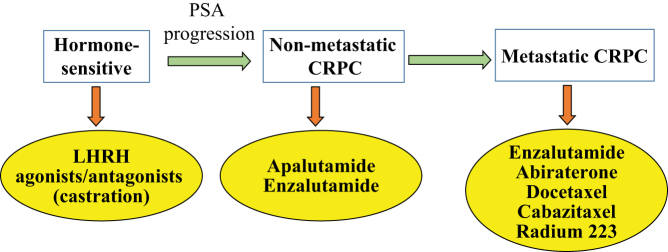
Figure 1
Figure 1
Sequence of treatment at various stages of prostate cancer.
Figure 2
Figure 2
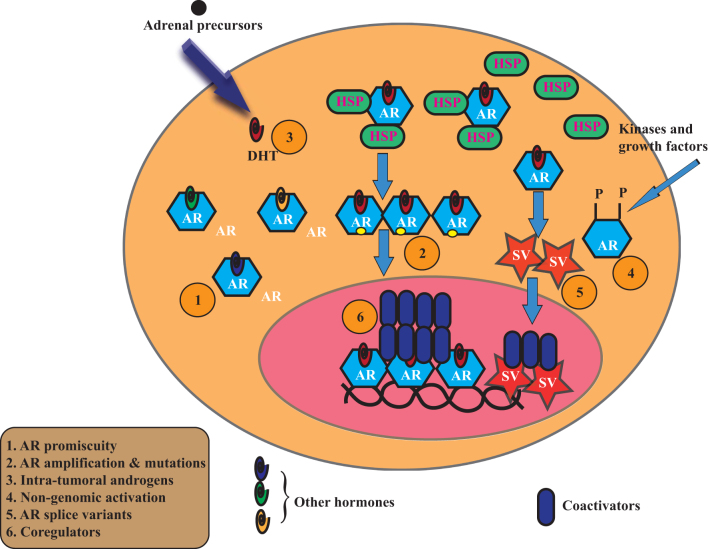
Mechanisms for castration-resistant prostate cancer (CRPC) emergence. 1. Androgen receptor (AR) promiscuity. Mutations in the AR ligand-binding domain (LBD) will result in the AR being activated by other hormones such as progesterone, corticosteroids, estradiol and others. 2. AR amplification and mutations. The AR copy numbers increase leading to an increase in the expression of AR that will become hyperactive and will respond to low levels of androgens. In addition, mutations in the AR LBD will cause the AR to be refractory to existing treatments. 3. Intra-tumoral androgen synthesis. Androgens such as androstenedione, and DHEA synthesized by the adrenals will be converted locally in the prostate to DHT that will lead to an increase in prostate cancer cell growth. 4. Non-genomic activation. AR can be activated by growth factors and kinases ligand independently, which will cause an increase in the cancer growth. 5. AR splice variants (AR-SVs). CRPCs that have relapsed from existing treatments express AR-SVs. As AR-SVs lack LBD, they are constitutively active and fail to respond to LBD-targeted treatments. 6. Coregulators. AR activity depends on the expression of coactivators. Several studies have indicated that advanced CRPCs have increased expression of coactivators causing the AR to be activated in the presence of castration-level androgens.
Figure 3
Figure 3
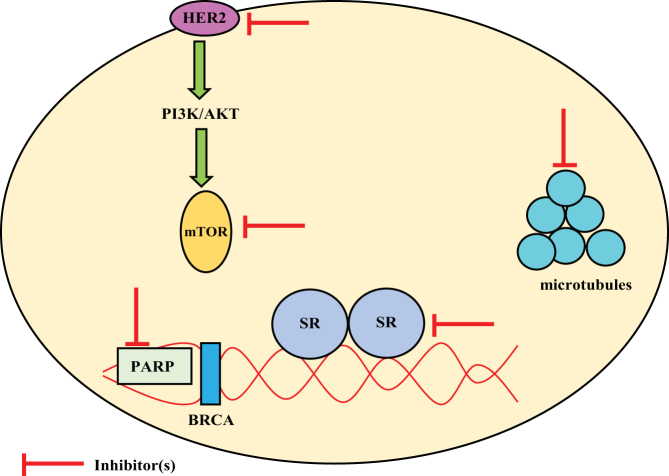
Various therapeutic targets and growth-promoting proteins common to prostate, breast and ovarian cancers.

References

    1. Siegel RL, Miller KD, Jemal A. Cancer statistics, 2018. CA: A Cancer Journal for Clinicians 2018. 68 7–30. (10.3322/caac.21442) - DOI - PubMed
    1. Pollock PA, Ludgate A, Wassersug RJ. In 2124, half of all men can count on developing prostate cancer. Current Oncology 2015. 22 10–12. (10.3747/co.22.2102) - DOI - PMC - PubMed
    1. Katsogiannou M, Ziouziou H, Karaki S, Andrieu C, Henry de Villeneuve M, Rocchi P. The hallmarks of castration-resistant prostate cancers. Cancer Treatment Reviews 2015. 41 588–597. (10.1016/j.ctrv.2015.05.003) - DOI - PubMed
    1. Stark JR, Perner S, Stampfer MJ, Sinnott JA, Finn S, Eisenstein AS, Ma J, Fiorentino M, Kurth T, Loda M, et al Gleason score and lethal prostate cancer: does 3 + 4 = 4 + 3? Journal of Clinical Oncology 2009. 27 3459–3464. (10.1200/JCO.2008.20.4669) - DOI - PMC - PubMed
    1. Brawley OW. Trends in prostate cancer in the United States. Journal of the National Cancer Institute Monographs 2012. 2012 152–156. (10.1093/jncimonographs/lgs035) - DOI - PMC - PubMed