Review
. 2019 Apr 5;294(14):5294-5308.
doi: 10.1074/jbc.REV118.002982. Epub 2019 Jan 14.

Pathways to disease from natural variations in human cytoplasmic tRNAs

Affiliations
Review

Pathways to disease from natural variations in human cytoplasmic tRNAs

Jeremy T Lant et al. J Biol Chem. .

Abstract

Perfectly accurate translation of mRNA into protein is not a prerequisite for life. Resulting from errors in protein synthesis, mistranslation occurs in all cells, including human cells. The human genome encodes >600 tRNA genes, providing both the raw material for genetic variation and a buffer to ensure that resulting translation errors occur at tolerable levels. On the basis of data from the 1000 Genomes Project, we highlight the unanticipated prevalence of mistranslating tRNA variants in the human population and review studies on synthetic and natural tRNA mutations that cause mistranslation or de-regulate protein synthesis. Although mitochondrial tRNA variants are well known to drive human diseases, including developmental disorders, few studies have revealed a role for human cytoplasmic tRNA mutants in disease. In the context of the unexpectedly large number of tRNA variants in the human population, the emerging literature suggests that human diseases may be affected by natural tRNA variants that cause mistranslation or de-regulate tRNA expression and nucleotide modification. This review highlights examples relevant to genetic disorders, cancer, and neurodegeneration in which cytoplasmic tRNA variants directly cause or exacerbate disease and disease-linked phenotypes in cells, animal models, and humans. In the near future, tRNAs may be recognized as useful genetic markers to predict the onset or severity of human disease.

Keywords: cancer; cytoplasmic tRNA; human genetics; human genome; mistranslation; neurodegeneration; nucleotide modification; protein synthesis; transfer RNA (tRNA).


Conflict of interest statement

The authors declare that they have no conflicts of interest with the contents of this article

Figures
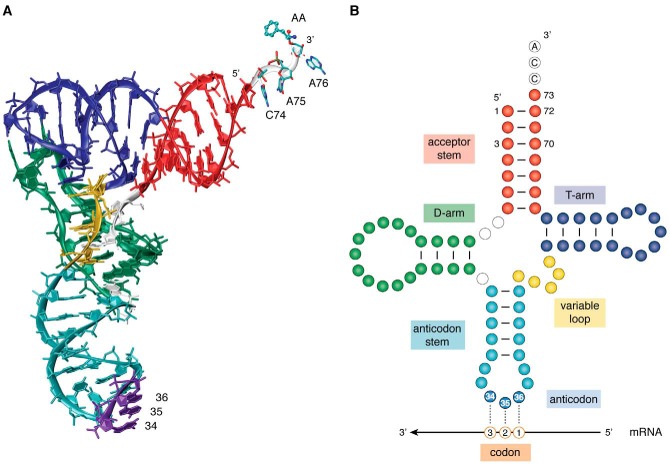
Figure 1.
Figure 1.
tRNA structure. A, tRNAs fold into an L-shaped three-dimensional structure with extensive intramolecular base-pairing. This tRNAPhe structure (Protein Data Bank code 1OB5) (134) is aminoacylated with phenylalanine (AA). B, in a two-dimensional representation, tRNA resembles a cloverleaf. In both diagrams, the tRNA is colored by structural elements: acceptor stem (red), dihydrouridine (D)-arm (green), anticodon stem (cyan), anticodon (bases 34–36 in purple), variable loop (yellow), TΨC (T) arm (navy), and the conserved CCA-3′ end (white). A schematic mRNA is shown below the tRNA diagram to indicate the tRNA nucleotides that base pair with each codon position.
Figure 2.
Figure 2.
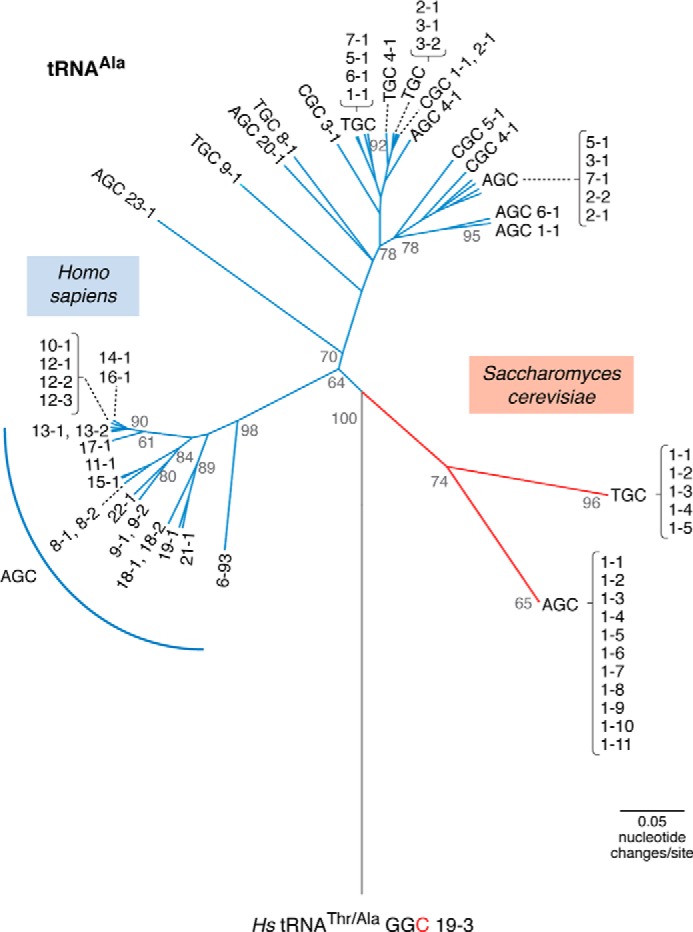
Phylogenetic relationships of human and yeast tRNAAla. The tree is based on an alignment of all known human and yeast tRNAAla iso-acceptors. The vastly expanded number and greater diversity of human tRNAAla genes compared with their yeast counterparts are evident. The tRNAs are labeled according to gene names in the genomic tRNA database (43), which include anticodon sequence followed by a numbering system where the first number indicates similar sequences, and the second number indicates a gene copy identifier. The human reference genome contains a misannotated tRNAAla, which was used to root the tree. This gene, tRNAAla-GGC-19-3, is a tRNAThr with a mutation (T36C) endowing the tRNA with an alanine anticodon. This is the only example of the alanine GGC anticodon in humans. Scale bar indicates the number of nucleotide changes per site in the tRNA sequences. The tree was calculated similarly as before (135). Briefly, a starting tree computed in MultiSeq 2.0 (136) was optimized to identify the maximum likelihood tree using PhyML 3.1 (137). Statistical branch support (out of 100) was calculated based on an approximate likelihood ratio test method (138) as implemented in PhyML.
Figure 3.
Figure 3.
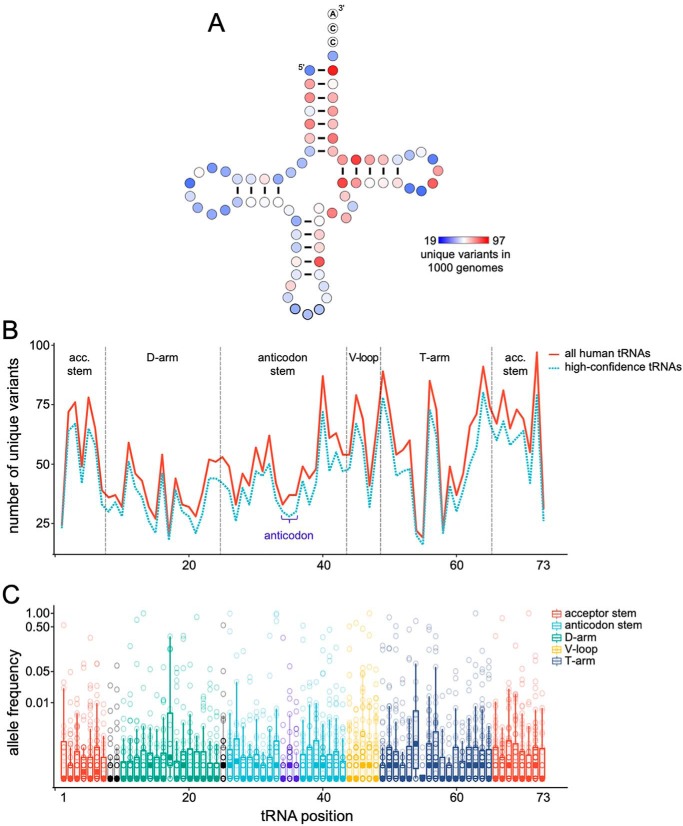
tRNA variants observed in the 1000 Genomes Project. A, variants that occur within tRNA genes (defined by GtRNAdb (128)) were downloaded from the 1000 Genomes Project phase 3 dataset (142). Insertions and deletions were removed, as were variants with no allele frequency available. Each variant was mapped to its corresponding tRNA position, according to standardized numbering (139), using an in-house Perl script. High-confidence tRNAs were defined as tRNAs with a tRNAscan-SE score of >50 (128). For the high confidence tRNA set, unique mutations are mapped to each position in the tRNA. B, same data in A are plotted for the high-confidence set (cyan dashed line) and for all human tRNA sequences (red line). C, allele frequencies (log2 scale) of all variants that occur at each tRNA position are represented in box and whisker plots. Boxes outline quartiles of the allele frequency distribution; filled circles depict the median allele frequency; whiskers show 1.5× quartile range; and open circles depict raw data, i.e. the allele frequencies for each unique tRNA variant at the indicated position.
Figure 4.
Figure 4.
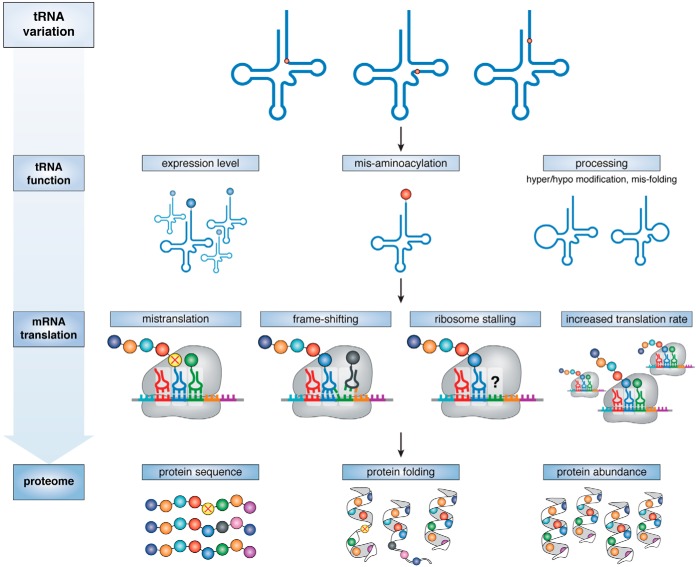
Phenotypic consequences of tRNA variation. tRNA variation can impact expression, aminoacylation, or processing and maturation of tRNAs, including nucleotide modification and tRNA folding. Alterations in the functional tRNA pool can impact mRNA translation by causing mistranslation, frame-shifting, ribosome stalling, or increased expression of codon-biased transcripts. These alterations can in turn alter the amino acid sequence, folding, and abundance of proteins across the entire proteome.

References

    1. Crick F. H. C. (1955) On degenerate templates and the adaptor hypothesis. A Note for the RNA Tie Club, 1–17
    1. Hoagland M. B., Stephenson M. L., Scott J. F., Hecht L. I., and Zamecnik P. C. (1958) A soluble ribonucleic acid intermediate in protein synthesis. J. Biol. Chem. 231, 241–257 - PubMed
    1. Holley R. W., Everett G. A., Madison J. T., and Zamir A. (1965) Nucleotide sequences in the yeast alanine transfer ribonucleic acid. J. Biol. Chem. 240, 2122–2128 - PubMed
    1. Gardner R. S., Wahba A. J., Basilio C., Miller R. S., Lengyel P., and Speyer J. F. (1962) Synthetic polynucleotides and the amino acid code. VII. Proc. Natl. Acad. Sci. U.S.A. 48, 2087–2094 10.1073/pnas.48.12.2087 - DOI - PMC - PubMed
    1. Nishimura S., Jones D. S., and Khorana H. G. (1965) Studies on polynucleotides. 48. The in vitro synthesis of a co-polypeptide containing two amino acids in alternating sequence dependent upon a DNA-like polymer containing two nucleotides in alternating sequence. J. Mol. Biol. 13, 302–324 10.1016/S0022-2836(65)80098-5 - DOI - PubMed

Publication types

Associated data