. 2018 Oct;60(4):347-373.
doi: 10.1111/jpr.12206. Epub 2018 Jul 19.

A Review on the Use of Wearable Functional Near-Infrared Spectroscopy in Naturalistic Environments

Affiliations

A Review on the Use of Wearable Functional Near-Infrared Spectroscopy in Naturalistic Environments

Paola Pinti et al. Jpn Psychol Res. 2018 Oct.

Abstract

The development of novel miniaturized wireless and wearable functional Near-Infrared Spectroscopy (fNIRS) devices have paved the way to new functional brain imaging that can revolutionize the cognitive research fields. Over the past few decades, several studies have been conducted with conventional fNIRS systems that have demonstrated the suitability of this technology for a wide variety of populations and applications, to investigate both the healthy brain and the diseased brain. However, what makes wearable fNIRS even more appealing is its capability to allow measurements in everyday life scenarios that are not possible with other gold-standard neuroimaging modalities, such as functional Magnetic Resonance Imaging. This can have a huge impact on the way we explore the neural bases and mechanisms underpinning human brain functioning. The aim of this review is to provide an overview of studies conducted with wearable fNIRS in naturalistic settings in the field of cognitive neuroscience. In addition, we present the challenges associated with the use of wearable fNIRS in unrestrained contexts, discussing solutions that will allow accurate inference of functional brain activity. Finally, we provide an overview of the future perspectives in cognitive neuroscience that we believe would benefit the most by using wearable fNIRS.

Keywords: cognitive neuroscience; ecological; fNIRS; wearable.


Figures
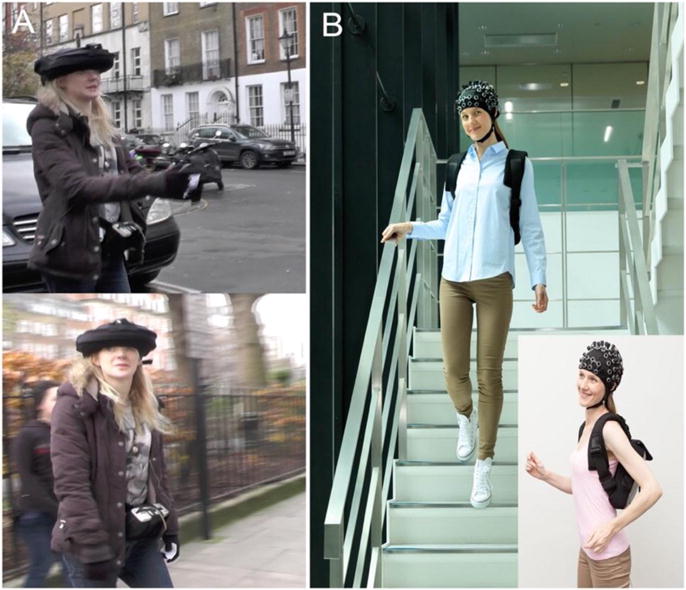
Figure 1
Figure 1
Examples of wireless and wearable fNIRS devices in unrestrained situations. Panel A shows a fibreless system (WOT-100, Hitachi, Japan) monitoring the prefrontal cortex outside the lab. A black cap is used to prevent detectors saturation. In panel B, a wearable device equipped with fibres (LIGHTNIRS, Shimadzu, Japan) measuring over the motor cortices is presented, where wires are connected to the control unit carried through a backpack (Photo courtesy of Shimadzu, Japan).
Figure 2
Figure 2
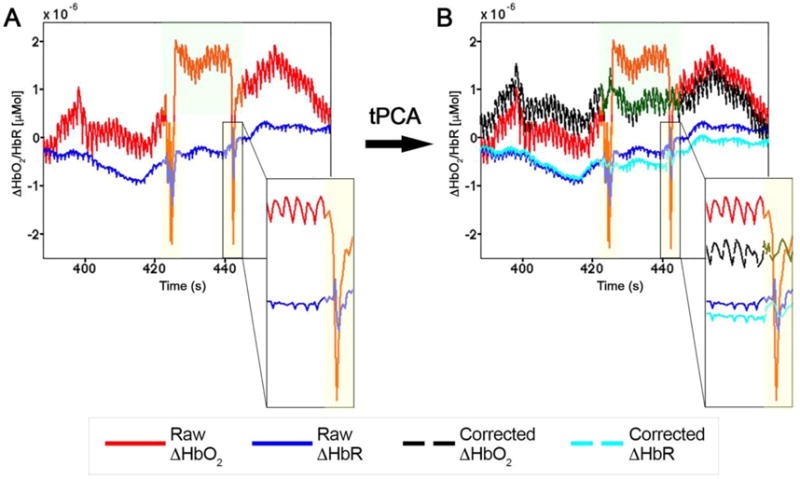
Example of motion artifacts in raw fNIRS signals (A) as shifts from baseline values (green shaded areas) and fast spikes (yellow shaded areas), where HbO2 and HbR are correlated. Panel B shows the effect of the application of the tPCA approach for the correction of motion errors. HbO2 and HbR become anti-correlated after being properly corrected. Data refer to the study by Pinti et al., 2015.
Figure 3
Figure 3
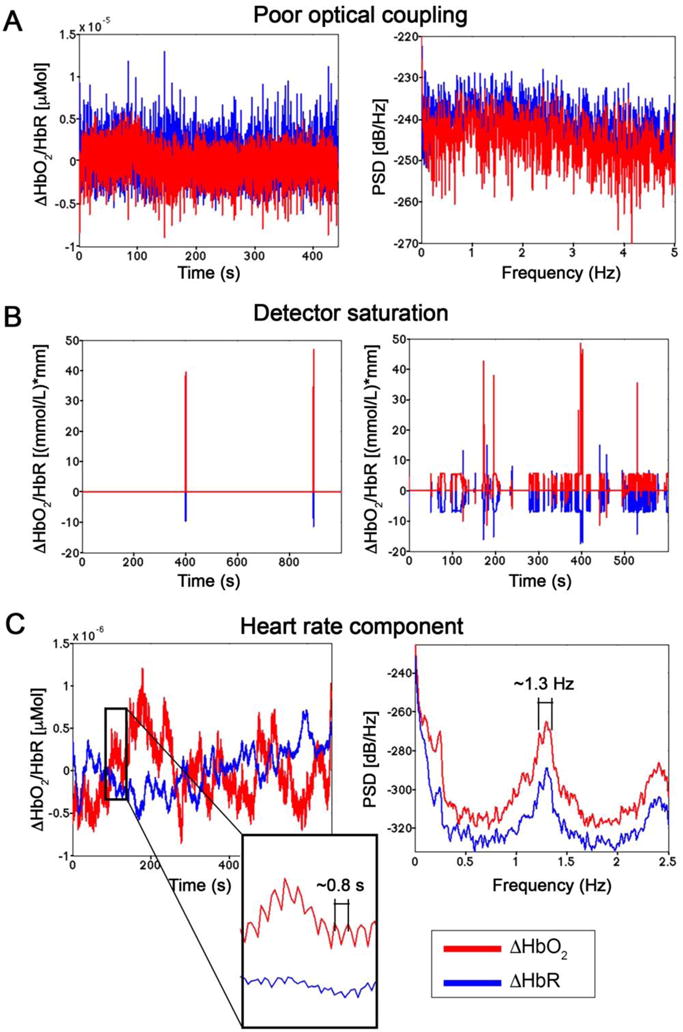
Example ΔHbO2 and ΔHbR in absence of a good coupling between the optodes and the head (A). This is reflected by the presence of only white noise, with a constant PSD. Data were in-house collected on the visual cortex using the Hitachi ETG-4000 during the presentation of a flashing checkerboard. In panel B, examples of channels corrupted by sunlight are shown, with consequent detector saturation. Data refer to the study by Pinti et al., 2015. The quality of fNIRS data can be assessed evaluating the presence of heart beat oscillations (C), visible both in the time- and in the frequency-domain. Data correspond to resting-state signals in-house recorded over the PFC using the Hitachi WOT-system.
Figure 4
Figure 4
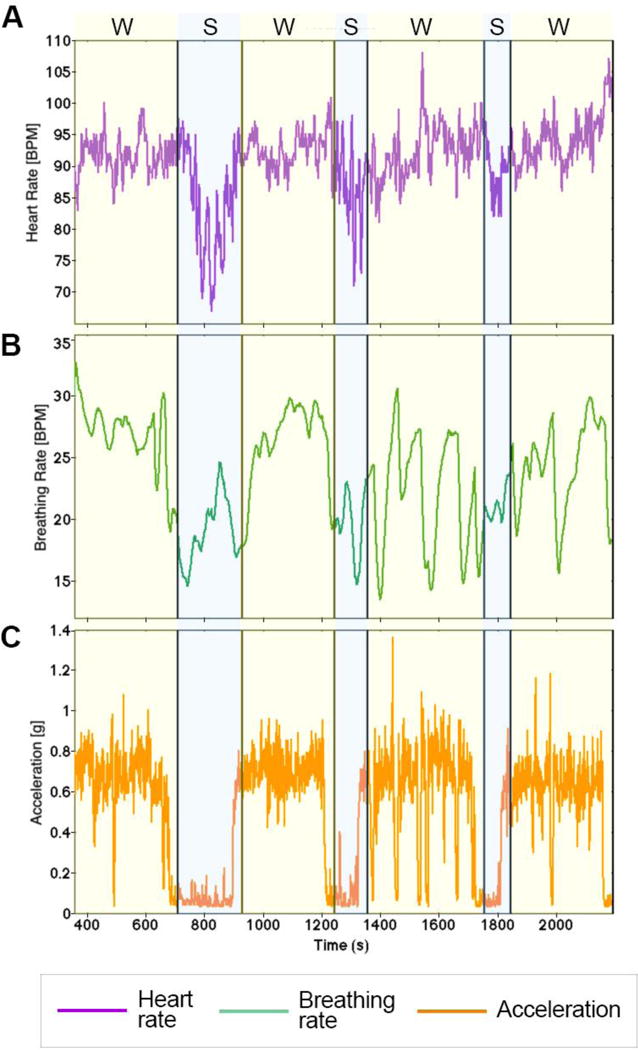
Heart rate (A), breathing rate (B), and acceleration (C) data referring to one participant undertaking the experiment described in Pinti et al. (2015). Yellow shaded areas indicate the conditions involving walking (W), while blue shaded areas represent the phases in which the participant was standing (S).
Figure 5
Figure 5
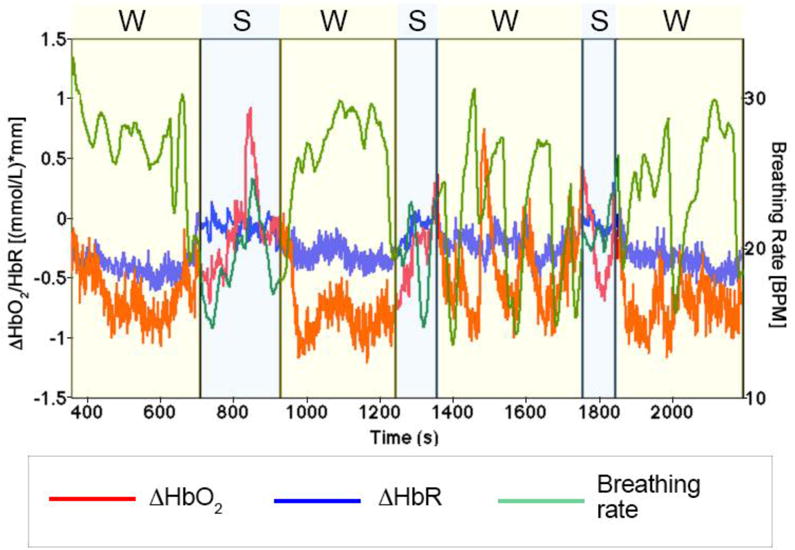
Breathing rate and unpre-processed concentration changes in oxy- and deoxy- haemoglobin referring to one participant undertaking the experiment described in Pinti et al. (2015). Yellow shaded areas indicate the conditions involving walking (W), while blue shaded areas represent the phases in which the participant was standing (S).
Figure 6
Figure 6
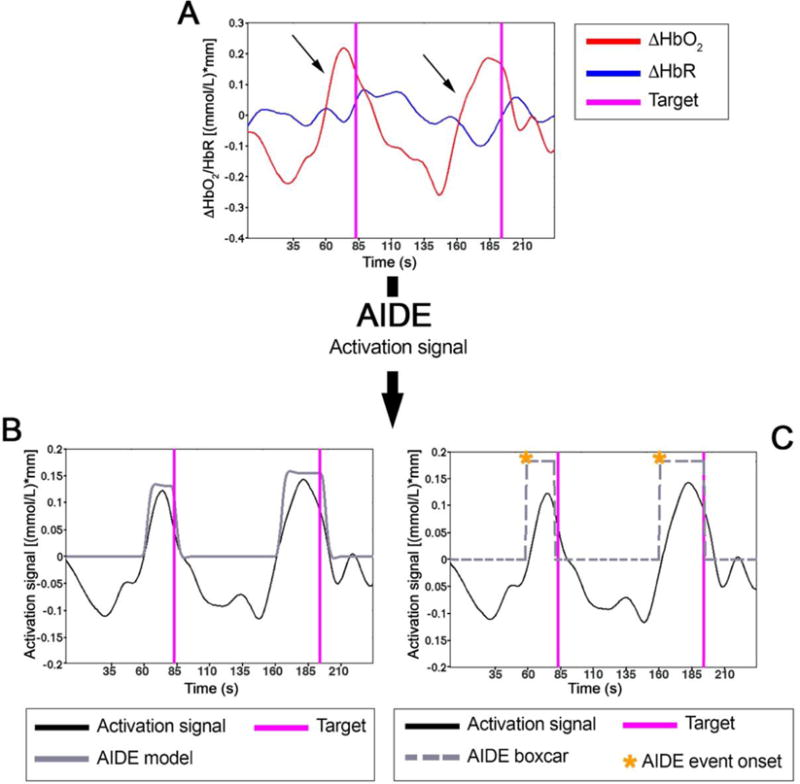
Example of ΔHbO2 and ΔHbR signals referring to one participant undertaking the experiment described in Pinti et al. (2015) (A). Magenta lines represent the time point in which the participant fist bumped two targets in the experimental area. Panel B shows the resulting activation model resulting from the application of AIDE (black line; Pinti et al., 2017), corresponding to the best fit with the activation signal (red line). The corresponding boxcar (black line) and the identified event onsets (orange asterisks) are illustrated in panel C. The estimated functional events occur ~20 s before the participant reached the targets (magenta lines).

References

    1. Aasted CM, Yücel MA, Cooper RJ, Dubb J, Tsuzuki D, Becerra L, Boas DA. Anatomical guidance for functional near-infrared spectroscopy: AtlasViewer tutorial. Neurophotonics. 2015;2(2):020801. doi: 10.1117/1.NPh.2.2.020801. - DOI - PMC - PubMed
    1. Allison T, Puce A, McCarthy G. Social perception from visual cues: role of the STS region. Trends in Cognitive Sciences. 2000;4:267–278. doi: 10.1016/S1364-6613(00)01501-1. - DOI - PubMed
    1. Atsumori H, Kiguchi M, Obata A, Sato H, Katura T, Funane T, Maki A. Development of wearable optical topography system for mapping the prefrontal cortex activation. Review of Scientific Instruments. 2009;80(4):043704. doi: 10.1063/1.3115207. - DOI - PubMed
    1. Atsumori H, Kiguchi M, Katura T, Funane T, Obata A, Sato H, Kubota K. Noninvasive imaging of prefrontal activation during attention-demanding tasks performed while walking using a wearable optical topography system. Journal of Biomedical Optics. 2010;15(4):046002–046002. doi: 10.1117/1.3462996. - DOI - PubMed
    1. Ayaz H, Onaral B, Izzetoglu K, Shewokis PA, McKendrick R, Parasuraman R. Continuous monitoring of brain dynamics with functional near infrared spectroscopy as a tool for neuroergonomic research: Empirical examples and a technological development. Frontiers in Human Neuroscience. 2013:7. doi: 10.3389/fnhum.2013.00871. - DOI - PMC - PubMed