


Health-Related Quality of Life in Patients with CVID Under Different Schedules of Immunoglobulin Administration: Prospective Multicenter Study
- PMID: 30644015
- PMCID: PMC6445807
- DOI: 10.1007/s10875-019-0592-5
Health-Related Quality of Life in Patients with CVID Under Different Schedules of Immunoglobulin Administration: Prospective Multicenter Study
Abstract
Objective: We assessed the health-related quality of life (HRQoL) in CVID adults receiving different schedules of immunoglobulin replacement therapy (IgRT) by intravenous (IVIG), subcutaneous (SCIG), and facilitated (fSCIG) preparations. For these patients, IgRT schedule was chosen after a period focused on identifying the most suitable individual option.
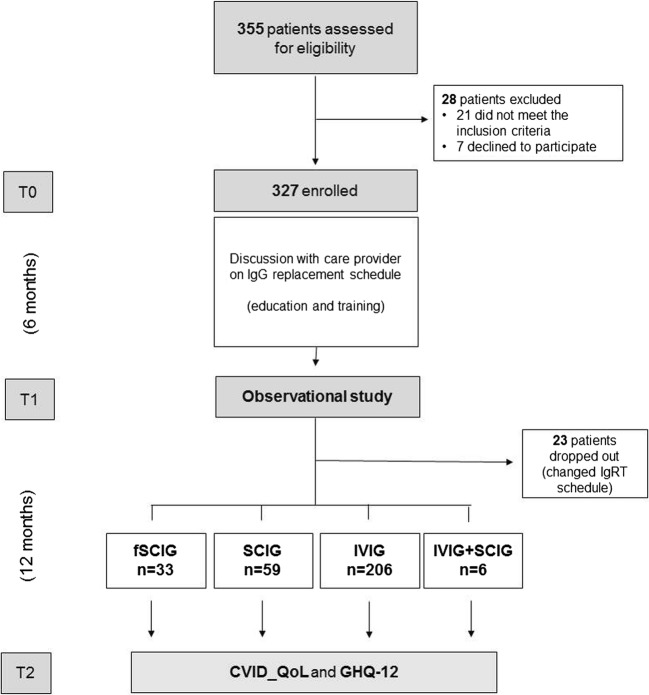
Methods: Three hundred twenty-seven participants were enrolled in a prospective, observational, 18-month study. Participants received IgRT for at least 2 years. The first 6 months were devoted to the educational process during which the choices related to IgRT were regularly re-assessed, and the shift to alternative regimen was permitted. During the following 12 months, clinical data were prospectively collected, and only patients who did not further modify their IgRT schedule were included in the analysis of HRQoL measured by CVID_QoL, a specific instrument, and by GHQ-12, a tool to assess minor psychiatric nonpsychotic disorders.
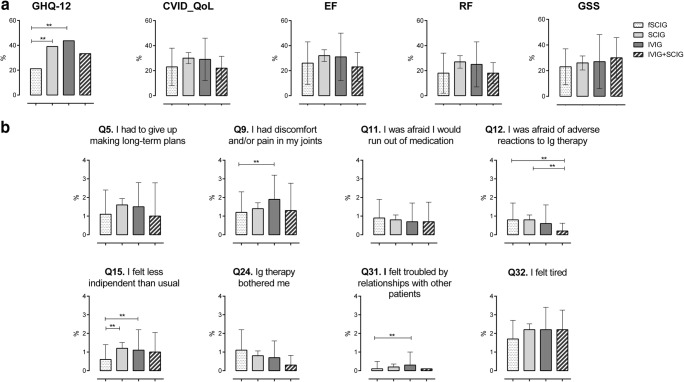
Results: Three hundred four patients were included in the analysis. CVID_QoL global score and its dimensions (emotional functioning, relational functioning, gastrointestinal symptoms) were similar in IVIG, SCIG, and fSCIG recipients. Patients receiving IgRT by different routes of administration reported similar capacity to make long-term plans, discomfort due to therapy, and concern to run out of medications. Multivariate analysis revealed the GHQ-12 status, but not the IgRT mode of administration, as the major factor impacting on treatment-related QoL items, and a significant impact of age on discomfort related to IgRT.
Conclusions: IgRT schedules do not impact the HRQoL in CVID if the treatment is established after an extensive educational period focused on individualizing the best therapeutic regimen.
Keywords: CVID_QoL; Health-related quality of life; common variable immunodeficiency; immunoglobulin replacement treatment; patient empowerment.
Conflict of interest statement
IQ receipt of consultation fees and grants by Shire, CSL Behring, Octapharma, and Kedrion; CA receipt of consultation fees by Shire, Roche, CSL Behring, Octapharma, and Novartis. AF provides compensated consultancy services to manufacturers of immunoglobulin therapies. FP, CM, LB, MC, GF, LC, GS, AP, RN, ST, and FC declared no conflict of interest.
Figures
References
-
- Bonilla FA, Barlan I, Chapel H, Costa-Carvalho BT, Cunningham-Rundles C, de la Morena MT, Espinosa-Rosales FJ, Hammarström L, Nonoyama S, Quinti I, Routes JM, Tang MLK, Warnatz K. International consensus document (ICON): common variable immunodeficiency disorders. J Allergy Clin Immunol Pract. 2016;4:38–59. doi: 10.1016/j.jaip.2015.07.025. - DOI - PMC - PubMed
Publication types
MeSH terms
Substances
LinkOut - more resources
Full Text Sources
