


The Effects of Maternal and Paternal Body Mass Index on Live Birth Rate after Intracytoplasmic Sperm Injection Cycles
- PMID: 30644241
- PMCID: PMC6334009
- DOI: 10.22074/ijfs.2019.5433
The Effects of Maternal and Paternal Body Mass Index on Live Birth Rate after Intracytoplasmic Sperm Injection Cycles
Abstract
Background: We designed the present study to evaluate the simultaneous effect of obesity in couples on in vitro fertilization/ intracytoplasmic sperm injection (IVF/ICSI) outcomes.
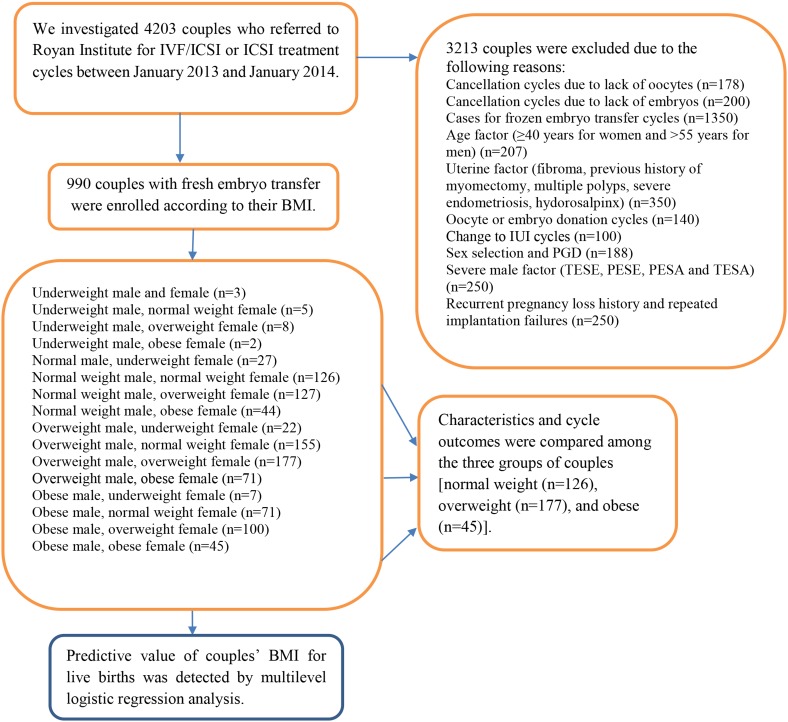
Materials and methods: In this cross-sectional study, performed at Royan Institute between January 2013 and January 2014, we evaluated the recorded data of all patients during this time period. The study population was limited to couples who underwent ICSI or IVF/ICSI cycles with autologous oocytes and fresh embryo transfers. We recorded the heights and weights of both genders and divided them into groups according to body mass index (BMI). Multilevel logistic regression analysis was used to determine the odds ratio for live births following ICSI or IVF/ICSI.
Results: In total, 990 couples underwent IVF/ICSI cycles during the study period. Among the ovulatory women, a significant difference existed between the BMI groups. There was a 60% decrease [95% confidence interval (CI): 0.11-0.83] in the odds of a live birth among overweight subjects and 84% (95% CI: 0.02-0.99) decrease among obese subjects. Among the anovulatory women, the association between the BMI and live births presented no clear tendencies. We did not observe any significant relationship between male BMI and live birth rate. The results demonstrated no significant association between the couples' BMI and live birth rate.
Conclusion: Based on the present findings, increased female BMI independently and negatively influenced birth rates after ICSI. However, increased male BMI had no impact on live births after ICSI, either alone or combined with increased female BMI.
Keywords: Body Mass Index; Female; Intracytoplasmic Sperm Injections; Live Birth; Male.
Copyright© by Royan Institute. All rights reserved.
Conflict of interest statement
The authors declare no conflicts of interest.
Figures
References
-
- Bakos HW, Henshaw RC, Mitchell M, Lane M. Paternal body mass index is associated with decreased blastocyst development and reduced live birth rates following assisted reproductive technology. Fertil Steril. 2011;95(5):1700–1704. - PubMed
-
- Styne-Gross A, Elkind-Hirsch K, Scott RT Jr. Obesity does not impact implantation rates or pregnancy outcome in women attempting conception through oocyte donation. Fertil Steril. 2005;83(6):1629–1634. - PubMed
-
- Dechaud H, Anahory T, Reyftmann L, Loup V, Hamamah S, Hedon B. Obesity does not adversely affect results in patients who are undergoing in vitro fertilization and embryo transfer. Eur J Obstet Gynecol Reprod Biol. 2006;127(1):88–93. - PubMed
-
- Wang X, Hao J, Zhang F, Li J, Kong H, Guo Y. Effects of female and male body mass indices on the treatment outcomes and neonatal birth weights associated with in vitro fertilization/intracytoplasmic sperm injection treatment in China. Fertil Steril. 2016;106(2):460–466. - PubMed
-
- Esinler I, Bozdag G, Yarali H. Impact of isolated obesity on ICSI outcome. Reprod Biomed Online. 2008;17(4):583–587. - PubMed
LinkOut - more resources
Full Text Sources