. 2019 Jan 15;9(1):145.
doi: 10.1038/s41598-018-35949-5.

High-Throughput Video Processing of Heart Rate Responses in Multiple Wild-type Embryonic Zebrafish per Imaging Field

Affiliations

High-Throughput Video Processing of Heart Rate Responses in Multiple Wild-type Embryonic Zebrafish per Imaging Field

W Kyle Martin et al. Sci Rep. .

Abstract

Heart rate assays in wild-type zebrafish embryos have been limited to analysis of one embryo per video/imaging field. Here we present for the first time a platform for high-throughput derivation of heart rate from multiple zebrafish (Danio rerio) embryos per imaging field, which is capable of quickly processing thousands of videos and ideal for multi-well platforms with multiple fish/well. This approach relies on use of 2-day post fertilization wild-type embryos, and uses only bright-field imaging, circumventing requirement for anesthesia or restraint, costly software/hardware, or fluorescently-labeled animals. Our original scripts (1) locate the heart and record pixel intensity fluctuations generated by each cardiac cycle using a robust image processing routine, and (2) process intensity data to derive heart rate. To demonstrate assay utility, we exposed embryos to the drugs epinephrine and clonidine, which increased or decreased heart rate, respectively. Exposure to organic extracts of air pollution-derived particulate matter, including diesel or biodiesel exhausts, or wood smoke, all complex environmental mixtures, decreased heart rate to varying degrees. Comparison against an established lower-throughput method indicated robust assay fidelity. As all code and executable files are publicly available, this approach may expedite cardiotoxicity screening of compounds as diverse as small molecule drugs and complex chemical mixtures.


Conflict of interest statement

The authors declare no conflict of interest, financial or otherwise.

Figures
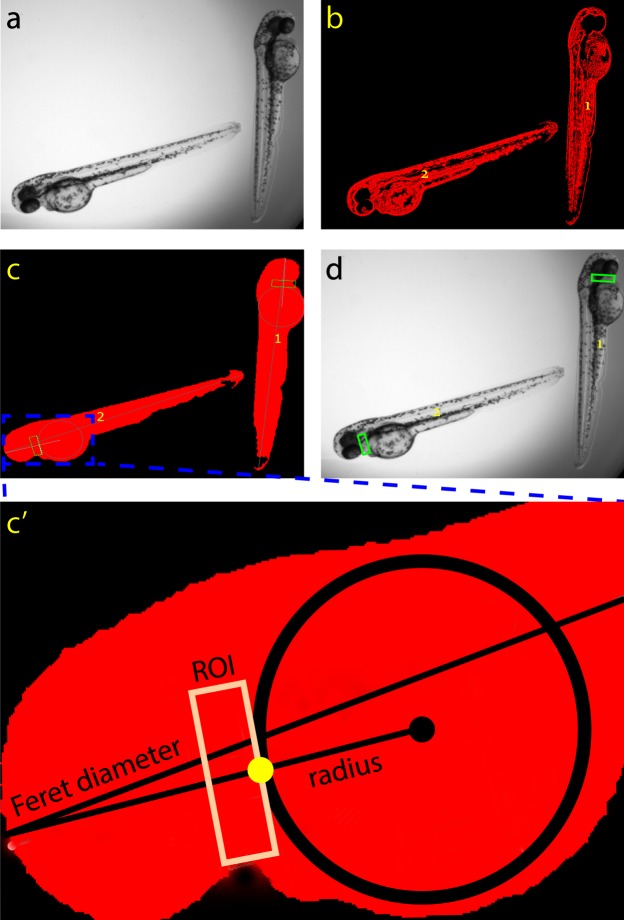
Figure 1
Figure 1
Image processing using FisHRateZ. (a) original image pulled from the 10-s video file. (b) FisHRateZ identifies embryos and removes all other particles (i.e., lint or dust) in wells. (c) The shape of the embryo allows for geometric determination of heart location for ROI placement. c’) inset of heart region of embryo shows: a Feret diameter, which is the longest line that can be drawn lengthwise across the embryo, a circle superimposed over yolk sac, a second line passing through the circle, and a region of interest rectangle (ROI) as described in the Methods and Materials section. (d) ROI boxes are superimposed over the original image and applied to each frame of the video for pixel intensity versus time plotting.
Figure 2
Figure 2
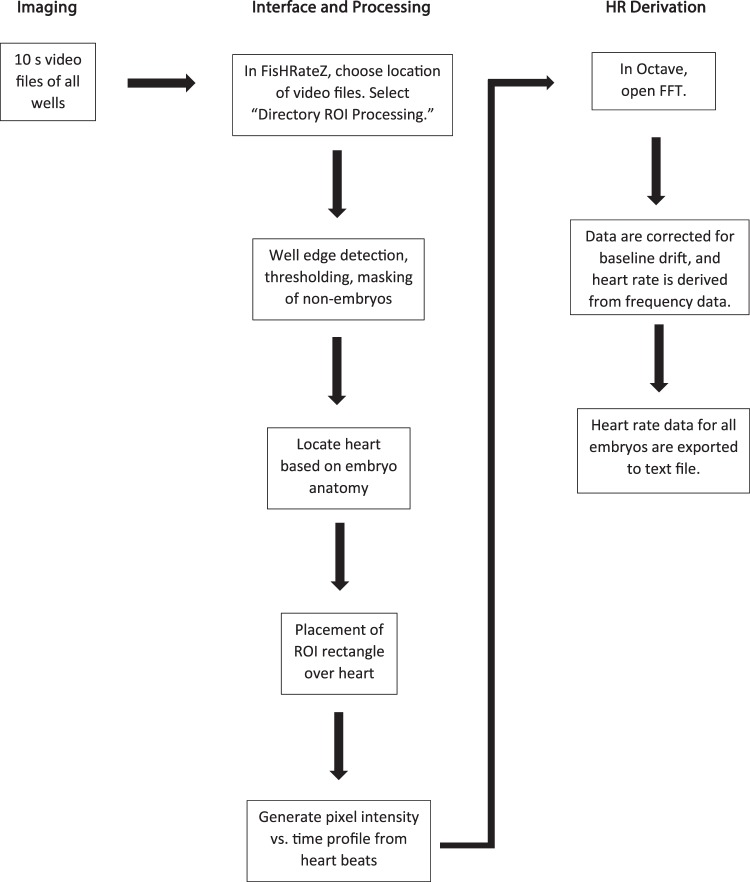
Workflow of heart rate derivation using FisHRateZ and original FFT.
Figure 3
Figure 3
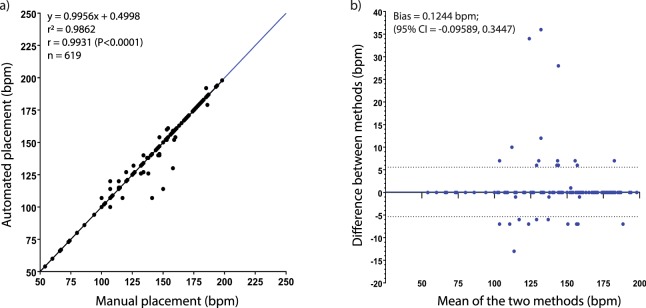
A comparison of heart rates derived from automated placement of Region of Interest match those derived via manual placement. (a) Heart rate data from both ROI placement methods were plotted against one another and linear regression derived r2, slope and p-value. r value indicates correlation of manual and automatic placement of ROI-derived data of all imaged animals across 10 total experiments. The line of identity (blue) illustrates a hypothetically “perfect” correlation between the two data sets for comparison. (b) A Bland-Altman analysis provides quantitative data on the disagreement between the two methods (bias) and the interval within which 95% of all disagreement occurs (95% limits of agreement indicated by dashed lines; −5.346 to 5.594). The x-axis is the average between the heart rates derived from the two methods, and the y-axis is the distance that those two values are from one another (Method A-Method B). A positive value on the y-axis indicates that Method A (manual ROI placement) returned a higher value, and vice versa.
Figure 4
Figure 4
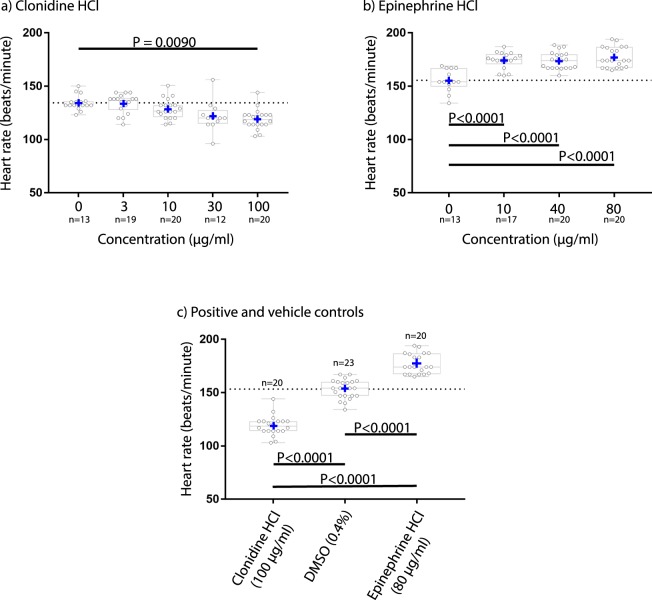
FisHRateZ successfully captured increases and decreases in heart rate. (a) clonidine HCl, (b) epinephrine HCl, (c) Side-by-side comparison of clonidine HCl 100 μg/ml, 0.4% DMSO, and epinephrine HCl 80 μg/ml. Concentration = 0 is 0.4% dimethyl sulfoxide (DMSO) vehicle control. One-way, two-tailed ANOVA and Tukey’s (panels a and c) or Kruskal-Wallis and Dunn’s (panel b; see Methods and Materials).
Figure 5
Figure 5
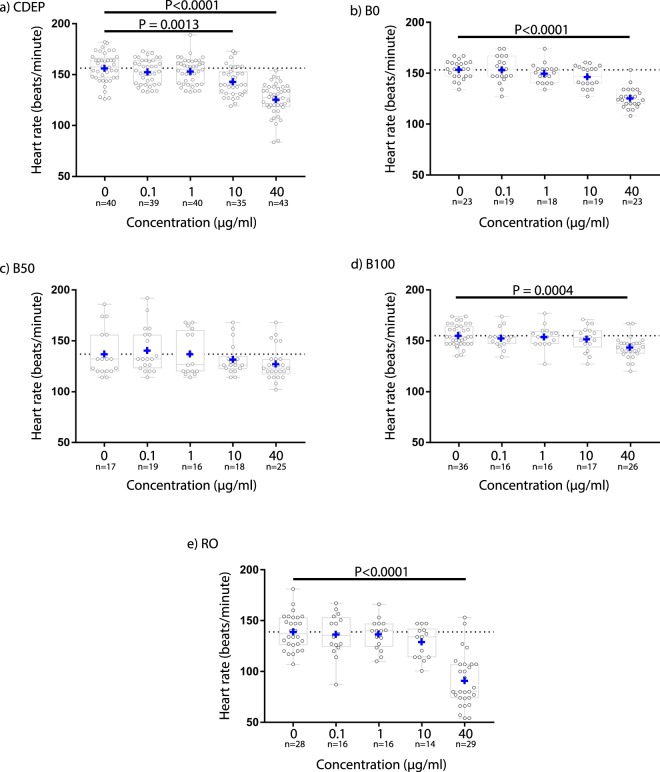
Heart rate responses to five organic extracts of complex mixtures of air pollutants. (a,b) pure petroleum diesels CDEP and B0. (c) B50, 1:1 blend of B0 and pure soy biodiesel. (d) B100, pure soy biodiesel. (e) RO, flaming red oak wood smoke. One-way, two-tailed ANOVA and Tukey’s.
Figure 6
Figure 6
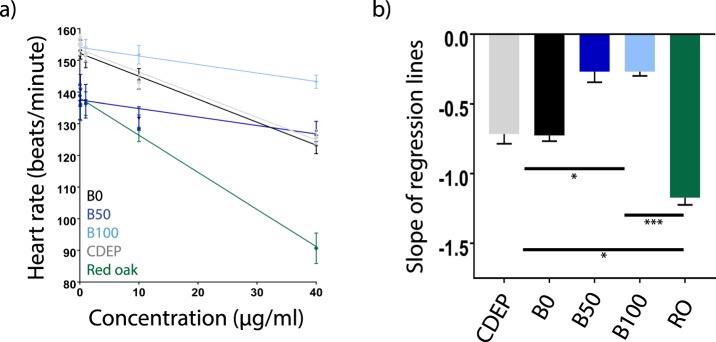
Potency of complex mixtures of air pollutants. (a) linear regressions of heart rate responses for RO (green), CDEP (silver), B0 (black), B50 (dark blue), and B100 (light blue). (b) Comparison of slopes, which were used as an indicator of the relative potency of the extracts (mean ± SEM). Slope values can be read as Δbpm/µg extractable organic matter/ml. (*p < 0.05, ***p < 0.001). One-way, two-tailed ANOVA and Tukey’s.

References

    1. Johnson NB, et al. Leading Causes of Morbidity and Mortality and Associated Behavioral Risk and Protective Factors—United States, 2005–2013. Morb. Mortal. Wkly. Rep. 2014;63:3–27.
    1. Wettstein ZS, et al. Cardiovascular and Cerebrovascular Emergency Department Visits Associated With Wildfire Smoke Exposure in California in 2015. J. Am. Heart Assoc. 2018;7:e007492. doi: 10.1161/JAHA.117.007492. - DOI - PMC - PubMed
    1. Naeher LP, et al. Woodsmoke health effects: A review. Inhal. Toxicol. 2007;19:67–106. doi: 10.1080/08958370600985875. - DOI - PubMed
    1. Cohen AJ, et al. Estimates and 25-year trends of the global burden of disease attributable to ambient air pollution: an analysis of data from the Global Burden of Diseases Study 2015. Lancet. 2017;389:1907–1918. doi: 10.1016/S0140-6736(17)30505-6. - DOI - PMC - PubMed
    1. Menke NB, Walsh SJ, King AM. Cardiotoxicodynamics: Toxicity of Cardiovascular Xenobiotics. Emerg. Med. Clin. North Am. 2015;33:563–595. doi: 10.1016/j.emc.2015.04.007. - DOI - PubMed

Publication types

MeSH terms

Substances