


Conditional deletion of Des1 in the mouse retina does not impair the visual cycle in cones
- PMID: 30645148
- PMCID: PMC6436658
- DOI: 10.1096/fj.201802493R
Conditional deletion of Des1 in the mouse retina does not impair the visual cycle in cones
Abstract
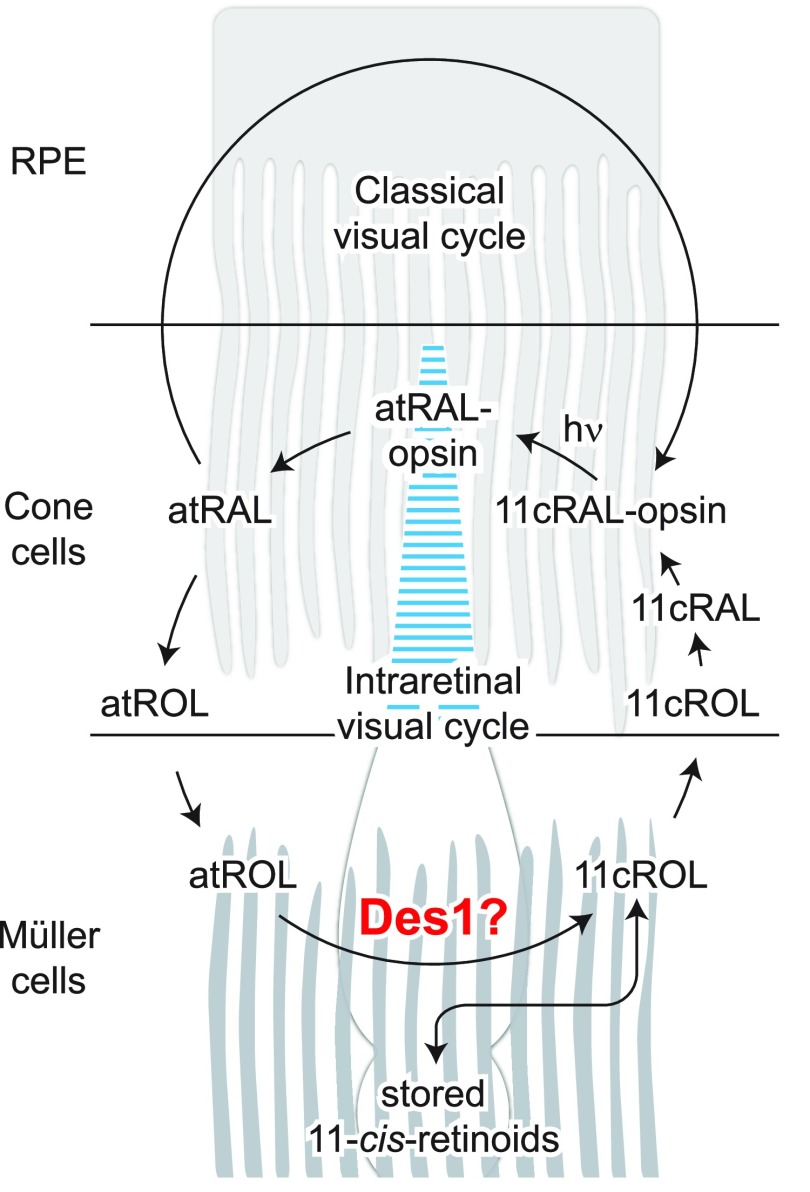
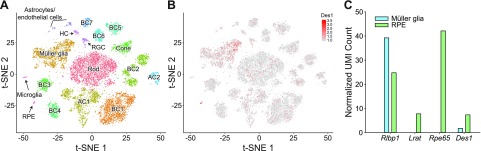
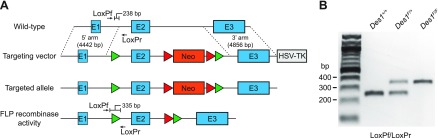
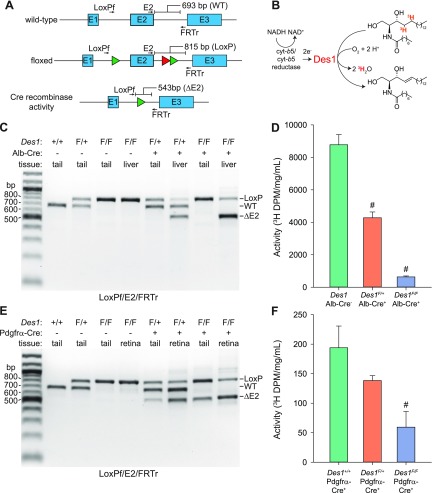
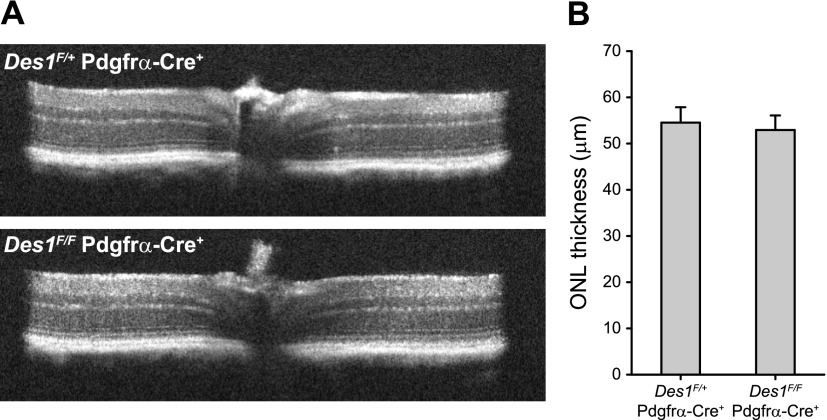
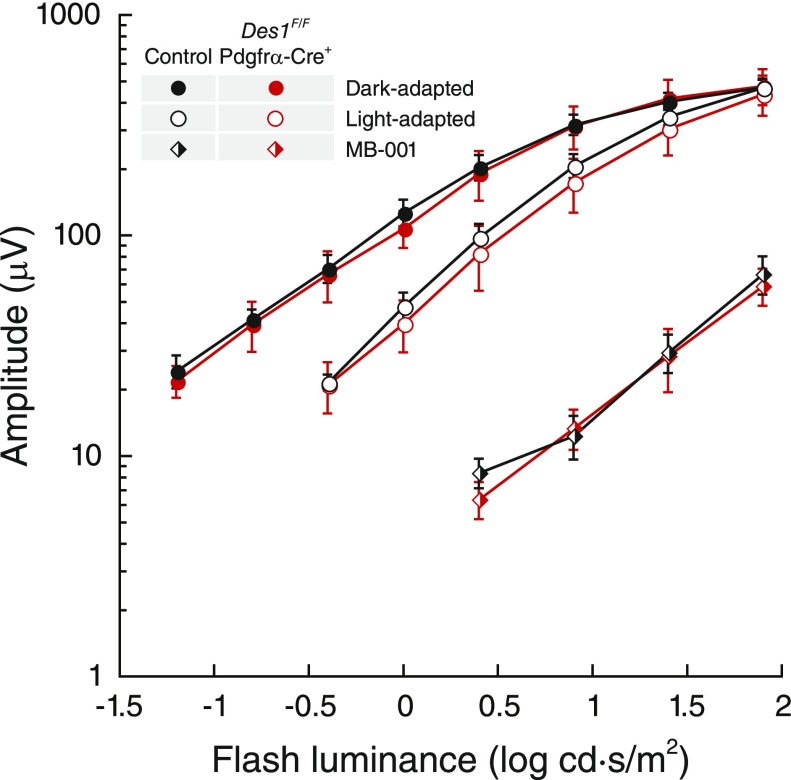
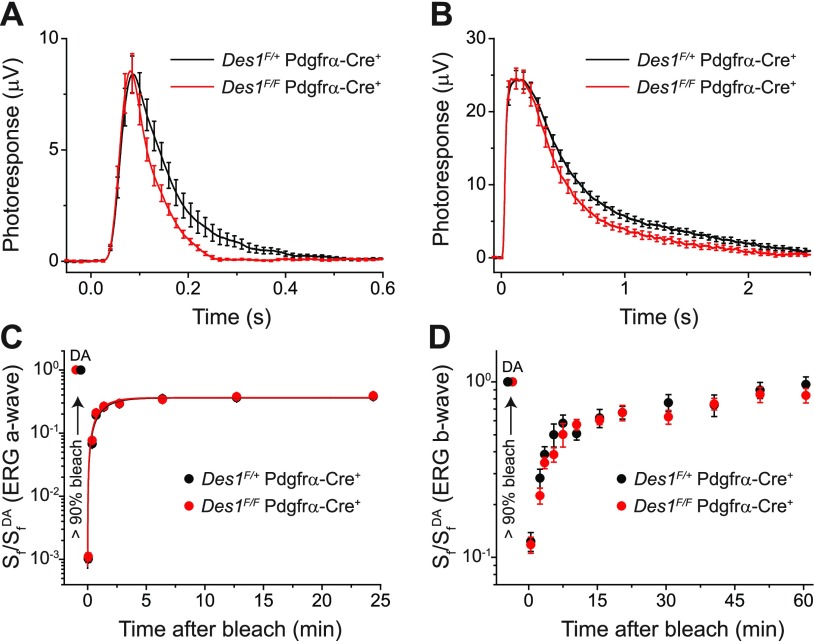
Cone photoreceptors are essential for vision under moderate to high illuminance and allow color discrimination. Their fast dark adaptation rate and resistance to saturation are believed to depend in part on an intraretinal visual cycle that supplies 11- cis-retinaldehyde to cone opsins. Candidate enzymes of this pathway have been reported, but their physiologic contribution to cone photoresponses remains unknown. Here, we evaluate the role of a candidate retinol isomerase of this pathway, sphingolipid δ4 desaturase 1 (Des1). Single-cell RNA sequencing analysis revealed Des1 expression not only in Müller glia but also throughout the retina and in the retinal pigment epithelium. We assessed cone functional dependence on Müller cell-expressed Des1 through a conditional knockout approach. Floxed Des1 mice, on a guanine nucleotide-binding protein subunit α transducin 1 knockout ( Gnat1-/-) background to allow isolated recording of cone-driven photoresponses, were bred with platelet-derived growth factor receptor α (Pdgfrα)-Cre mice to delete Des1 in Müller cells. Conditional knockout of Des1 expression, as shown by tissue-selective Des1 gene recombination and reduced Des1 catalytic activity, caused no gross changes in the retinal structure and had no effect on cone sensitivity or dark adaptation but did slightly accelerate the rate of cone phototransduction termination. These results indicate that Des1 expression in Müller cells is not required for cone visual pigment regeneration in the mouse.-Kiser, P. D., Kolesnikov, A.V., Kiser, J. Z., Dong, Z., Chaurasia, B., Wang, L., Summers, S. A., Hoang, T., Blackshaw, S., Peachey, N. S., Kefalov, V. J., Palczewski, K. Conditional deletion of Des1 in the mouse retina does not impair the visual cycle in cones.
Keywords: Müller glia; photoreceptor; retinoid cycle; sphingolipidδ(4) desaturase.
Conflict of interest statement
The authors thank David Peck and Elizabeth Bulman (both of Case Western Reserve University) for assistance with animal breeding, genotyping, and husbandry. This research was supported by funding from the U.S. Department of Veterans Affairs (IK2BX002683 to P.D.K.); a Research Career Scientist Award (to N.S.P.); the U.S. National Institutes of Health (NIH) National Eye Institute (R01EY009339 to K.P. and P.D.K., R01EY024864 to K.P., R01EY019312 to V.J.K., R01EY021126 to K.P. and V.J.K., R24EY027283 to K.P., P.D.K., V.J.K., S.B., and N.S.P., R01DK115824 to S.A.S., P30EY011373 to the Department of Ophthalmology and Visual Sciences at Case Western Reserve University, P30EY025585 to the Cleveland Clinic Cole Eye Institute, and P30EY002687 to the Department of Ophthalmology and Visual Sciences at Washington University); the American Diabetes Association (to S.A.S); the American Heart Association (to S.A.S.). The authors acknowledge departmental support from a Research to Prevent Blindness unrestricted grant. S.A.S. is a consultant and shareholder of Centaurus Therapeutics. The remaining authors declare no competing financial interests.
Figures
References
-
- Hofmann K. P., Scheerer P., Hildebrand P. W., Choe H. W., Park J. H., Heck M., Ernst O. P. (2009) A G protein-coupled receptor at work: the rhodopsin model. Trends Biochem. Sci. 34, 540–552 - PubMed
-
- Kiser P. D., Zhang J., Sharma A., Angueyra J. M., Kolesnikov A. V., Badiee M., Tochtrop G. P., Kinoshita J., Peachey N. S., Li W., Kefalov V. J., Palczewski K. (2018) Retinoid isomerase inhibitors impair but do not block mammalian cone photoreceptor function. J. Gen. Physiol. 150, 571–590 - PMC - PubMed
Publication types
MeSH terms
Substances
Grants and funding
- P30 EY011373/EY/NEI NIH HHS/United States
- P30 EY002687/EY/NEI NIH HHS/United States
- R01 EY019312/EY/NEI NIH HHS/United States
- R01 DK115824/DK/NIDDK NIH HHS/United States
- P30 EY025585/EY/NEI NIH HHS/United States
- IK2 BX002683/BX/BLRD VA/United States
- IK6 BX005233/BX/BLRD VA/United States
- R24 EY027283/EY/NEI NIH HHS/United States
- R24 EY024864/EY/NEI NIH HHS/United States
- R24 EY021126/EY/NEI NIH HHS/United States
- R01 EY025696/EY/NEI NIH HHS/United States
- R01 EY020560/EY/NEI NIH HHS/United States
- R01 EY009339/EY/NEI NIH HHS/United States
LinkOut - more resources
Full Text Sources
Molecular Biology Databases
Miscellaneous
