


Comparison of Copper Concentration Between Rejected Renal Grafts and Cancerous Kidneys
- PMID: 30645698
- PMCID: PMC6706355
- DOI: 10.1007/s12011-018-1621-6
Comparison of Copper Concentration Between Rejected Renal Grafts and Cancerous Kidneys
Abstract
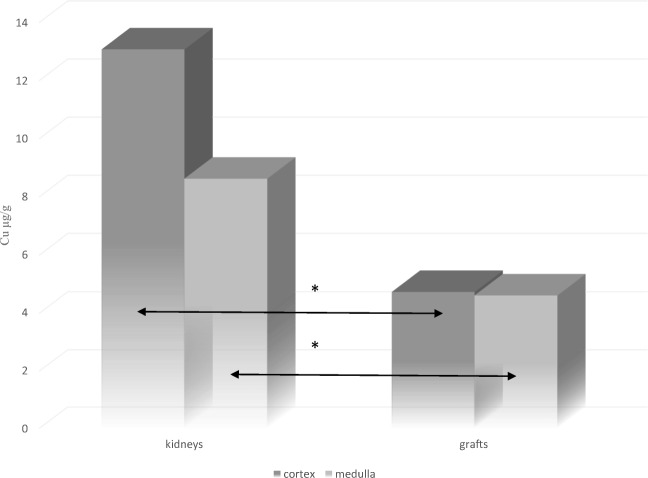
In the body, disorders in the composition and concentration of trace elements, including copper, can lead to the development of various alterations that may result in incorrect functioning of the kidneys. Data on the concentrations of copper in human kidneys are discussed; however, little is known about the concentration of trace elements within rejected renal grafts and kidneys with tumor lesions. The aim of our study was to compare the copper concentration between cancerous kidneys and rejected renal grafts with the division on renal cortex and renal medulla. Material consisted of kidneys from patients hospitalized at the Department of Urology and General Surgery and Transplantation of the Independent Public Clinical Hospital No. 2 at the Pomeranian Medical University in Szczecin, north-western Poland. The study material consisted of kidneys with tumor lesions (n = 33), and renal grafts (n = 10), obtained from patients belongs to the north-western areas of Poland. The examination was performed using ICP-AES method. Regarding the pathological kidneys, excluding grafts, the concentration of Cu in the renal cortex was 52% higher than in medullary region and the difference between the compared concentrations was statistically confirmed (p < 0.05). Taking into account renal grafts, the concentration of Cu in the medulla was slightly lower than in the cortex (less than 3%). In summary, copper in rejected and cancerous kidneys tends to accumulate in higher amount in the renal cortex than medulla, what can be explained by the fact that renal corpuscles, where the first phase of filtration is performed, are located only in the cortical region of the kidney. Furthermore, renal grafts accumulate significantly less copper than kidneys with neoplastic changes, what could have been caused by immunosuppressive medicines used by the graft recipients. The lower copper concentration in renal grafts could be a consequence of the altered immune system, including inflammatory process or/and non-immune mechanisms. Additionally, cancerous and non-cancerous kidneys exhibit different perfusion rate in renal glomeruli, what can finally lead to disparity in chemical elements concentration, including copper.
Keywords: Copper; Cortex; Kidney; Medulla; Pathological kidney; Renal grafts.
Conflict of interest statement
The authors declare that they have no conflict of interest.
Figures
References
-
- Aalbers TG, Houtman JP, Makkink B. Trace-element concentrations in human autopsy tissue. Clin Chem. 1987;33:2057–2064. - PubMed
-
- Antonowicz-Juchniewicz J, Jodkowska A, Kwieciniska D. Secondary nephropathies in occupational health practice. I. Secondary nephropathies due to occupational exposure. Med Pr. 2006;57:389–400. - PubMed
-
- Ataullakhanov IA. Effect of the menstrual function on the metabolism, of copper and iodine in the organism. Akush Ginekol (Mosk) 1968;44:61–64. - PubMed
MeSH terms
Substances
LinkOut - more resources
Full Text Sources
Medical
