Association of Electronic Cigarette Use With Smoking Habits, Demographic Factors, and Respiratory Symptoms
- PMID: 30646032
- PMCID: PMC6324524
- DOI: 10.1001/jamanetworkopen.2018.0789
Association of Electronic Cigarette Use With Smoking Habits, Demographic Factors, and Respiratory Symptoms
Abstract
Importance: There is an ongoing debate about whether electronic cigarettes (e-cigarettes) are the solution to the tobacco epidemic or a new public health threat. Large representative studies are needed to study e-cigarette use in the general population, but hardly any have been published.
Objectives: To estimate the prevalence of e-cigarette use and to investigate the association of e-cigarette use with smoking habits, demographic factors, and respiratory symptoms.
Design, setting, and participants: Cross-sectional, population-based study of random samples of the population, performed within the Obstructive Lung Disease in Northern Sweden (OLIN) study and West Sweden Asthma Study (WSAS). The same validated questionnaire including identical questions was used in OLIN and WSAS. In 2016, OLIN and WSAS conducted postal questionnaire surveys in random samples of adults aged 20 to 75 years. In OLIN, 6519 participated (response rate, 56.4%); in WSAS, 23 753 participated (response rate, 50.1%).
Main outcomes and measures: Electronic cigarette use, smoking habits, and respiratory symptoms.
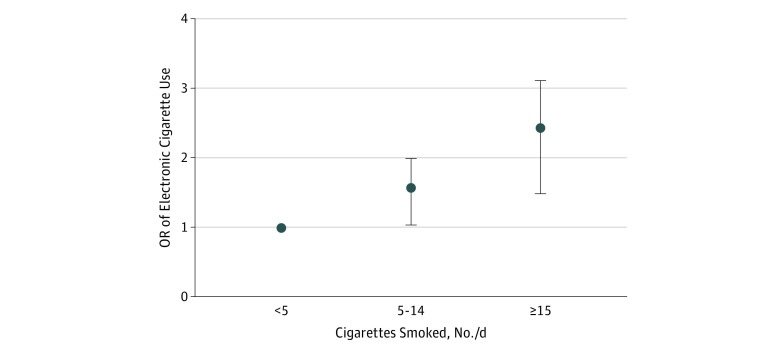
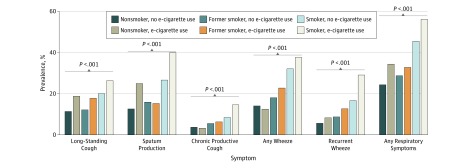
Results: Of 30 272 participants (16 325 women [53.9%]), 3897 (12.9%) were aged 20 to 29 years; 4242 (14.0%), 30 to 39 years; 5082 (16.8%), 40 to 49 years; 6052 (20.0%), 50 to 59 years; 6628 (21.9%), 60 to 69 years; and 4371 (14.4%), 70 to 75 years. The number of current smokers was 3694 (12.3%), and 7305 (24.4%) were former smokers. The number of e-cigarette users was 529 (2.0%), and e-cigarette use was more common among men (275 of 12 347 [2.2%; 95% CI, 2.0%-2.5%]) than women (254 of 14 022 [1.8%; 95% CI, 1.6%-2.0%]). Among current smokers, 350 of 3566 (9.8%; 95% CI, 8.8%-10.8%) used e-cigarettes compared with 79 of 6875 (1.1%; 95% CI, 0.9%-1.3%) in former smokers and 96 of 15 832 (0.6%; 95% CI, 0.5%-0.7%) in nonsmokers (P < .001). Among e-cigarette users who answered the survey question about cigarette-smoking habits (n = 525), 350 (66.7%; 95% CI, 62.7%-70.7%) were current smokers, 79 (15.0%; 95% CI, 11.9%-18.1%) were former smokers, and 96 (18.3%; 95% CI, 15.0%-21.6%) were nonsmokers (P < .001 for trend). In a regression analysis, e-cigarette use was associated with male sex (odds ratio [OR], 1.35; 95% CI, 1.12-1.62); age groups 20 to 29 years (OR, 2.77; 95% CI, 1.90-4.05), 30 to 39 years (OR, 2.27; 95% CI, 1.53-3.36), 40 to 49 years (OR, 1.65; 95% CI, 1.11-2.44), and 50 to 59 years (OR, 1.47; 95% CI, 1.01-2.12); educational level at primary school (OR, 1.99; 95% CI, 1.51-2.64) and upper secondary school (OR, 1.57; 95% CI, 1.25-1.96); former smoking (OR, 2.37; 95% CI, 1.73-3.24); and current smoking (OR, 18.10; 95% CI, 14.19-23.09). All respiratory symptoms were most common among dual users and former smokers and nonsmokers who used e-cigarettes.
Conclusions and relevance: Use of e-cigarettes was most common among smokers, and dual users had the highest prevalence of respiratory symptoms. On a population level, this study indicates that the present use of e-cigarettes does not adequately serve as a smoking cessation tool.
Conflict of interest statement
Figures
Comment in
-
Electronic Cigarettes: A Role in Smoking Cessation?Am J Respir Crit Care Med. 2020 Aug 15;202(4):595-597. doi: 10.1164/rccm.201908-1584RR. Am J Respir Crit Care Med. 2020. PMID: 32437241 Free PMC article. No abstract available.
References
-
- Backman H, Hedman L, Jansson SA, Lindberg A, Lundbäck B, Rönmark E. Prevalence trends in respiratory symptoms and asthma in relation to smoking—two cross-sectional studies ten years apart among adults in northern Sweden. World Allergy Organ J. 2014;7(1):. doi: 10.1186/1939-4551-7-1 - DOI - PMC - PubMed