Assessment of Long-term Follow-up of Randomized Trial Participants by Linkage to Routinely Collected Data: A Scoping Review and Analysis
- PMID: 30646311
- PMCID: PMC6324362
- DOI: 10.1001/jamanetworkopen.2018.6019
Assessment of Long-term Follow-up of Randomized Trial Participants by Linkage to Routinely Collected Data: A Scoping Review and Analysis
Abstract
Importance: Follow-up of participants in randomized trials may be limited by logistic and financial factors. Some important randomized trials have been extended well beyond their original follow-up period by linkage of individual participant information to routinely collected data held in administrative records and registries.
Objective: To perform a scoping review of randomized clinical trials extended by record linkage to characterize this literature and explore any additional insights into treatment effectiveness provided by long-term follow-up using record linkage.
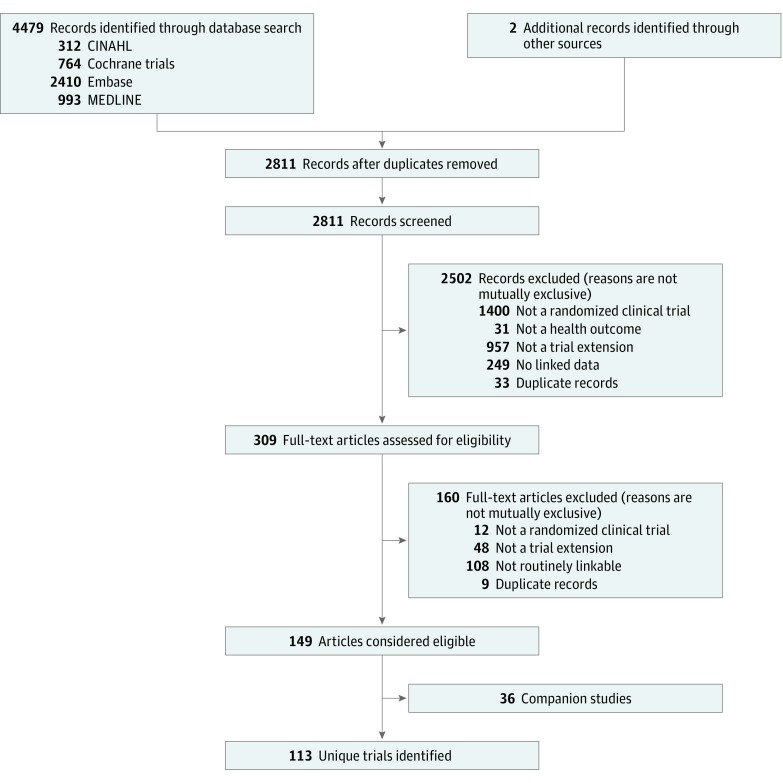
Data sources: A literature search in Embase, CINAHL, MEDLINE, and the Cochrane Register of Controlled Trials was performed for the period January 1, 1945, through November 25, 2016.
Study selection: Various combinations of search terms were used, as there is no accepted terminology. Determination of study eligibility and extraction of information about trial characteristics and outcomes, for both original and extended trial reports, were performed in duplicate.
Data extraction and synthesis: Assessment of study eligibility and data extraction were performed independently by 2 reviewers. All analyses were descriptive.
Main outcomes and measures: Outcomes in the pairs of original and extended trials were categorized according to whether any benefits or harms from interventions were sustained, were lost, or emerged during long-term follow-up.
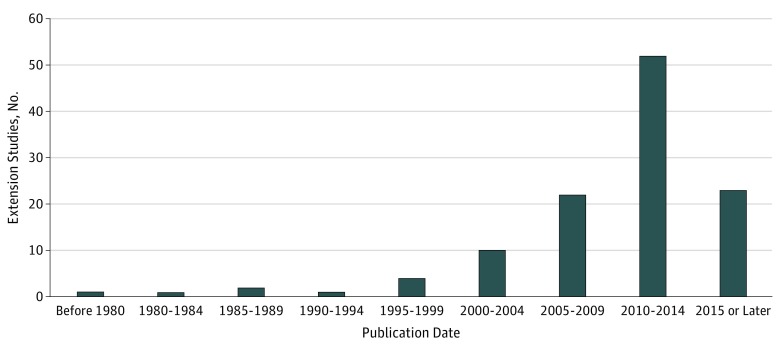
Results: A total of 113 extended trials were included in the study. Linkage to administrative and registry data extended follow-up by between 1 and 55 years. The most common interventions were pharmaceuticals (47 [41.6%]), surgery (19 [16.8%]), and disease screening (19 [16.8%]). End points most frequently studied through record linkage included mortality (88 [77.9%]), cancer (41 [36.3%]), and cardiovascular events (37 [32.7%]). One hundred four trial extensions (92.0%) were analyzed according to the original trial randomization. The reports provided details of 155 analyses of study outcomes. Seventy-four analyses (47.7%) identified statistically significant benefits in the trial extension phase. In 21 of these (28.4%), benefits were significant only in this period. Null results in both the original and extended trials were seen in 34 of the analyses (21.9%). Loss of significant benefits of an intervention were seen in 12 analyses (7.7%). Statistically significant harms were seen in 16 trial extension analyses (10.3%), and in 14 of these (87.5%), the harms were significant only in the trial extension phase.
Conclusions and relevance: Trial extension by linkage to routinely collected data is a versatile underused approach that may add critical insights beyond those of the original trial. Some beneficial and harmful outcomes of interventions are captured only in the extension phase of randomized trials.
Conflict of interest statement
Figures
Comment in
-
How Routinely Collected Data for Randomized Trials Provide Long-term Randomized Real-World Evidence.JAMA Netw Open. 2018 Dec 7;1(8):e186014. doi: 10.1001/jamanetworkopen.2018.6014. JAMA Netw Open. 2018. PMID: 30646306 No abstract available.