Incidence Trends of Atopic Dermatitis in Infancy and Early Childhood in a Nationwide Prescription Registry Study in Norway
- PMID: 30646341
- PMCID: PMC6324394
- DOI: 10.1001/jamanetworkopen.2018.4145
Incidence Trends of Atopic Dermatitis in Infancy and Early Childhood in a Nationwide Prescription Registry Study in Norway
Erratum in
-
Errors in Figure Titles.JAMA Netw Open. 2023 Mar 1;6(3):e236504. doi: 10.1001/jamanetworkopen.2023.6504. JAMA Netw Open. 2023. PMID: 36917114 Free PMC article. No abstract available.
Abstract
Importance: With increasing prevalence of atopic dermatitis (AD) and its manifestation in most countries, together with the supporting evidence of the progression to other atopic phenotypes, AD has developed into a worldwide public health concern. The presence of the disease of has increased since the 1950s, but some recent studies suggest a stationary or decreasing trend.
Objective: To analyze a nationwide health register based on prescription data to determine the incidence rate (IR) of AD in an entire pediatric population.
Design, setting, and participants: All children resident in Norway younger than 6 years from January 1, 2009, through December 31, 2015, were included in this cohort study. Medical diagnoses and disease-specific medications were used as a proxy for identifying children with AD in this population-based prescription registry study. The prescription study was terminated in 2016. The total number of 295 286 disease-specific prescriptions was analyzed from August 2016 through December 2017. The hypothesis was formulated before, during, and after the data collection.
Main outcomes and measures: All children with a medical diagnosis of AD or eczema based on at least 2 prescriptions of topical corticosteroids or at least 1 prescription of topical calcineurin inhibitors. Incidence rates per person-year (PY) and IR ratios were calculated.
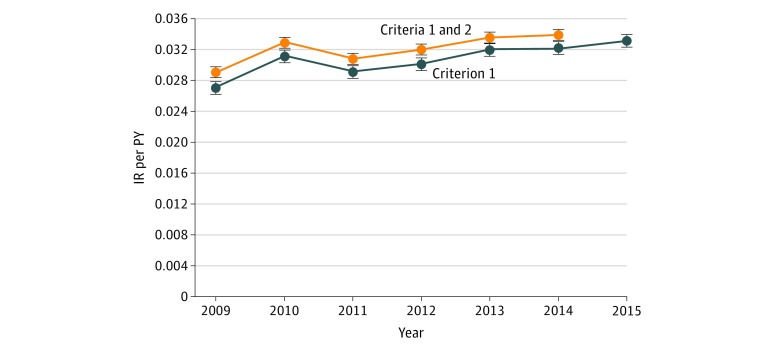
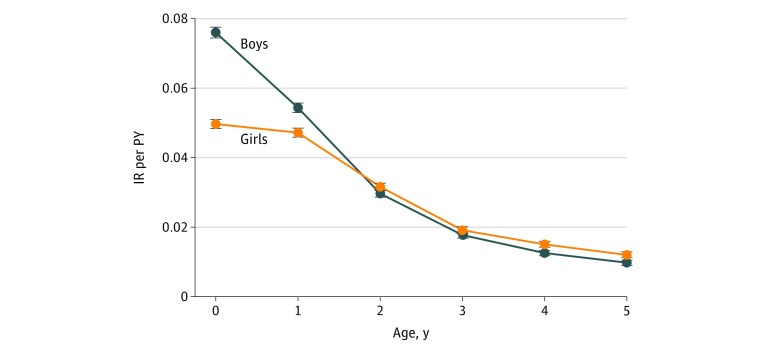
Results: A total of 295 286 disease-specific prescriptions were dispensed to 122 470 children, of whom 63 460 had AD and 56 009 (88.3%) had reimbursed prescriptions and associated AD diagnoses. The annual Norwegian study population (aged <6 years) increased from 357 451 children in 2009 to 373 954 in 2015. The overall IR increased from 0.028 per PY (95% CI, 0.028-0.029 per PY) in 2009 to 0.034 per PY (95% CI, 0.033-0.035 per PY) in 2014. For children younger than 1 year, the IR increased from 0.052 per PY (95% CI, 0.050-0.053 PY) in 2009 to 0.073 per PY (95% CI, 0.071-0.075 per PY) in 2014. In this age group, the IR was 53% higher in boys compared with girls (IR ratio, 1.53; 95% CI, 1.49-1.57; P < .001). The incidence proportion before the age of 6 years was 17.4% (95% CI, 17.2%-17.7%). The primary seasons for the onset of AD were winter and spring.
Conclusions and relevance: This nationwide study suggests an increase in the IR of pediatric AD, especially among children younger than 1 year. This study's findings suggest that increase occurred with a higher IR during winter and spring seasons. Atopic dermatitis had an earlier onset in boys than in girls. During the study period, more than 1 in 6 children younger than 6 years had, at some point, been affected by AD.
Conflict of interest statement
Figures


Comment in
-
The Rise in Atopic Dermatitis in Young Children: What Is the Explanation?JAMA Netw Open. 2018 Nov 2;1(7):e184205. doi: 10.1001/jamanetworkopen.2018.4205. JAMA Netw Open. 2018. PMID: 30646336 No abstract available.
References
-
- Latvala J, von Hertzen L, Lindholm H, Haahtela T. Trends in prevalence of asthma and allergy in Finnish young men: nationwide study, 1966-2003. BMJ. 2005;330(7501):1186-1187. doi: 10.1136/bmj.38448.603924.AE - DOI - PMC - PubMed