Association of Childhood Trauma Exposure With Adult Psychiatric Disorders and Functional Outcomes
- PMID: 30646356
- PMCID: PMC6324370
- DOI: 10.1001/jamanetworkopen.2018.4493
Association of Childhood Trauma Exposure With Adult Psychiatric Disorders and Functional Outcomes
Erratum in
-
Error in Table.JAMA Netw Open. 2020 May 1;3(5):e207276. doi: 10.1001/jamanetworkopen.2020.7276. JAMA Netw Open. 2020. PMID: 32364590 Free PMC article. No abstract available.
Abstract
Importance: Being exposed to trauma is a common childhood experience associated with symptoms and impairments in childhood.
Objective: To assess the association between cumulative childhood trauma exposure and adult psychiatric and functional outcomes.
Design, setting, and participants: Prospective, population-based cohort study of 1420 participants. A community representative sample of participants was assessed with structured Child and Adolescent Psychiatric Assessment interviews up to 8 times in childhood (ages 9-16 years; 6674 observations; 1993-2000) for lifetime trauma exposure as defined by the Diagnostic and Statistical Manual of Mental Disorders. Participants were followed up 4 times in adulthood (ages 19, 21, 25, and 30 years; 4556 observations of 1336 participants; 1999-2015) with the structured Young Adult Psychiatric Assessment Interview for psychiatric outcomes, functional outcomes, and evidence of a disrupted transition to adulthood. Analysis was completed in 2018.
Exposure: Participants were assessed with the structured Child and Adolescent Psychiatric Assessment interview (parent and self-report) up to 8 times in childhood for lifetime trauma exposure (ages 9-16 years; 6674 observations; 1993-2000).
Main outcomes and measures: Participants were assessed up to 4 times with the structured Young Adult Psychiatric Assessment interview (self-report) in adulthood (ages 19, 21, 25, and 30 years; 4556 observations of 1336 participants; 1999-2015) for psychiatric outcomes, functional outcomes, and evidence of a disrupted transition to adulthood.
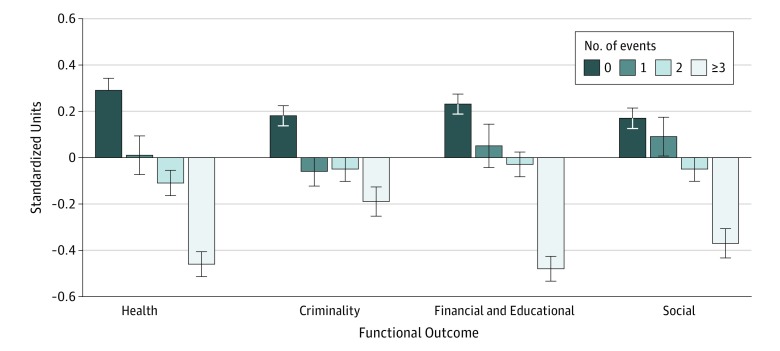
Results: Among the 1420 study participants, 630 (49.0%) were female and 983 (89.4%) were white. By age 16 years, 30.9% of children (n = 451) were exposed to 1 traumatic event, 22.5% (n = 289) were exposed to 2 such events, and 14.8% (n = 267) were exposed to 3 or more. Cumulative childhood trauma exposure to age 16 years was associated with higher rates of adult psychiatric disorders (odds ratio for any disorder, 1.2; 95% CI, 1.0-1.4) and poorer functional outcomes, including key outcomes that indicate a significantly disrupted transition to adulthood (eg, failure to hold a job and social isolation). Childhood trauma exposure continued to be associated with higher rates of adult psychiatric and functional outcomes after adjusting for a broad range of childhood risk factors, including psychiatric functioning and family adversities and hardships (adjusted odds ratio for any disorder, 1.3; 95% CI, 1.0-1.5).
Conclusions and relevance: Cumulative childhood trauma exposure was associated with poor adult outcomes even after accounting for many of the childhood and family factors associated with both trauma exposure and poor adult outcomes. Childhood trauma exposures are common, but often preventable, thus providing a clear target for child-focused public health efforts to ameliorate long-term morbidity.
Conflict of interest statement
Figures
Comment in
-
Social Injustice and the Cycle of Traumatic Childhood Experiences and Multiple Problems in Adulthood.JAMA Netw Open. 2018 Nov 2;1(7):e184488. doi: 10.1001/jamanetworkopen.2018.4488. JAMA Netw Open. 2018. PMID: 30646350 No abstract available.
References
-
- American Psychiatric Association Diagnostic and Statistical Manual of Mental Disorders Fifth Edition (DSM-5). Washington, DC: American Psychiatric Press Inc; 2013.