Prevalence of Severe Maternal Morbidity and Factors Associated With Maternal Mortality in Ontario, Canada
- PMID: 30646359
- PMCID: PMC6324398
- DOI: 10.1001/jamanetworkopen.2018.4571
Prevalence of Severe Maternal Morbidity and Factors Associated With Maternal Mortality in Ontario, Canada
Abstract
Importance: Severe maternal morbidity is defined by potentially life-threatening conditions. The association between the number of severe maternal morbidity (SMM) indicators and maternal death is not known.
Objective: To quantify the association between the number of SMM indicators and maternal mortality.
Design, setting, and participants: This population-based cohort study used provincial databases for data on all live birth and stillbirth hospital deliveries among women in Ontario, Canada, from April 1, 2002, to February 18, 2017. Excluded from this cohort were those with invalid identification number, non-Ontario residency, maternal age younger than 10 years or older than 55 years or unknown, or gestational age fewer than 20 weeks or unknown as well as any out-of-hospital births, ectopic pregnancies, or spontaneous or induced abortions.
Exposures: Number of SMM indicators identified between 20 weeks' gestation and 42 days after the index delivery.
Main outcomes and measures: Maternal death occurring from delivery to 42 days after the index delivery.
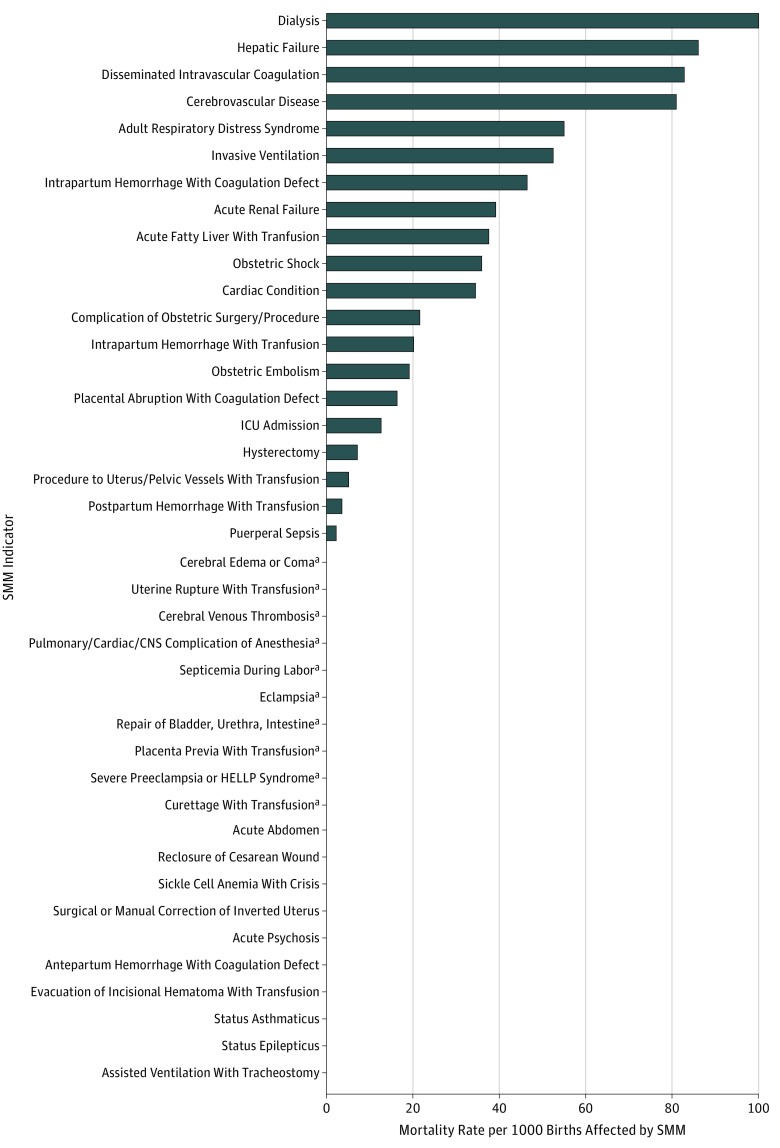
Results: Of the 1 953 943 total births among 1 211 396 women, 181 maternal deaths occurred within 42 days after birth, a rate of 9.3 per 100 000 births. Of the 181 women who died, 123 (68.0%) had at least 1 SMM indicator compared with 1.7% (33 152) of women who survived. Standardized differences suggested that women who died, compared with the women who lived, were older (mean [SD] age, 31.0 [6.2] years vs 30.1 [5.5] years; standardized difference, 0.15) and more likely to reside in a lower-income area (99 [54.7%] vs 832 231 [42.6%]; standardized difference, 0.24), be nulliparous (93 [51.4%] vs 880 386 [45.1%]; standardized difference, 0.13), and be of Afro-Caribbean origin (12 [6.6%] vs 64 948 [3.3%]; standardized difference, 0.15). The most frequent SMM indicators were intensive care unit admission (81 [44.8%]), invasive ventilation (77 [42.5%]), cardiac conditions (69 [38.1%]), complications of obstetric surgery or procedures (32 [17.7%]), and postpartum hemorrhage with blood transfusion (31 [17.1%]). The rate of maternal mortality increased exponentially with the number of SMM indicators: 0 indicators (3.0 per 100 000 births), 1 (71.7 per 100 000 births), 2 (385.9 per 100 000 births), 3 (1274.2 per 100 000 births), 4 (2236.8 per 100 000 births), 5 (4285.7 per 100 000 births), and 6 or more (9422.5 per 100 000 births). Adjusted relative risks for maternal death ranged from 20.1 (95% CI, 11.6-34.7) with 1 SMM indicator to 2192.0 (95% CI, 1287.0-3735.0) with 6 or more SMM indicators compared with 0 indicators.
Conclusions and relevance: Maternal death may be associated with the number of SMM indicators and occur in certain identifiable groups of women; targeting preventable SMM indicators or limiting their progression may reduce the number of maternal deaths.
Conflict of interest statement
Figures
References
-
- Lisonkova S, Liu S, Bartholomew S, Liston RM, Joseph KS; Maternal Health Study Group of the Canadian Perinatal Surveillance System . Temporal trends in maternal mortality in Canada II: estimates based on hospitalization data. J Obstet Gynaecol Can. 2011;33(10):1020-1030. doi: 10.1016/S1701-2163(16)35051-4 - DOI - PubMed
Publication types
MeSH terms
Grants and funding
LinkOut - more resources
Full Text Sources
Medical
Miscellaneous