


Association Between Obesity and Cardiovascular Outcomes: A Systematic Review and Meta-analysis of Mendelian Randomization Studies
- PMID: 30646365
- PMCID: PMC6324374
- DOI: 10.1001/jamanetworkopen.2018.3788
Association Between Obesity and Cardiovascular Outcomes: A Systematic Review and Meta-analysis of Mendelian Randomization Studies
Abstract
Importance: Although dyslipidemia has been consistently shown to be associated with atherogenesis, an association between obesity and cardiovascular disease outcomes remains controversial. Mendelian randomization can minimize confounding if variables are randomly and equally distributed in the population of interest.
Objective: To assess evidence from mendelian randomization studies to provide a less biased estimate of any association between obesity and cardiovascular outcomes.
Data sources: Systematic searches of MEDLINE and Scopus from database inception until January 2018, supplemented with manual searches of the included reference lists.
Study selection: Studies that used mendelian randomization methods to assess the association between any measure of obesity and the incidence of cardiovascular events and those that reported odds ratios (ORs) with 95% CIs estimated using an instrumental variable method were included. The 5 studies included in the final analysis were based on a consensus among 3 authors.
Data extraction and synthesis: Two investigators independently extracted study characteristics using a standard form and pooled data using a random-effects model. The Meta-analysis of Observational Studies in Epidemiology (MOOSE) reporting guideline was followed.
Main outcomes and measures: Obesity associated with type 2 diabetes, coronary artery disease, or stroke. The hypothesis was formulated prior to data collection.
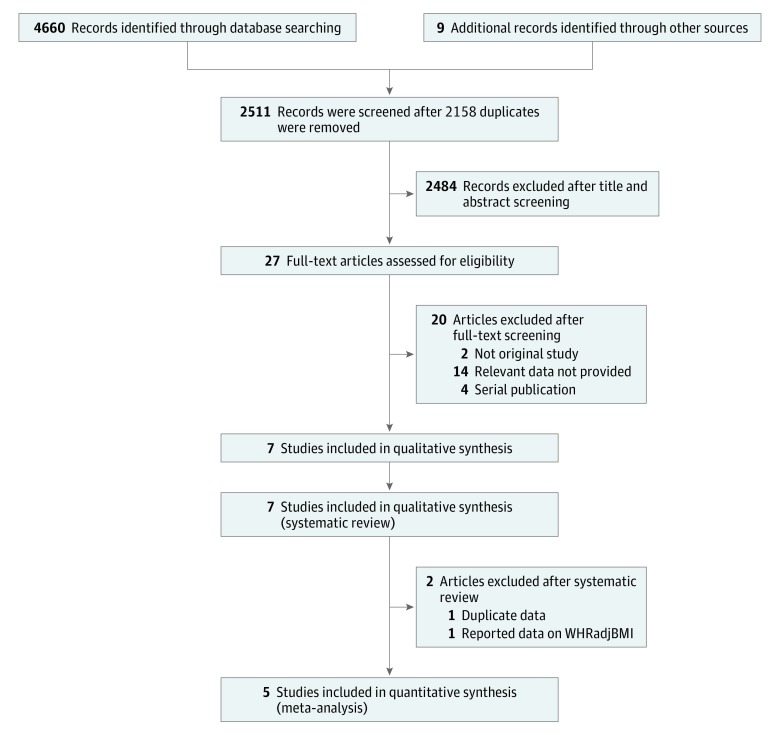
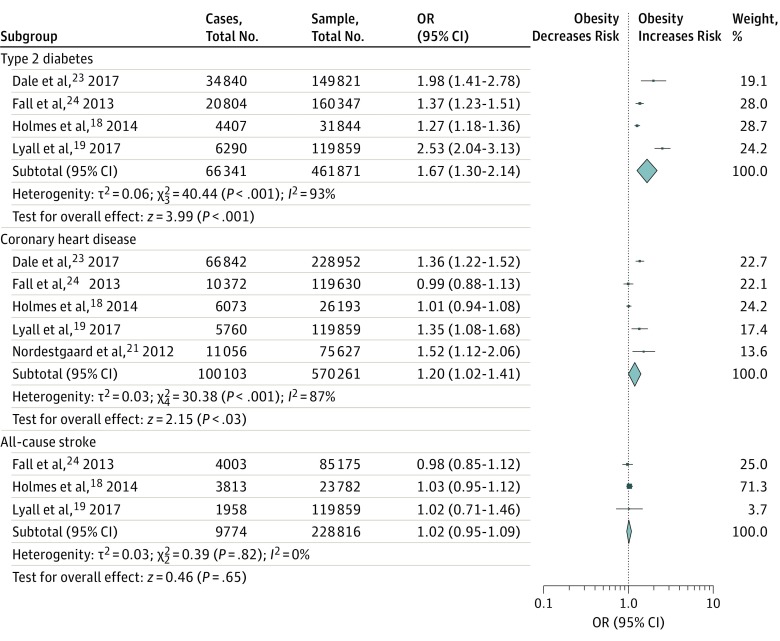
Results: Of 4660 potentially relevant articles, 2511 titles were screened. Seven studies were included in the systematic review, and 5 studies with 881 692 participants were eligible to be included in the meta-analysis. Pooled estimates revealed that obesity was significantly associated with an increased risk of type 2 diabetes (OR, 1.67; 95% CI, 1.30-2.14; P < .001; I2 = 93%) and coronary artery disease (OR, 1.20; 95% CI, 1.02-1.41; P = .03; I2 = 87%). No association between obesity and stroke was found (OR, 1.02; 95% CI, 0.95-1.09; P = .65; I2 = 0%).
Conclusions and relevance: The present meta-analysis suggests that obesity is associated with type 2 diabetes and coronary artery disease. Although this analysis of mendelian randomization studies does not prove causality, it is supportive of a causal association. Hence, health care practitioners should continue to emphasize weight reduction to combat coronary artery disease.
Conflict of interest statement
Figures
Comment in
-
Adiposity and Cardiometabolic Outcomes: What Can Meta-analyses of Mendelian Randomization Studies Contribute?JAMA Netw Open. 2018 Nov 2;1(7):e183778. doi: 10.1001/jamanetworkopen.2018.3778. JAMA Netw Open. 2018. PMID: 30646361 No abstract available.
References
-
- Benjamin EJ, Blaha MJ, Chiuve SE, et al. ; American Heart Association Statistics Committee and Stroke Statistics Subcommittee . Heart disease and stroke statistics-2017 update: a report from the American Heart Association. Circulation. 2017;135(10):e146-. doi: 10.1161/CIR.0000000000000485 - DOI - PMC - PubMed
-
- Centers for Disease Control and Prevention Heart disease facts. https://www.cdc.gov/heartdisease/facts.htm. Accessed March 1, 2018.
-
- Baigent C, Blackwell L, Emberson J, et al. ; Cholesterol Treatment Trialists’ (CTT) Collaboration . Efficacy and safety of more intensive lowering of LDL cholesterol: a meta-analysis of data from 170,000 participants in 26 randomised trials. Lancet. 2010;376(9753):1670-1681. doi: 10.1016/S0140-6736(10)61350-5 - DOI - PMC - PubMed
-
- Baigent C, Keech A, Kearney PM, et al. ; Cholesterol Treatment Trialists’ (CTT) Collaborators . Efficacy and safety of cholesterol-lowering treatment: prospective meta-analysis of data from 90,056 participants in 14 randomised trials of statins. Lancet. 2005;366(9493):1267-1278. doi: 10.1016/S0140-6736(05)67394-1 - DOI - PubMed
Publication types
MeSH terms
Grants and funding
LinkOut - more resources
Full Text Sources
Medical
