


Acute Effects of Smoked and Vaporized Cannabis in Healthy Adults Who Infrequently Use Cannabis: A Crossover Trial
- PMID: 30646391
- PMCID: PMC6324384
- DOI: 10.1001/jamanetworkopen.2018.4841
Acute Effects of Smoked and Vaporized Cannabis in Healthy Adults Who Infrequently Use Cannabis: A Crossover Trial
Erratum in
-
Error in Table Title.JAMA Netw Open. 2018 Dec 7;1(8):e187241. doi: 10.1001/jamanetworkopen.2018.7241. JAMA Netw Open. 2018. PMID: 30646302 Free PMC article. No abstract available.
Abstract
Importance: Vaporization is an increasingly popular method for cannabis administration, and policy changes have increased adult access to cannabis drastically. Controlled examinations of cannabis vaporization among adults with infrequent current cannabis use patterns (>30 days since last use) are needed.
Objective: To evaluate the acute dose effects of smoked and vaporized cannabis using controlled administration methods.
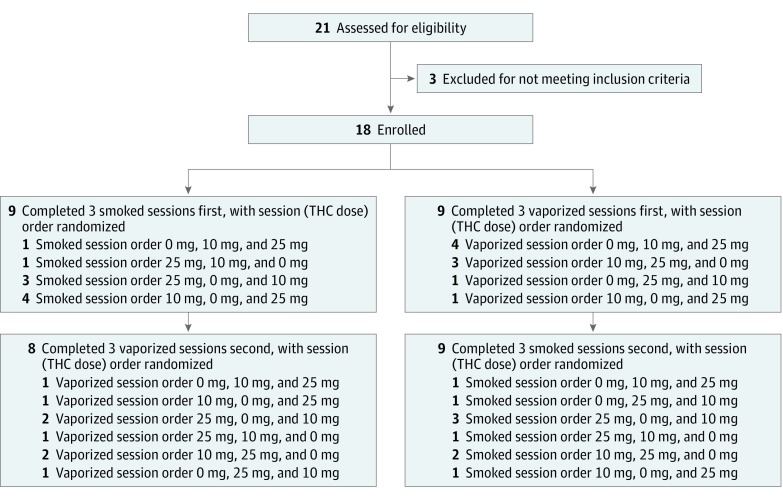
Design, setting, and participants: This within-participant, double-blind, crossover study was conducted from June 2016 to January 2017 at the Behavioral Pharmacology Research Unit, Johns Hopkins University School of Medicine, and included 17 healthy adults. Six smoked and vaporized outpatient experimental sessions (1-week washout between sessions) were completed in clusters (order counterbalanced across participants); dose order was randomized within each cluster.
Interventions: Cannabis containing Δ9-tetrahydrocannabinol (THC) doses of 0 mg, 10 mg, and 25 mg was vaporized and smoked by each participant.
Main outcomes and measures: Change from baseline scores for subjective drug effects, cognitive and psychomotor performance, vital signs, and blood THC concentration.
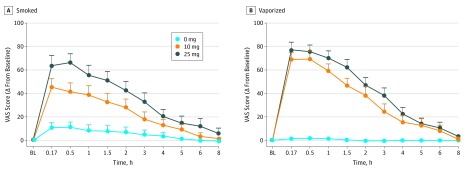
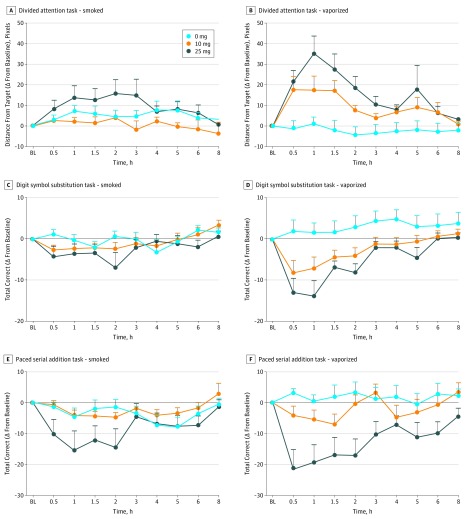
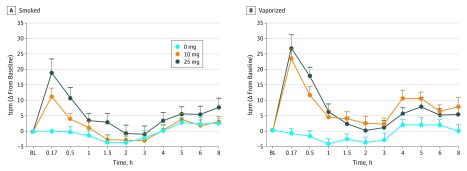
Results: The sample included 17 healthy adults (mean [SD] age, 27.3 [5.7] years; 9 men and 8 women) with no cannabis use in the prior month (mean [SD] days since last cannabis use, 398 [437] days). Inhalation of cannabis containing 10 mg of THC produced discriminative drug effects (mean [SD] ratings on a 100-point visual analog scale, smoked: 46 [26]; vaporized: 69 [26]) and modest impairment of cognitive functioning. The 25-mg dose produced significant drug effects (mean [SD] ratings, smoked: 66 [29]; vaporized: 78 [24]), increased incidence of adverse effects, and pronounced impairment of cognitive and psychomotor ability (eg, significant decreased task performance compared with placebo in vaporized conditions). Vaporized cannabis resulted in qualitatively stronger drug effects for most pharmacodynamic outcomes and higher peak concentrations of THC in blood, compared with equal doses of smoked cannabis (25-mg dose: smoked, 10.2 ng/mL; vaporized, 14.4 ng/mL). Blood THC concentrations and heart rate peaked within 30 minutes after cannabis administration and returned to baseline within 3 to 4 hours. Several subjective drug effects and observed cognitive and psychomotor impairments persisted for up to 6 hours on average.
Conclusions and relevance: Vaporized and smoked cannabis produced dose-orderly drug effects, which were stronger when vaporized. These data can inform regulatory and clinical decisions surrounding the use of cannabis among adults with little or no prior cannabis exposure.
Trial registration: ClinicalTrials.gov Identifier: NCT03676166.
Conflict of interest statement
Figures
Comment in
-
Peering Through the Haze of Smoked vs Vaporized Cannabis-To Vape or Not to Vape?JAMA Netw Open. 2018 Nov 2;1(7):e184838. doi: 10.1001/jamanetworkopen.2018.4838. JAMA Netw Open. 2018. PMID: 30646385 No abstract available.
-
Reappraising prazosin for night-time symptoms in post-traumatic stress disorder.Aust N Z J Psychiatry. 2020 Aug;54(8):848-849. doi: 10.1177/0004867420910216. Epub 2020 Mar 1. Aust N Z J Psychiatry. 2020. PMID: 32114767 No abstract available.
References
-
- Cyrenne P, Shanahan M. Toward a regulatory framework for the legalization of cannabis: how do we get to there from here? Can Public Policy. 2018;44(1):-. doi:10.3138/cpp.2017-026 - DOI
Publication types
MeSH terms
Substances
Associated data
LinkOut - more resources
Full Text Sources
Medical
