Review
. 2019 Jan 14;10(1):43.
doi: 10.3390/genes10010043.

Genomic Enhancers in Brain Health and Disease

Affiliations
Review

Genomic Enhancers in Brain Health and Disease

Nancy V N Carullo et al. Genes (Basel). .

Abstract

Enhancers are non-coding DNA elements that function in cis to regulate transcription from nearby genes. Through direct interactions with gene promoters, enhancers give rise to spatially and temporally precise gene expression profiles in distinct cell or tissue types. In the brain, the accurate regulation of these intricate expression programs across different neuronal classes gives rise to an incredible cellular and functional diversity. Newly developed technologies have recently allowed more accurate enhancer mapping and more sophisticated enhancer manipulation, producing rapid progress in our understanding of enhancer biology. Furthermore, identification of disease-linked genetic variation in enhancer regions has highlighted the potential influence of enhancers in brain health and disease. This review outlines the key role of enhancers as transcriptional regulators, reviews the current understanding of enhancer regulation in neuronal development, function and dysfunction and provides our thoughts on how enhancers can be targeted for technological and therapeutic goals.

Keywords: eRNA; enhancer; epigenetic; gene regulation; neuron; transcription.


Conflict of interest statement

The authors declare no conflict of interest.

Figures
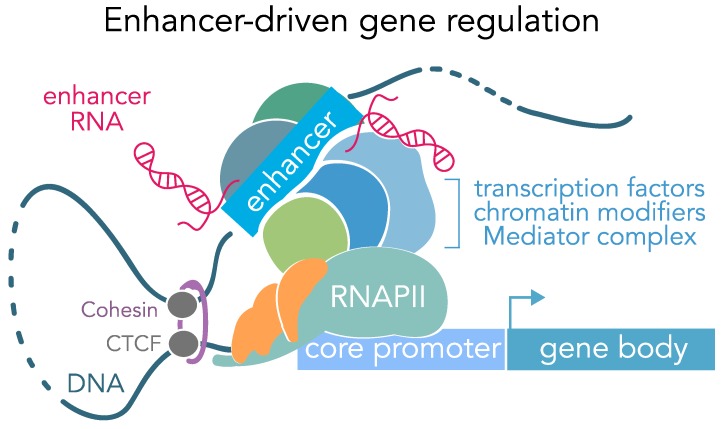
Figure 1
Figure 1
Regulation of gene expression patterns by genomic enhancers. Illustration of enhancer-promoter chromosomal looping (mediated by CTCF and cohesin) that allows distal enhancer elements to physically interact with and activate gene promoters. These interactions increase binding of transcription factors, chromatin modifiers, and the Mediator complex at gene promoters to recruit RNA polymerase II (RNAPII). Enhancers are characterized by elevated DNA sequence conservation, open chromatin, transcription factor binding motifs, characteristic histone modifications, DNA hypomethylation, and bidirectional transcription to generate enhancer RNAs (eRNAs).
Figure 2
Figure 2
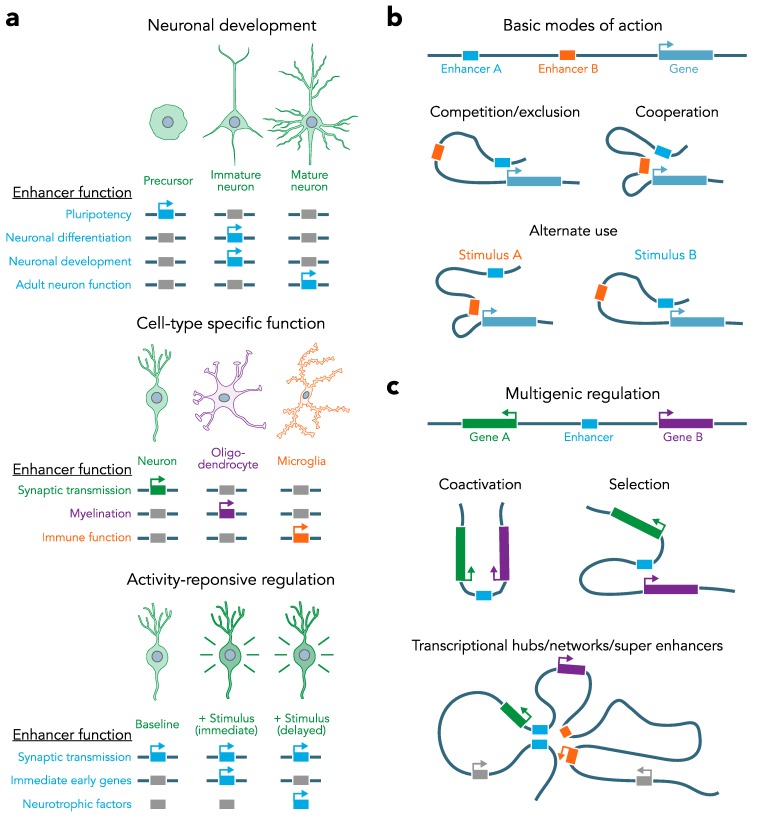
Developmental, cell-type specific, and stimulus dependent enhancer activity and looping functions. a, Distinct enhancers become active at specific developmental stages and in specific cell types (Top). These enhancer activity profiles regulate expression of cell identity genes in a spatiotemporal manner ensuring proper cell fate and function (Middle). A subset of enhancers responds to stimulation. These enhancers typically regulate activity-responsive genes and increase their expression in response to a certain stimulus, with specific temporal windows after stimulus induction (Bottom). b, Basic modes of action for enhancer looping in gene regulation. Genes can be regulated by multiple enhancers that compete with each other, act simultaneously, or alternate depending on the context or stimulus. c, Putative mechanisms driving coordinated regulation of many genes by single enhancers or enhancer-enhancer interactions. An enhancer can act on multiple genes in parallel, serving functions of coactivation or selection. Likewise, super enhancers or transcriptional hubs may co-localize related genes to drive expression of specific gene programs that define key cellular functions or phenotypes.
Figure 3
Figure 3
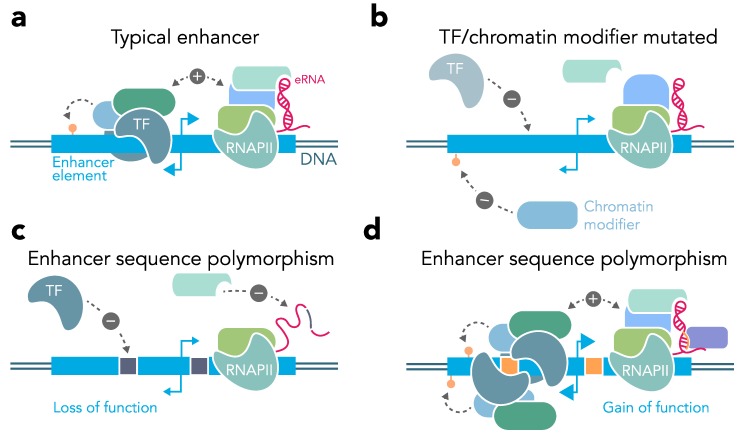
Enhancer dysfunction in genetic brain diseases and disorders. a, Illustration of enhancer-mediated interactions including transcription factor (TF) binding to motifs in enhancer DNA sequence, recruitment of chromatin modifying enzymes and RNA polymerase (RNAPII), as well as transcription of eRNAs. These interactions increase binding of transcription factors and epigenetic modifiers at gene promoters to regulate linked genes in cis. b, Mutations in chromatin modifiers and TFs commonly found at enhancers often lead to neurodevelopmental and intellectual disability. This could occur via loss of DNA binding, loss of catalytic activity, or loss of protein-ribonucleotide or protein-protein interactions that mediate enhancer function. c-d, Sequence polymorphisms located in enhancers could confer either loss of function (e.g., if polymorphism includes TF motif or results in change to eRNA sequence that abolishes protein-ribonucleotide interactions), or potentially gain of function (e.g., via recruitment of new TFs or novel eRNA-protein interactions).

References

    1. Grosschedl R., Birnstiel M.L. Spacer DNA sequences upstream of the T-A-T-A-A-A-T-A sequence are essential for promotion of H2A histone gene transcription in vivo. Proc. Natl. Acad. Sci. USA. 1980;77:7102–7106. doi: 10.1073/pnas.77.12.7102. - DOI - PMC - PubMed
    1. Moreau P., Hen R., Wasylyk B., Everett R., Gaub M.P., Chambon P. The SV40 72 base repair repeat has a striking effect on gene expression both in SV40 and other chimeric recombinants. Nucleic Acids Res. 1981;9:6047–6068. doi: 10.1093/nar/9.22.6047. - DOI - PMC - PubMed
    1. Banerji J., Rusconi S., Schaffner W. Expression of a beta-globin gene is enhanced by remote SV40 DNA sequences. Cell. 1981;27:299–308. doi: 10.1016/0092-8674(81)90413-X. - DOI - PubMed
    1. Fromm M., Berg P. Deletion mapping of DNA regions required for SV40 early region promoter function in vivo. J. Mol. Appl. Genet. 1982;1:457–481. - PubMed
    1. Benoist C., Chambon P. In vivo sequence requirements of the SV40 early promoter region. Nature. 1981;290:304–310. doi: 10.1038/290304a0. - DOI - PubMed

Publication types