


Catheter ablation for atrial fibrillation in heart failure with reduced ejection fraction: a systematic review and meta-analysis of randomized controlled trials
- PMID: 30646857
- PMCID: PMC6332840
- DOI: 10.1186/s12872-019-0998-2
Catheter ablation for atrial fibrillation in heart failure with reduced ejection fraction: a systematic review and meta-analysis of randomized controlled trials
Abstract
Background: Previous randomized controlled trials (RCT)s showed similar outcomes in patients with atrial fibrillation (AF) and heart failure with reduced ejection fraction (HFrEF) treated with anti-arrhythmic drugs (AAD) compared to rate control therapy. We sought to evaluate whether catheter ablation is superior to medical therapy in patients with AF and HFrEF.
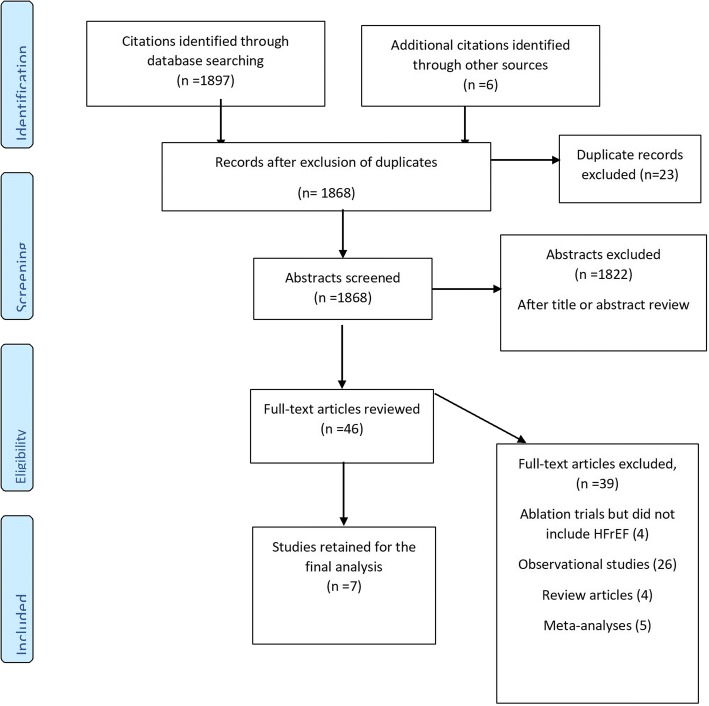
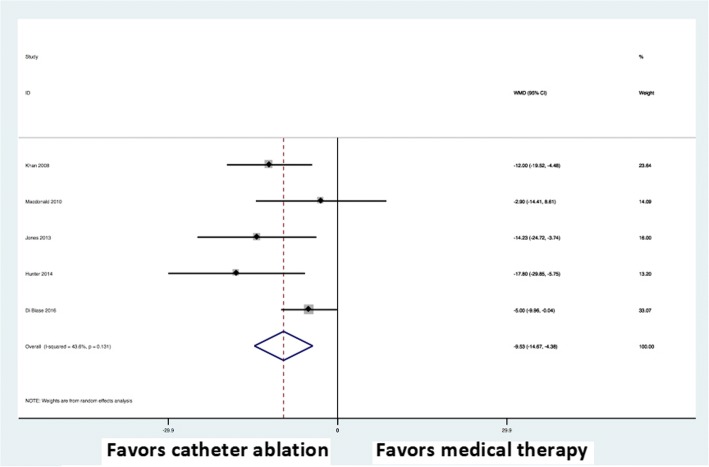
Methods: We searched electronic databases for all RCTs that compared catheter ablation and medical therapy (with or without use of AAD). We used random-effects models to summarize the studies. The primary end-point was all-cause mortality. Secondary outcomes included heart failure-related hospitalizations and change in left ventricular ejection fraction (LVEF).
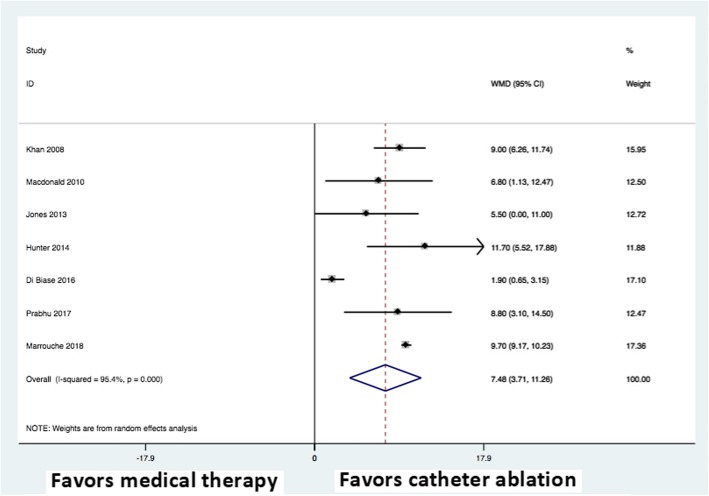
Results: We retrieved and summarized 7 randomized controlled trials, enrolling 856 patients (429 in the catheter ablation arm and 427 in the medical therapy arm). Compared with medical therapy (including use of AAD), AF catheter ablation was associated with a significant reduction in mortality (risk ratio 0.50; 95% confidence interval [CI]: 0.34 to 0.74; P = 0.0005) and heart failure-related hospitalizations (risk ratio 0.56; 95% CI: 0.44 to 0.71; P < 0.0001). Furthermore, catheter ablation led to significant improvements in LVEF (weighted mean difference, 7.48; 95% CI: 3.71 to 11.26; P < 0.0001).
Conclusions: Compared to medical therapy, including use of AAD, catheter ablation for AF was associated with a significant reduction in mortality and heart failure-related hospitalizations as well as an improvement in LVEF in patients with HFrEF. Larger trials are needed to confirm whether rhythm control with ablation is superior to rate control in patients with AF and heart failure.
Keywords: Atrial fibrillation; Catheter ablation; Heart failure.
Conflict of interest statement
Ethics approval and consent to participate
This study used data from previously published studies that individually obtained ethics approval.
Consent for publication
Not applicable
Competing interests
Dr. Essebag has received honoraria from Abbott, biosense medical, boston scientific and Medtronic.
Publisher’s Note
Springer Nature remains neutral with regard to jurisdictional claims in published maps and institutional affiliations.
Figures



References
-
- Anter E, Jessup M, Callans DJ. Atrial fibrillation and heart failure. 2009. pp. 2516–2525. - PubMed
-
- Malhi N, Hawkins NM, Andrade JG, Krahn AD, Deyell MW. Catheter ablation of atrial fibrillation in heart failure with reduced ejection fraction. J Cardiovasc Electrophysiol. 2018;29(7):1049–1058. - PubMed
-
- Verma A, Kalman JM, Callans DJ. Treatment of patients with atrial fibrillation and heart failure with reduced ejection fraction. Circulation. 2017;135(16):1547–1563. - PubMed
-
- Byrne M, Kaye DM, Power J. The synergism between atrial fibrillation and heart failure. J Card Fail. 2008;14(4):320–326. - PubMed
-
- Wasmund SL, Li JM, Page RL, Joglar JA, Kowal RC, Smith ML, et al. Effect of atrial fibrillation and an irregular ventricular response on sympathetic nerve activity in human subjects. Circulation. 2003;107(15):2011–2015. - PubMed
Publication types
MeSH terms
Substances
LinkOut - more resources
Full Text Sources
Medical
