. 2019 May;44(6):1152-1162.
doi: 10.1038/s41386-019-0313-z. Epub 2019 Jan 8.

Lactate is an antidepressant that mediates resilience to stress by modulating the hippocampal levels and activity of histone deacetylases

Affiliations

Lactate is an antidepressant that mediates resilience to stress by modulating the hippocampal levels and activity of histone deacetylases

Nabil Karnib et al. Neuropsychopharmacology. 2019 May.

Abstract

Chronic stress promotes depression in some individuals, but has no effect in others. Susceptible individuals exhibit social avoidance and anxious behavior and ultimately develop depression, whereas resilient individuals live normally. Exercise counteracts the effects of stress. Our objective was to examine whether lactate, a metabolite produced during exercise and known to reproduce specific brain exercise-related changes, promotes resilience to stress and acts as an antidepressant. To determine whether lactate promotes resilience to stress, male C57BL/6 mice experienced daily defeat by a CD-1 aggressor, for 10 days. On the 11th day, mice were subjected to behavioral tests. Mice received lactate before each defeat session. When compared with control mice, mice exposed to stress displayed increased susceptibility, social avoidance and anxiety. Lactate promoted resilience to stress and rescued social avoidance and anxiety by restoring hippocampal class I histone deacetylase (HDAC) levels and activity, specifically HDAC2/3. To determine whether lactate is an antidepressant, mice only received lactate from days 12-25 and a second set of behavioral tests was conducted on day 26. In this paradigm, we examined whether lactate functions by regulating HDACs using co-treatment with CI-994, a brain-permeable class I HDAC inhibitor. When administered after the establishment of depression, lactate behaved as antidepressant. In this paradigm, lactate regulated HDAC5 and not HDAC2/3 levels. On the contrary, HDAC2/3 inhibition was antidepressant-like. This indicates that lactate mimics exercise's effects and rescues susceptibility to stress by modulating HDAC2/3 activity and suggests that HDAC2/3 play opposite roles before and after establishment of susceptibility to stress.


Figures
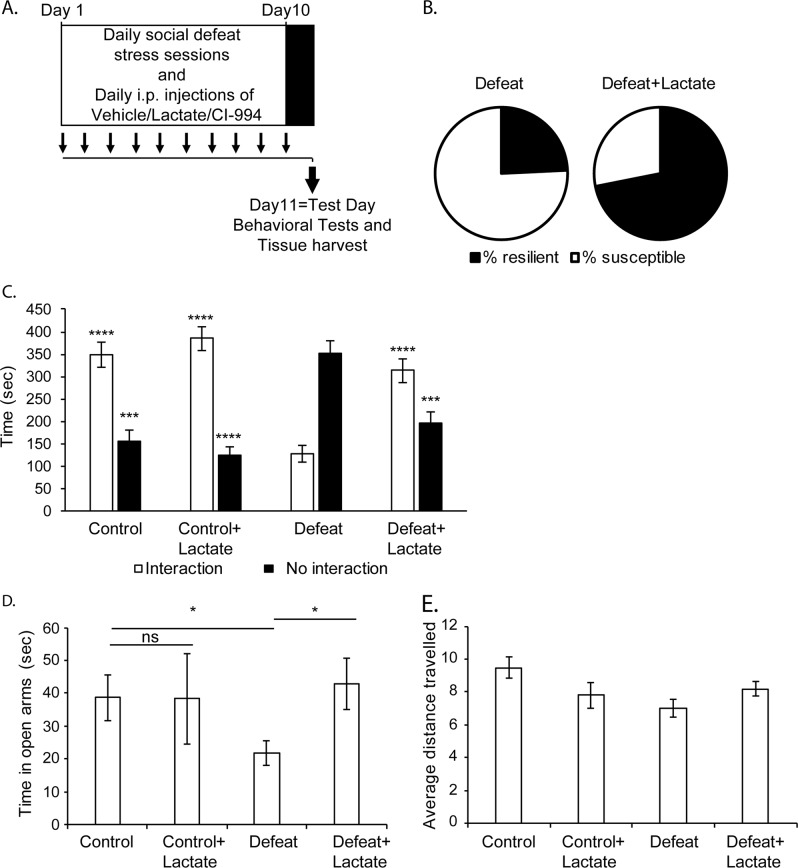
Fig. 1
Fig. 1
Lactate mediates resilience to chronic social defeat stress and rescues social avoidance behavior and anxiety. a The chronic social defeat paradigm consists of 10 days of daily defeat sessions that involve direct physical contact with an aggressor mouse for 7 min. On the 11th day, behavioral tests and tissue collection are conducted. Mice receive daily intra-peritoneal injections of either vehicle, lactate or the class I HDAC inhibitor, CI-994, 4 h before each defeat session. b Lactate increases resilience to stress. In the group of mice (n = 33) receiving saline and subjected to CSDS 24.2% are resilient to stress, whereas 75.8% are susceptible to stress. In the group of mice (n = 32) receiving lactate (180 mg/kg, daily for 10 days) and subjected to CSDS, 71.9% are resilient to stress, whereas 28.1% are susceptible to stress. c Intra-peritoneal injections of lactate (180 mg/kg, daily for ten days) reverse the chronic social defeat phenotype as shown by the increase in the time spent in interaction zone of the social interaction test. Statistical significance was measured by two-way Anova followed by multiple comparison test. Significance was measured vs. the defeat groups (Interaction: treatment F1,85 = 31.17, p < 0.0001 and stress F1,85 = 17.77, p < 0.0001; No interaction: treatment F1,85 = 19.61, p < 0.0001 and stress F1,85 = 9.008, p = 0.0035). ****p < 0.0001. The n numbers for the control, control + lactate, defeat (susceptible), and defeat + lactate are 15, 16, 25, and 32 respectively. d Intra-peritoneal injections of lactate decrease anxiety as measured by the significant increase in the time spent in the open arms of the elevated plus maze (EPM). Statistical significance was measured by unpaired t-test. Significance was measured vs. the defeat groups *p < 0.05. The n numbers for the control, control + lactate, defeat (susceptible), and defeat + lactate are 15, 16, 25, and 32, respectively. e The locomotor activity of all mice groups was not affected by lactate or defeat as measured by the distance traveled in the open field. Statistical significance was measured by one-way Anova followed by the Tukey’s multiple comparison test (F3,54 = 1.162, p = 0.3328)
Fig. 2
Fig. 2
The resilient phenotype is associated with increased hippocampal HDAC2 and HDAC3 protein levels as compared to the susceptible phenotype. a Real time RTPCR results showing that only Hdac3 mRNA expression is significantly decreased in the hippocampi of defeat animals as compared to control; whereas lactate restores normal Hdac3 mRNA expression. Statistical significance was measured by one-way Anova followed by the Dunnett’s multiple comparison test (F2,7 = 7.266, p < 0.05); defeat vs. control *p = 0.0270 and defeat vs. defeat + lactate *p = 0.0188. The n numbers for control, defeat, and defeat + lactate are 3, 3, and 4, respectively. No significant changes in Hdac1, Hdac2, Hdac5, or Hdac8 mRNA levels are observed. The n numbers for control, defeat and, defeat + lactate are 4, 4, and 4, respectively, for Hdac1, Hdac2, and Hdac8. The n numbers for control, defeat, and defeat + lactate are 8, 9, and 7, respectively, for Hdac5. b Representative western blot images depicting hippocampal HDAC2 and HDAC3 levels in susceptible vs. resilient mice. c Quantification of the HDAC2 western blots. Statistical significance was measured by unpaired t-test *p < 0.05. The n number of hippocampi analyzed is 9 for the susceptible and 10 for the resilient groups. d Quantification of the HDAC3 western blots. Statistical significance was measured by unpaired t-test *p < 0.05. The n number of hippocampi analyzed is 8 for the susceptible and 10 for the resilient groups. e Representative western blot images depicting hippocampal HDAC1, HDAC5, and HDAC8 levels in susceptible vs. resilient mice. f Quantification of the HDAC1, HDAC5, and HDAC8 western blots. Statistical significance was measured by one-way Anova followed by the Dunnett’s multiple comparison test (HDAC1: F2,5 = 8.63766, p = 0.0239; susceptible vs. control p = 0.1251 and susceptible vs. resilient p = 0.1457; HDAC5: F2,6 = 5.065, p = 0.0515; susceptible vs. control p = 0.2845 and susceptible vs. resilient p = 0.2480; HDAC8: F2,6 = 0.9725 p = 0.4307; susceptible vs. control p = 0.9822 and susceptible vs. resilient p = 0.3920). The n number of hippocampi analyzed is 8 for the susceptible and 10 for the resilient groups. g Real time RTPCR results show that the expression of the histone methyltransferase G9a, the NMDA receptor subunit Grin2a and the immediate early gene Arc mRNA is significantly decreased in the hippocampi of resilient mice as compared to susceptible mice. G9a was previously shown to be involved in cocaine-induced vulnerability to stress in the nucleus accumbens [44]. Grin2 was found to be involved in mood related disorders [45, 46]. Statistical significance was measured by t-test (G9a: p = 0.05, Grin2a: p = 0.047 and Arc: p = 0.038). The n number of hippocampi analyzed is 3
Fig. 3
Fig. 3
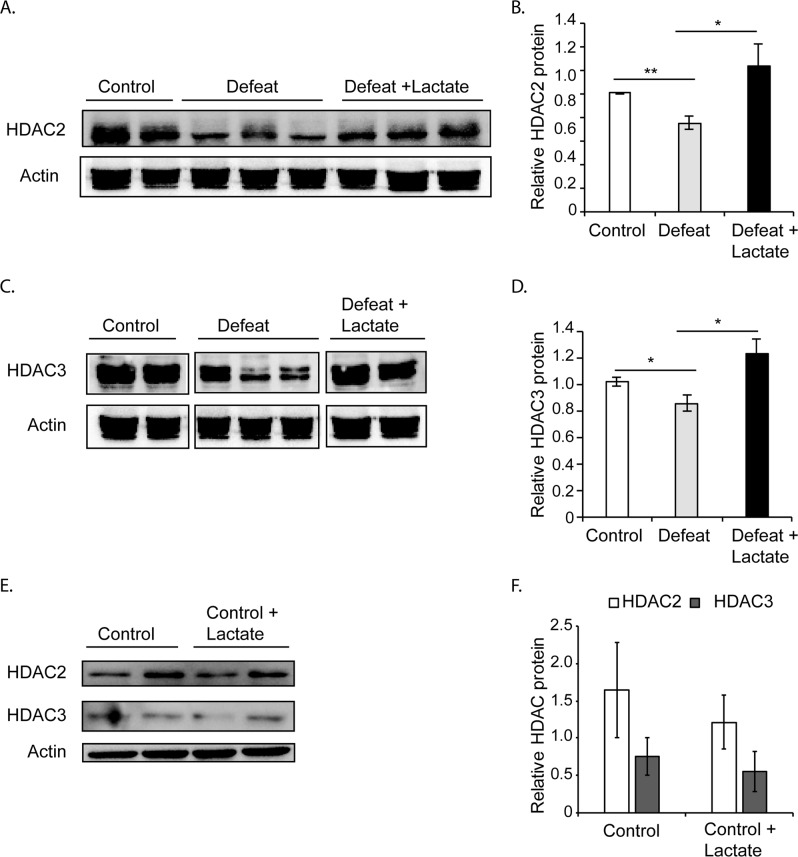
Lactate restores hippocampal protein levels of HDAC2 and HDAC3 in mice exposed to CSDS. a Representative western blot images depicting hippocampal HDAC2 levels in control, defeat, and defeat + lactate mice. Mice exposed to CSDS have lower levels of hippocampal HDAC2 vs. control. Daily intra-peritoneal injections (180 mg/kg, daily for 10 days) of lactate restored HDAC2 protein levels. b Quantification of the HDAC2 western blots. Statistical significance was measured by 1way Anova followed by Tukey’s multiple comparison test (F2,11 = 4.316, p = 0.0413). Significance was measured vs. defeat **p < 0.01 and *p < 0.05. The n number of hippocampi analyzed is 4 for control, 5 for defeat, and 5 for the defeat + lactate groups, respectively. c Representative western blot images depicting hippocampal HDAC3 levels in control, defeat, and defeat + lactate mice. Mice exposed to CSDS have lower levels of hippocampal HDAC3 vs. control. Daily intra-peritoneal injections (180 mg/kg, daily for 10 days) of lactate-restored HDAC3 protein levels. d Quantification of the HDAC3 western blots. Statistical significance was measured by one-way Anova followed by Tukey’s multiple comparison test (F2,12 = 5.342, p = 0.0219). Significance was measured vs. defeat *p < 0.05. The n number of hippocampi analyzed is 5 for control, 5 for defeat, and 5 for the defeat + lactate groups, respectively. e Representative western blot images depicting hippocampal HDAC2 and HDAC3 levels in control and control + lactate mice. f Quantification of the HDAC2/HDAC3 western blots
Fig. 4
Fig. 4
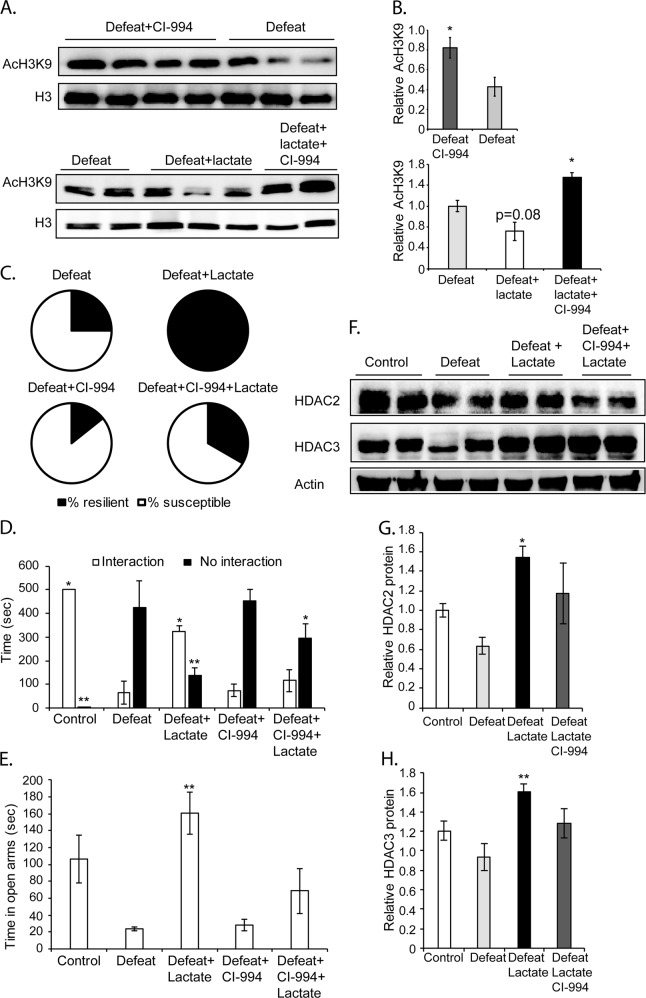
Lactate promotes resilience and rescues social behavior in mice exposed to CSDS by restoring HDAC2 and HDAC3 protein levels and deacetylase activity. a The brain-permeable class I HDACi, CI-994, induces acetylation of histone H3 lysine (K)9 levels. Lactate treatment decreases acetyl histone H3K9 levels in defeat mice as compared to defeat, whereas the combined treatment of lactate + CI-994 significantly increases acetyl histone H3K9 level. Representative western blot images depicting hippocampal acetyl histone H3K9 levels in defeat and defeat + CI-994 mice as well as in defeat, defeat + lactate, and defeat + lactate + CI-994 mice. b Quantification of the acetyl histone H3K9 western blots. Statistical significance was measured by the unpaired t-test. Significance was measured vs. defeat *p < 0.05. The n of hippocampi analyzed are 3 for defeat, 3 for defeat + lactate, 3 for defeat + lactate + CI-994, and 4 for the defeat + CI-994 groups, respectively. c The lactate-mediated increases in resilience to stress are dependent on class I HDAC activity. In the group of mice (n = 4) receiving saline and subjected to chronic social defeat stress, 25% are resilient to stress, whereas 75 % are susceptible to stress. In the group of mice (n = 5) receiving lactate (180 mg/kg, daily for ten days) and subjected to CSDS, 100% are resilient to stress. In the group of mice (n = 7) receiving CI-994 (30 mg/kg, daily for 10 days) and subjected to CSDS, 14.3% are resilient to stress, whereas 85.7 % are susceptible to stress. In the group of mice (n = 6) receiving the combined lactate (180 mg/kg, daily for ten days) and CI-994 (30 mg/kg, daily for 10 days) treatment and subjected to CSDS, 33.3% are resilient to stress, whereas 66.7 % are susceptible to stress. Even though the n number for control, defeat, defeat + lactate is relatively low, these experiment follow the same paradigm as Fig. 1c and show identical results. We opted not to compile these experiments together and include only the animals that were subjected to chronic social defeat stress at the same time as the CI-994 or combined treatments. The results with the CI-994 and the combined treatment were conclusive even with the n = 7 and 6, respectively, and did not warrant further increases in the number of animals. d Intra-peritoneal injections of the combined lactate and CI-994 treatment fail to reverse the chronic social defeat phenotype. This is shown by non-significant change in the time spent in interaction zone of the social interaction test by this group (defeat + lactate + CI-994) as compared to defeat mice. CI-994 on its own was also unable to rescue social avoidance, whereas, as expected, lactate reversed it. Statistical significance was measured by one-way Anova followed by Dunnet’s multiple comparison test (interaction: F4,17 = 4.935, p = 0.008; no interaction: F4,17 = 8.625, p = 0.0005). Significance was measured vs. the defeat groups. *p < 0.05, **p < 0.01. The n numbers for the control, defeat, defeat + lactate, defeat + CI-994, and defeat + lactate + CI-994 are 3, 3, 5, 7, and 7, respectively. e Intra-peritoneal injections of the combined lactate and CI-994 treatment fails to rescue anxious behavior as measured in the EPM. This is shown by non-significant change in the time spent in the open arms of the EPM by this group (defeat + lactate + CI-994) as compared to defeat mice (p = 0.4624). CI-994 on its own was also unable to rescue anxiety, whereas as expected lactate reversed it. Statistical significance was measured by one-way Anova followed by Dunnet’s multiple comparison test (F4,19 = 7.473, p = 0.0009). Significance was measured vs. the defeat groups. **p < 0.01. The n numbers for the control, defeat, and defeat + lactate, defeat + CI-994, and defeat + lactate + CI-994 are 3, 3, 6, 7, and 6, respectively. f Lactate restores hippocampal HDAC2 and HDAC3 protein levels even when administered with CI-994. Representative western blot images depicting hippocampal HDAC2 and HDAC3 levels in control, defeat, defeat + lactate, and defeat + lactate + CI-994 mice. Mice exposed to CSDS have lower levels of hippocampal HDAC2/HDAC3 vs. control. Daily intra-peritoneal injections of lactate or lactate + CI-994 restored hippocampal HDAC2/HDAC3 protein levels. g Quantification of the HDAC2 western blots. Statistical significance was measured by one-way Anova followed by Dunnet’s multiple comparison test (F3,12 = 2.838, p = 0.0828). Significance was measured vs. defeat *p < 0.05. The n of hippocampi analyzed are 4 for each group. h Quantification of the HDAC3 western blots. Statistical significance was measured by one-way Anova followed by Dunnett’s multiple comparison test (F3,12 = 5.256, p = 0.0151). Significance was measured vs. defeat **p < 0.01. The n of hippocampi analyzed are 4 for each group
Fig. 5
Fig. 5
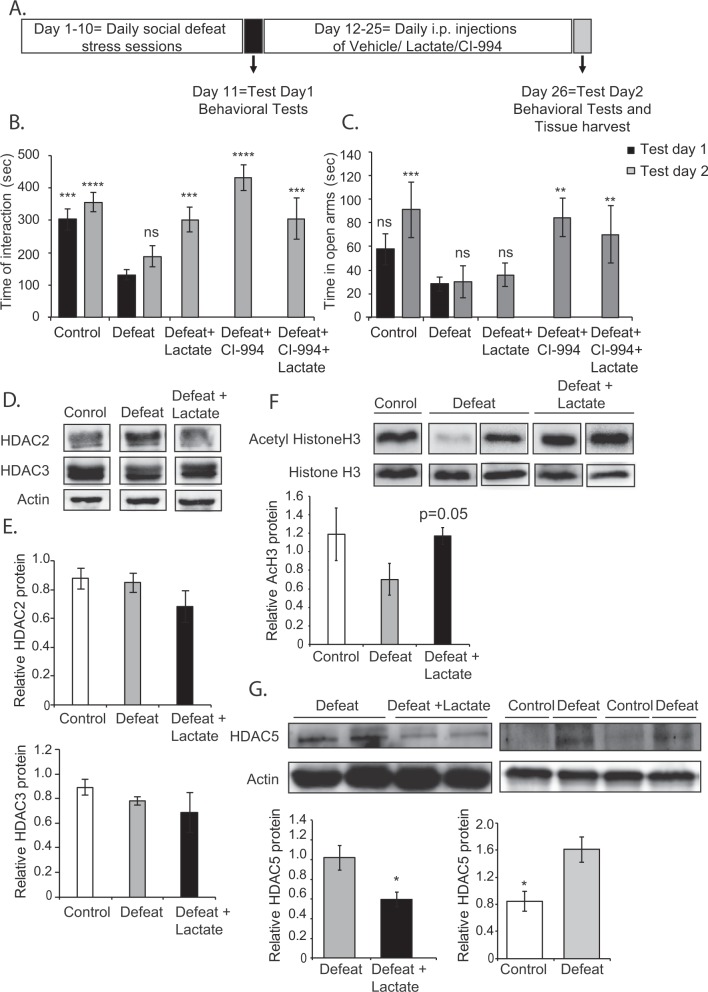
Lactate is an antidepressant that can rescue social avoidance phenotypes after their establishment. As an antidepressant, lactate increases hippocampal acetyl histone H3 and decreases hippocampal HDAC5 protein levels. a Modified chronic social defeat paradigm to assess the therapeutic potential of the compounds. This paradigm comprises of 10 days of daily defeat sessions that involve direct physical contact with an aggressor mouse for 7 min. On day 11, behavioral tests (test day 1) are conducted. During the 10 days of CSDS, mice do not receive any compound. From days 12–25, mice receive daily intra-peritoneal injections of either vehicle, lactate (180 mg/kg), CI-994 (30 mg/kg) or lactate + CI-994. On day 26, behavioral tests (test day 2) are conducted and tissue is collected. b Lactate rescues established defeat/depressed phenotype. Mice continue to exhibit social avoidance phenotype on test day 2 (day 26). No significant change is observed in the time of interaction between defeat groups on test day 1 and 2 (p = 0.8249). Intra-peritoneal injections of lactate (180 mg/kg), CI-994 (30 mg/kg), and lactate + CI-994, daily from days 12–25 reverse the chronic social defeat phenotype as shown by the significant increase on test day 2 in the time spent in interaction zone of the social interaction test as compared to the time spent there by the defeat group (test day 1 and 2). Statistical significance was measured by one-way Anova followed by Dunnett’s multiple comparison test (F6,70 = 13.01, p < 0.0001). Significance was measured vs. the defeat groups. *p < 0.05, **p < 0.01, and ****p < 0.0001. The n numbers for the control (test day 1), control (test day 2), defeat (test day 1), defeat (test day 2), defeat + lactate (test day 2), defeat + CI-994 (test day 2), and defeat + lactate + CI-994 (test day 2) are 8, 8, 30, 6, 8, 8, and 8, respectively. c Lactate fails to rescue the established anxiety phenotype. Mice continue to exhibit anxious behavior on test day 2 (day 26). No significant change is observed in the time spent exploring the open arms of the EPM between defeat groups on test day 1 and 2 (p = 0.9998). Daily intra-peritoneal injections of lactate (180 mg/kg) from days 12–25 failed to rescue anxiety phenotypes; on the other hand, intra-peritoneal injections CI-994 (30 mg/Kg) were anxiolytic as shown by the significant increase on test day 2 in the time spent exploring the open arms of the EPM compared to the time spent there by the defeat group (test day 1 and 2). The combined treatment of lactate and CI-994 also significantly rescued anxiety. Statistical significance was measured by one-way Anova followed by Dunnett’s multiple comparison test (F6,59 = 5.49, p = 0.0001). Significance was measured vs. the defeat groups. *p < 0.05, **p < 0.01, and ****p < 0.0001. The n numbers for the control, defeat, defeat + lactate, defeat + CI-994, and defeat + lactate + CI-994 are 5, 21, 6, 5, and 5, respectively. d Representative western blot images depicting hippocampal HDAC2 and HDAC3 levels in control, defeat, and defeat group receiving lactate from days 12–25. e Quantification of the HDAC2 and HDAC3 western blots. Statistical significance was measured by one-way ANOVA followed by Dunnett’s post-test. The n number of hippocampi analyzed is 4. f Representative western blot image depicting hippocampal acetyl histone H3 levels in control, defeat, and defeat group receiving lactate from days 12–25. Quantification of the acetyl histone H3 western blots. Statistical significance was measured by unpaired t-test. The n number of hippocampi analyzed is 4. g Representative western blot images depicting hippocampal HDAC5 levels in control, defeat, and defeat group receiving lactate from days 12–25. Quantification of the HDAC5 western blots. Statistical significance was measured by unpaired t-test. *p < 0.05. The n number of hippocampi analyzed is 3 for the control, 6 for the defeat group, and 5 for the defeat + lactate group

References

    1. Smith K. Mental health: a world of depression. Nature. 2014;515:181. - PubMed

    1. Block SG, Nemeroff CB. Emerging antidepressants to treat major depressive disorder. Asian J Psychiatr. 2014;12:7–16. doi: 10.1016/j.ajp.2014.09.001. - DOI - PubMed
    1. Nestler EJ, Barrot M, DiLeone RJ, Eisch AJ, Gold SJ, Monteggia LM. Neurobiology of depression. Neuron. 2002;34:13–25. doi: 10.1016/S0896-6273(02)00653-0. - DOI - PubMed
    1. Nestler EJ, Pena CJ, Kundakovic M, Mitchell A, Akbarian S. Epigenetic basis of mental illness. Neuroscientist. 2016;22:447–63. doi: 10.1177/1073858415608147. - DOI - PMC - PubMed
    1. Tsankova N, Renthal W, Kumar A, Nestler EJ. Epigenetic regulation in psychiatric disorders. Nat Rev Neurosci. 2007;8:355–67. doi: 10.1038/nrn2132. - DOI - PubMed

Publication types

MeSH terms