


Cytotoxic and molecular impacts of allelopathic effects of leaf residues of Eucalyptus globulus on soybean (Glycine max)
- PMID: 30647666
- PMCID: PMC6296619
- DOI: 10.1016/j.jgeb.2017.08.005
Cytotoxic and molecular impacts of allelopathic effects of leaf residues of Eucalyptus globulus on soybean (Glycine max)
Abstract
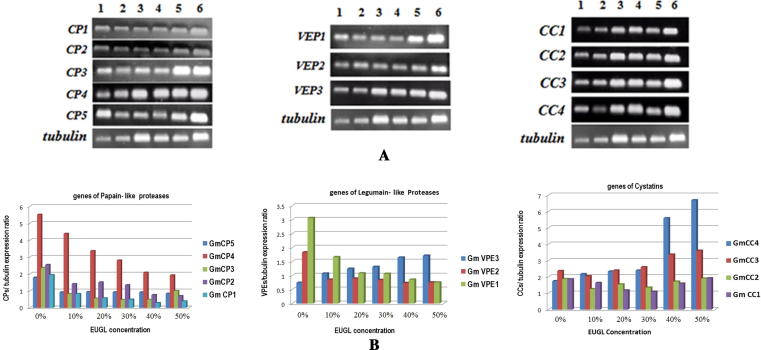
Eucalyptus trees litter plays a crucial role in structuring plant populations and regulating crop quality. To help characterize the allelopathic impact of Eucalyptus plantations and understand the interactions between tree litter and understorey plant populations, we performed two different genomic approaches to determine soybean (Glycine max) crop plant response to biotic stress induced by leaf residues of Eucalyptus globulus trees. For assessing cell death, a qualitative method of DNA fragmentation test (comet assay) was employed to detect cleavage of the genomic DNA into oligonucleosomal fragments and help to characterize the apoptotic event among the experimental samples. In addition, quantitative method of genome analysis at the transcriptional level also was conducted to investigate the expression responses of soybean genome to allelochemicals. Expression of specific genes, which are responsible for the breakdown of proteins during programmed cell death PCD (cysteine proteases and their inhibitors), was examined using semi-quantitative RT-PCR (sqPCR). Results of both conducted analyses proved significant genetic effects of Eucalyptus leaf residues on soybean crop genome, revealed by steady increase in DNA damage as well as variation in the transcript levels of cysteine proteases and inhibitors. Further detailed studies using more sensitive methods are necessary for a comprehensive understanding of the allelopathic effects of Eucalyptus plantations on crops.
Keywords: CC, cystatins; CPE, papain–like cysteine proteases; Comet assay; Cysteine proteases; EUGL, Eucalyptus ground leaves; Eucalyptus globulus; Glycine max; PCD, programmed cell death; VPE, vacuolar processing enzyme (legumain-like cysteine proteases); sqRT-PCR, semiquantitative reverse transcription polymerase chain reaction.
Figures

References
-
- Chou C.H. Roles of allelopathy in plant biodiversity and sustainable agriculture. Crit Rev Plant Sci. 1999;18:609–636.
-
- Hegab M.M., Gabr M.A., Al-Wakeel S.A., Hamed B.A. Allelopathic potential of Eucalyptus rostrata leaf residue on some metabolic activities of Zea mays L. Univ J Plant Sci. 2016;4(2):11–21.
-
- Sasikumar K., Vijayalakshmi C., Parthiban K.T. Allelopathic effects of Eucalyptus on blackgram (Phaseolus mungo L.) Allelopathy J. 2002;9:205–214.
-
- Zhang C., Fu S. Allelopathic effects of leaf litter and live roots exudates of Eucalyptus species on crops. Allelopathy J. 2010;26(1):91–100.
LinkOut - more resources
Full Text Sources
Research Materials
Miscellaneous