


Maternal glucose levels during pregnancy and childhood adiposity in the Hyperglycemia and Adverse Pregnancy Outcome Follow-up Study
- PMID: 30648193
- PMCID: PMC6421132
- DOI: 10.1007/s00125-018-4809-6
Maternal glucose levels during pregnancy and childhood adiposity in the Hyperglycemia and Adverse Pregnancy Outcome Follow-up Study
Abstract
Aims/hypothesis: Maternal type 2 diabetes during pregnancy and gestational diabetes are associated with childhood adiposity; however, associations of lower maternal glucose levels during pregnancy with childhood adiposity, independent of maternal BMI, remain less clear. The objective was to examine associations of maternal glucose levels during pregnancy with childhood adiposity in the Hyperglycemia and Adverse Pregnancy Outcome (HAPO) cohort.
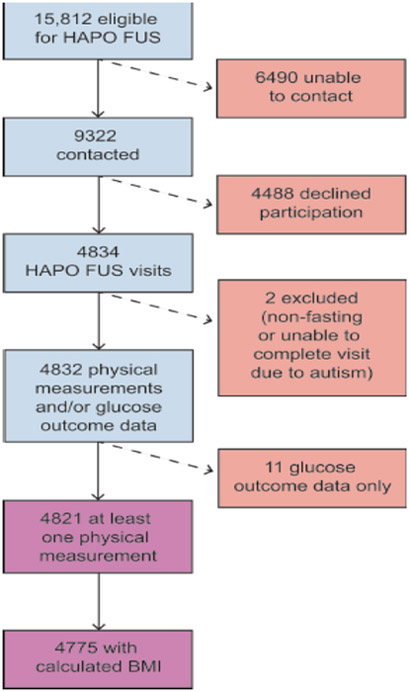
Methods: The HAPO Study was an observational epidemiological international multi-ethnic investigation that established strong associations of glucose levels during pregnancy with multiple adverse perinatal outcomes. The HAPO Follow-up Study (HAPO FUS) included 4832 children from ten HAPO centres whose mothers had a 75 g OGTT at ~28 weeks gestation 10-14 years earlier, with glucose values blinded to participants and clinical caregivers. The primary outcome was child adiposity, including: (1) being overweight/obese according to sex- and age-specific cut-offs based on the International Obesity Task Force (IOTF) criteria; (2) IOTF-defined obesity only; and (3) measurements >85th percentile for sum of skinfolds, waist circumference and per cent body fat. Primary predictors were maternal OGTT and HbA1c values during pregnancy.
Results: Fully adjusted models that included maternal BMI at pregnancy OGTT indicated positive associations between maternal glucose predictors and child adiposity outcomes. For one SD difference in pregnancy glucose and HbA1c measures, ORs for each child adiposity outcome were in the range of 1.05-1.16 for maternal fasting glucose, 1.11-1.19 for 1 h glucose, 1.09-1.21 for 2 h glucose and 1.12-1.21 for HbA1c. Associations were significant, except for associations of maternal fasting glucose with offspring being overweight/obese or having waist circumference >85th percentile. Linearity was confirmed in all adjusted models. Exploratory sex-specific analyses indicated generally consistent associations for boys and girls.
Conclusions/interpretation: Exposure to higher levels of glucose in utero is independently associated with childhood adiposity, including being overweight/obese, obesity, skinfold thickness, per cent body fat and waist circumference. Glucose levels less than those diagnostic of diabetes are associated with greater childhood adiposity; this may have implications for long-term metabolic health.
Keywords: Adiposity; Childhood obesity; Glucose; Pregnancy.
Figures
References
-
- Metzger BE (2007) Long-term outcomes in mothers diagnosed with gestational diabetes mellitus and their offspring. Clin Obstet Gynecol 50: 972–979 - PubMed
-
- Pettitt DJ, Baird HR, Aleck KA, Bennett PH, Knowler WC (1983) Excessive obesity in offspring of Pima Indian women with diabetes during pregnancy. N Engl J Med 308: 242–245 - PubMed
-
- Silverman BL, Rizzo TA, Cho NH, Metzger BE (1998) Long-term effects of the intrauterine environment. The Northwestern University Diabetes in Pregnancy Center. Diabetes Care 21 Suppl 2: B142–149 - PubMed
-
- Metzger BE, Lowe LP, Dyer AR, et al. (2008) Hyperglycemia and adverse pregnancy outcomes. N Engl J Med 358: 1991–2002 - PubMed
-
- (2010) Hyperglycaemia and Adverse Pregnancy Outcome (HAPO) Study: associations with maternal body mass index. BJOG 117: 575–584 - PubMed
Publication types
MeSH terms
Substances
Grants and funding
LinkOut - more resources
Full Text Sources
Medical
Miscellaneous
