Review
. 2019 Oct 20;31(12):858-873.
doi: 10.1089/ars.2018.7712. Epub 2019 Mar 4.

Thiol-Redox Regulation in Lung Development and Vascular Remodeling

Affiliations
Review

Thiol-Redox Regulation in Lung Development and Vascular Remodeling

Gaston Ofman et al. Antioxid Redox Signal. .

Abstract

Significance: Redox homeostasis is finely tuned and governed by distinct intracellular mechanisms. The dysregulation of this either by external or internal events is a fundamental pathophysiologic base for many pulmonary diseases. Recent Advances: Based on recent discoveries, it is increasingly clear that cellular redox state and oxidation of signaling molecules are critical modulators of lung disease and represent a final common pathway that leads to poor respiratory outcomes. Critical Issues: Based on the wide variety of stimuli that alter specific redox signaling pathways, improved understanding of the disease and patient-specific alterations are needed for the development of therapeutic targets. Further Directions: For the full comprehension of redox signaling in pulmonary disease, it is essential to recognize the role of reactive oxygen intermediates in modulating biological responses. This review summarizes current knowledge of redox signaling in pulmonary development and pulmonary vascular disease.

Keywords: alveolar development; pulmonary circulation; reactive oxygen species; thiol regulation.


Figures

<b>FIG. 1.</b>
FIG. 1.
Thiol regulation of alveolar development and vascular remodeling. Environmental and external factors stimulate the production of ROIs. ROIs activate several metabolic pathways that ultimately affect alveolar development and vascular remodeling. Homeostasis is mediated by transcription factors and post-translational modifications that regulate the final enzymatic responders. HIF, hypoxia-inducible factor; NFκB, nuclear factor κB; Nrf2, nuclear factor erythroid-derived 2-like 2; ROIs, reactive oxygen intermediates.
<b>FIG. 2.</b>
FIG. 2.
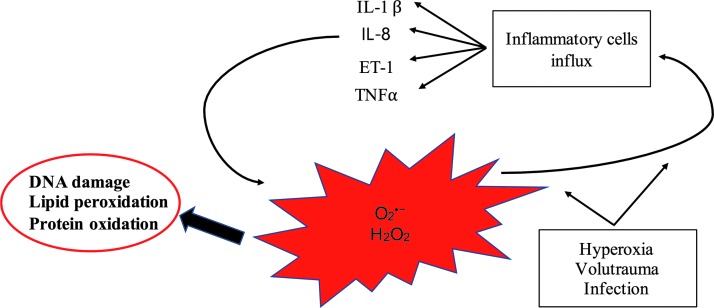
ROIs vicious cycle of inflammation. ROIs regulate the inflammatory cells influx after exposure to exogenous stimulus such as hyperoxia, volutrauma, or infection resulting in an additional release/production of proinflammatory cytokines that generates more ROIs. This provokes DNA damage, lipid peroxidation, and protein oxidation and ultimately destruction of the alveolar–capillary barrier, vascular leak, influx of inflammatory mediators, pulmonary edema, and cell death. ET-1, Endothelin-1; H2O2, hydrogen peroxide; IL, interleukin; O2•−, superoxide; TNFα, tumor necrosis factor alpha.
<b>FIG. 3.</b>
FIG. 3.
Glutathione redox cycle. GSH is synthesized from the amino acids l-glutamate, l-cysteine, and glycine in a two-step pathway requiring energy from ATP. Glu and Cys are combined via the action of GCL. This dipeptide then combines with Gly via a reaction from GS. GSH undergoes a redox reaction using glutathione peroxidase GPx to detoxify ROIs such as H2O2. GSH is converted to an oxidized form (GSSG) and is recycled back to GSH by the enzymatic reaction of GR, which requires the cofactor NADPH to form a redox cycle. ATP, adenosine-5-triphosphate; Cys, cysteine; GCL, glutamate cysteine ligase; GR, glutathione reductase; GS, glutathione synthetase; GSH, glutathione; NADPH, nicotinamide adenine dinucleotide phosphate.
<b>FIG. 4.</b>
FIG. 4.
The Trx system. Trx is maintained in a reduced state by the enzyme TXNRD. TrxR reduces the active site of oxidized Trx (TrxS2) from a disulfide to a dithiol [Trx(SH)2] with NADPH as a cofactor. Trx intervenes in reduction of disulfide in proteins and as a direct antioxidant via reduction of H2O2 by Prx. Prx, peroxiredoxins; Trx, thioredoxin; TXNRD, Trx reductase.
<b>FIG. 5.</b>
FIG. 5.
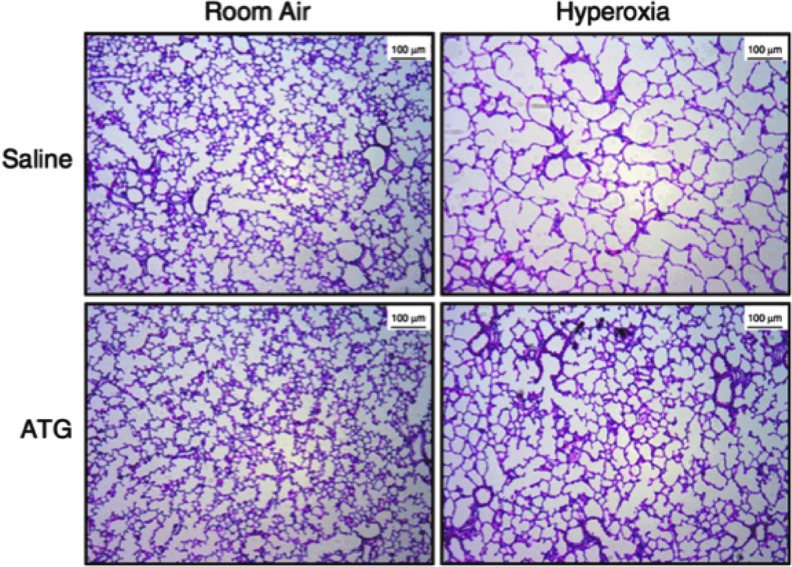
Regulation of the Trx system and effects on hyperoxic lung injury. Lung histology at 14 days of life of newborn C3H/HeN mice treated with a single intraperitoneal dose of 25 mg/kg ATG, a TXNRD inhibitor, or saline and exposed to room air or hyperoxia (85% O2) for 14 days. Scale bars: 100 μm. Reprinted with permission of the American Thoracic Society. Copyright © 2018 American Thoracic Society. Li et al. (102) The American Journal of Respiratory Cell and Molecular Biology is an official journal of the American Thoracic Society.
<b>FIG. 6.</b>
FIG. 6.
Se enhances Nrf2 nuclear localization and ARE-luciferase activity in AFN-treated mtCCs. Nuclear Nrf2 expression and ARE-luciferase activity. mtCCs were cultured in 5% fetal bovine serum-containing media containing 0, 10, 25, or 100 nM Na2SeO3. (A) Cells were cultured in the presence or absence of 0.5 μM AFN for 1 h and Nrf2 expression was determined by Western blotting of nuclear fractions. (B, C) mtCCs were cultured as described, transfected with ARE-luciferase and Renilla luciferase plasmid DNA for 24 h, and incubated in the presence or absence of 0.5 μM AFN for 18 h. (B) Luciferase activity in 0, 10, 25, or 100 nM Na2SeO3-supplemented cells. (C) Fold-change luciferase activity in control and AFN-treated cells. Data (mean ± standard error of the mean, n = 3) were analyzed by one-way ANOVA followed by Tukey's post hoc analysis (A, B) or t-test (C). *p < 0.05 versus respective (Na2SeO3); $p < 0.03 versus 0 nM Na2SeO3 + AFN; #p < 0.02 versus 10 mM Na2SeO3 + AFN. Reprinted from Redox Biology Tindell et al. (163), with permission from Elsevier. ARE, antioxidant response element; mtCC, mouse transformed clara cells.

References

    1. Ahola T, Lapatto R, Raivio KO, Selander B, Stigson L, Jonsson B, Jonsbo F, Esberg G, Stövring S, Kjartansson S, Stiris T, Lossius K, Virkola K, and Fellman V. N-acetylcysteine does not prevent bronchopulmonary dysplasia in immature infants: a randomized controlled trial. J Pediatr 143: 713–719, 2003 - PubMed
    1. Allis CD. and Jenuwein T. The molecular hallmarks of epigenetic control. Nat Rev Genet 17: 487–500, 2016 - PubMed
    1. Angelo M, Singel DJ, and Stamler JS. An S-nitrosothiol (SNO) synthase function of hemoglobin that utilizes nitrite as a substrate. Proc Natl Acad Sci U S A 103: 8366–8371, 2006 - PMC - PubMed
    1. Aquilano K, Baldelli S, and Ciriolo MR. Glutathione: new roles in redox signaling for an old antioxidant. Front Pharmacol 5: 196, 2014 - PMC - PubMed
    1. Asikainen TM, Chang LY, Coalson JJ, Schneider BK, Waleh NS, Ikegami M, Shannon JM, Winter VT, Grubb P, Clyman RI, Yoder BA, Crapo JD, and White CW. Improved lung growth and function through hypoxia-inducible factor in primate chronic lung disease of prematurity. FASEB J 20: 1698–1700, 2006 - PubMed

Publication types

Substances

LinkOut - more resources