


Catch-Up Growth in Full-Term Small for Gestational Age Infants: A Systematic Review
- PMID: 30649167
- PMCID: PMC6370265
- DOI: 10.1093/advances/nmy091
Catch-Up Growth in Full-Term Small for Gestational Age Infants: A Systematic Review
Abstract
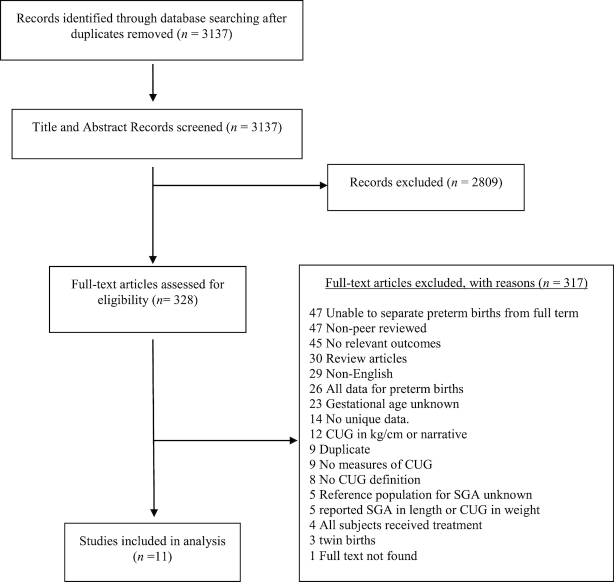
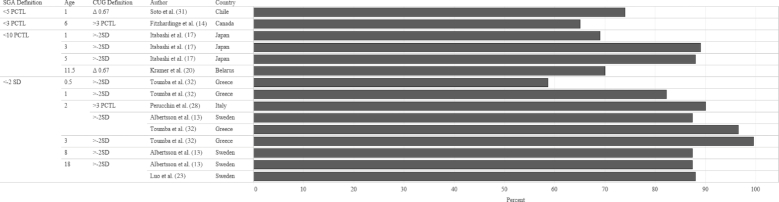
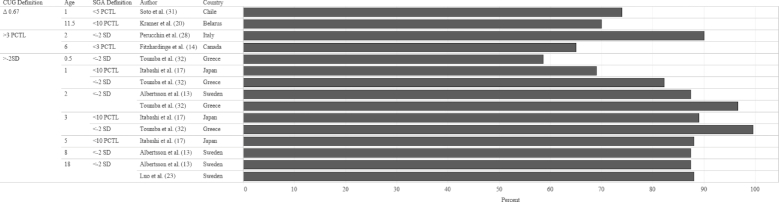
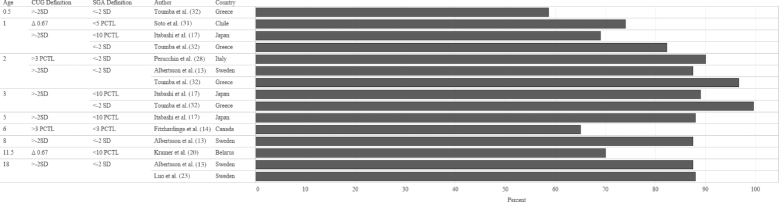
This is the first systematic review to examine the global prevalence of catch-up growth (CUG) in small for gestational age (SGA) infants who were born at full term (FT). Size at birth and subsequent growth is an important indicator of neonatal and adult health. Globally, 16% of infants are SGA at birth, ranging from 7% in industrialized countries to 41.5% in South Asia. SGA infants are at increased risk for negative developmental and adult health outcomes. Some achieve CUG but others do not. CUG has immediate and late health implications especially in low- and middle-income countries. This systematic review sought to determine the global prevalence of CUG among FT-SGA infants. We performed a literature search of MEDLINE, Pubmed, Embase, Web of Science, and Scopus, as well as grey literature databases, and identified 3137 studies. The final analysis included 11 studies. The median prevalence of CUG was 87.4% across all definitions of SGA and CUG. However, multiple definitions were used to classify SGA and CUG. Nine unique reference populations were used to classify SGA, and 6 to approximate CUG. Due to this heterogeneity, a meta-analysis could not be conducted. Program implementation for this vulnerable group of infants is dependent on proper classification. Given the wide range of definitions and reference standards used in the past, it is not possible to determine the global need for programs to address CUG for FT-SGA infants or to rationally plan any such programs. We highlight the need and propose standard definitions and references for SGA and CUG.
Figures
References
-
- Tudehope D, Vento M, Bhutta Z, Pachi P. Nutritional requirements and feeding recommendations for small for gestational age infants. J Pediatr. 2013;162(3 Suppl):S81–9. - PubMed
-
- Lee AC, Katz J, Blencowe H, Cousens S, Kozuki N, Vogel JP, Adair L, Baqui AH, Bhutta ZA, Caulfield LE et al. National and regional estimates of term and preterm babies born small for gestational age in 138 low-income and middle-income countries in 2010. Lancet Glob Health. 2013;1(1):e26–36. - PMC - PubMed
-
- Lee PA, Chernausek SD, Hokken-Koelega AC, Czernichow P, International Small for Gestational Age Advisory Board. International Small for Gestational Age Advisory Board consensus development conference statement: management of short children born small for gestational age, April 24–October 1, 2001. Pediatrics. 2003;111(6 Pt 1):1253–61. - PubMed
-
- WHO Physical Status: The Use and Interpretation of Anthropometry. WHO Technical Report Series Geneva: WHO; 1995.
