


Exercise training impacts skeletal muscle gene expression related to the kynurenine pathway
- PMID: 30649918
- PMCID: PMC6457098
- DOI: 10.1152/ajpcell.00448.2018
Exercise training impacts skeletal muscle gene expression related to the kynurenine pathway
Abstract
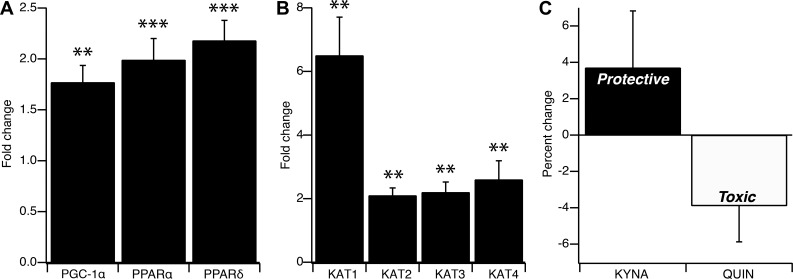
Exercise positively impacts mood and symptoms of depression; however, the mechanisms underlying these effects are not fully understood. Recent evidence highlights a potential role for skeletal muscle-derived transcription factors to influence tryptophan metabolism, along the kynurenine pathway, which has important implications in depression. This has important consequences for older adults, whose age-related muscle deterioration may influence this pathway and may increase their risk for depression. Although exercise training has been shown to improve skeletal muscle mass in older adults, whether this also translates into improvements in transcription factors and metabolites related to the kynurenine pathway has yet to be examined. The aim of the present study was to examine the influence of a 12-wk exercise program on skeletal muscle gene expression of transcription factors, kynurenine aminotransferase (KAT) gene expression, and plasma concentrations of tryptophan metabolites (kynurenines) in healthy older men over 65 yr of age. Exercise training significantly increased skeletal muscle gene expression of transcription factors (peroxisome proliferator-activated receptor-γ coactivator 1α, peroxisome proliferator-activated receptor-α, and peroxisome proliferator-activated receptor-δ: 1.77, 1.99, 2.18-fold increases, respectively, P < 0.01] and KAT isoforms 1-4 (6.5, 2.1, 2.2, and 2.6-fold increases, respectively, P ≤ 0.01). Concentrations of plasma kynurenines were not altered. These results demonstrate that 12 wk of exercise training significantly altered skeletal muscle gene expression of transcription factors and gene expression related to the kynurenine pathway, but not circulating kynurenine metabolites in older men. These findings warrant future research to determine whether distinct exercise modalities or varying intensities could induce a shift in the kynurenine pathway in depressed older adults.
Keywords: PGC-1α; aging; kynurenine; physical activity; skeletal muscle.
Conflict of interest statement
No conflicts of interest, financial or otherwise, are declared by the authors.
Figures
References
-
- Agudelo LZ, Femenía T, Orhan F, Porsmyr-Palmertz M, Goiny M, Martinez-Redondo V, Correia JC, Izadi M, Bhat M, Schuppe-Koistinen I, Pettersson AT, Ferreira DMS, Krook A, Barres R, Zierath JR, Erhardt S, Lindskog M, Ruas JL. Skeletal muscle PGC-1α1 modulates kynurenine metabolism and mediates resilience to stress-induced depression. Cell 159: 33–45, 2014. [Erratum in Cell 160: 351, 2015.] doi: 10.1016/j.cell.2014.07.051. - DOI - PubMed
-
- Bell KE, Snijders T, Zulyniak M, Kumbhare D, Parise G, Chabowski A, Phillips SM. A whey protein-based multi-ingredient nutritional supplement stimulates gains in lean body mass and strength in healthy older men: a randomized controlled trial. PLoS One 12: e0181387, 2017. doi: 10.1371/journal.pone.0181387. - DOI - PMC - PubMed
-
- Derbré F, Gomez-Cabrera MC, Nascimento AL, Sanchis-Gomar F, Martinez-Bello VE, Tresguerres JAF, Fuentes T, Gratas-Delamarche A, Monsalve M, Viña J. Age associated low mitochondrial biogenesis may be explained by lack of response of PGC-1α to exercise training. Age (Dordr) 34: 669–679, 2012. doi: 10.1007/s11357-011-9264-y. - DOI - PMC - PubMed
Publication types
MeSH terms
Substances
Grants and funding
LinkOut - more resources
Full Text Sources
Medical
