


The Relationship Between Networking, LinkedIn Use, and Retrieving Informational Benefits
- PMID: 30649924
- PMCID: PMC6444899
- DOI: 10.1089/cyber.2018.0294
The Relationship Between Networking, LinkedIn Use, and Retrieving Informational Benefits
Abstract
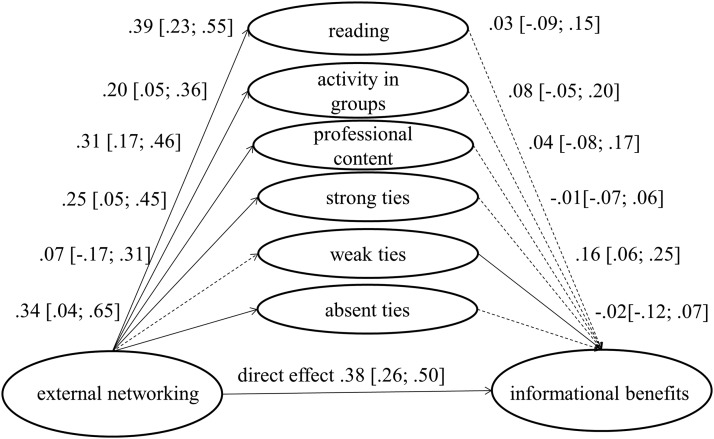
Previous research has shown that users of social network sites designed for professional purposes, such as LinkedIn, report higher professional informational benefits than nonusers. However, this effect could only be partly explained by social media use as there was also a selection effect, such that people who have more informational benefits were more likely to use LinkedIn. The goal of this study was to explore whether differences in networking, defined as a set of behaviors with the aim of building, maintaining, and using internal and external contacts for instrumental purposes, can explain this selection effect. We used data from a panel study with a representative sample of Dutch Internet users (n = 685; 259 LinkedIn users) to examine the relationships between networking and LinkedIn use as well as professional informational benefits, that is, timely access to relevant information. The results showed that people scoring high on external networking (but not internal networking within their organization) are also more likely to use LinkedIn. External networking was also positively correlated with active and passive use as well as the number of strong and latent ties on LinkedIn. However, in a mediation model the direct effect of networking on informational benefits was not mediated by actual social media use and network composition; instead, the number of weak ties had a direct effect on informational benefits. The results thus indicate that networking is a major driver of informational benefits from LinkedIn use.
Keywords: LinkedIn; informational benefits; networking.
Conflict of interest statement
No competing financial interests exist.
Figures
References
-
- Ma SQ, Leung L. The impacts of personality traits, use intensity and features use of LinkedIn on bridging social capital. Applied Research in Quality of Life 2018;1–20
-
- Utz S. Is LinkedIn making you more successful? The informational benefits derived from public social media. New Media and Society 2016; 18:2685–2702
-
- Utz S, Breuer J. Informational benefits from social media use for professional purposes: results from a longitudinal study. Cyberpsychology: Journal of Psychosocial Research on Cyberspace 2016; 10:article 1
-
- Wolff H-G, Moser K. Entwicklung und Validierung einer Networkingskala. Diagnostica 2006; 52:161–180
-
- Porter CM, Woo SE. Untangling the networking phenomenon: a dynamic psychological perspective on how and why people network. Journal of Management 2015; 41:1477–1500
MeSH terms
LinkOut - more resources
Full Text Sources
