


Mood Disorders, Accelerated Aging, and Inflammation: Is the Link Hidden in Telomeres?
- PMID: 30650526
- PMCID: PMC6356466
- DOI: 10.3390/cells8010052
Mood Disorders, Accelerated Aging, and Inflammation: Is the Link Hidden in Telomeres?
Abstract
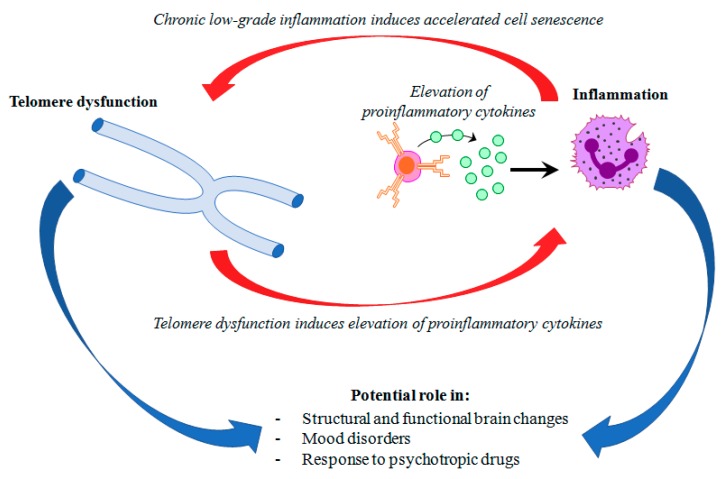
Mood disorders are associated with an increased risk of aging-related diseases, which greatly contribute to the excess morbidity and mortality observed in affected individuals. Clinical and molecular findings also suggest that mood disorders might be characterized by a permanent state of low-grade inflammation. At the cellular level, aging translates into telomeres shortening. Intriguingly, inflammation and telomere shortening show a bidirectional association: a pro-inflammatory state seems to contribute to aging and telomere dysfunction, and telomere attrition is able to induce low-grade inflammation. Several independent studies have reported shorter telomere length and increased levels of circulating inflammatory cytokines in mood disorders, suggesting a complex interplay between altered inflammatory⁻immune responses and telomere dynamics in the etiopathogenesis of these disorders. In this review, we critically discuss studies investigating the role of telomere attrition and inflammation in the pathogenesis and course of mood disorders, and in pharmacological treatments with psychotropic medications.
Keywords: aging; antidepressants; bipolar disorder; inflammation; lithium; major depression; mood disorders; mood stabilizers; telomere shortening.
Conflict of interest statement
The authors declare no conflict of interest.
Figures
References
-
- World Health Organization. [(accessed on 13 December 2018)]; Available online: http://www.who.int/news-room/fact-sheets/detail/mental-disorders.
Publication types
MeSH terms
Substances
LinkOut - more resources
Full Text Sources
Other Literature Sources
Medical
