


Comparison of Population Aging in Europe and Asia Using a Time-Consistent and Comparative Aging Measure
- PMID: 30651037
- PMCID: PMC7322980
- DOI: 10.1177/0898264318824180
Comparison of Population Aging in Europe and Asia Using a Time-Consistent and Comparative Aging Measure
Abstract
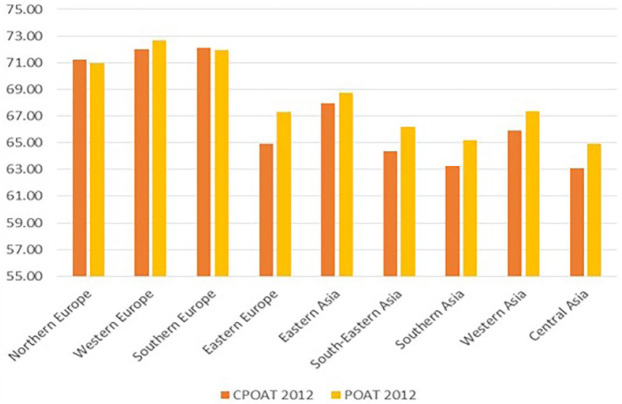
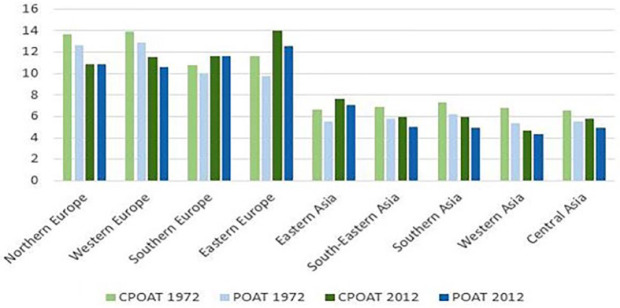
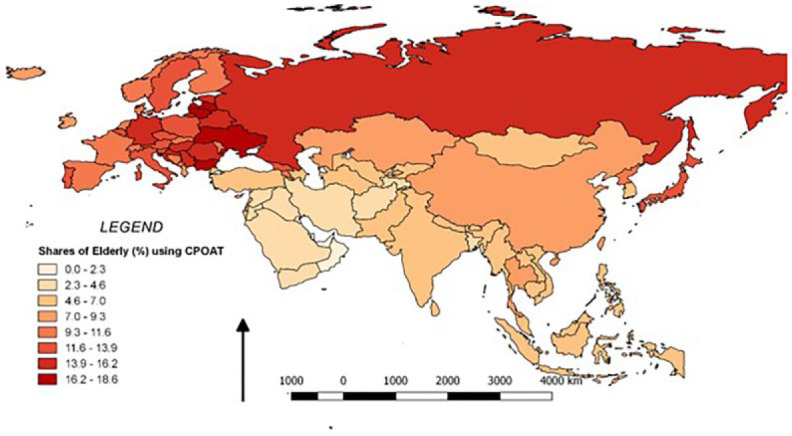
Objective: We compare population aging in Europe and Asia using a measure that is both consistent over time and appropriate for cross-country comparison. Method: Sanderson and Scherbov proposed to estimate the old-age threshold by the age at which the remaining life expectancy (RLE) equals 15 years. We propose an adjustment of this measure, taking into account cross-national differences in the exceptionality of reaching that age. Results: Our old-age threshold was lower than 65 years in 2012 in Central Asia, Southern Asia, Southeastern Asia, and many Eastern European countries. These populations also experienced a higher share of elderly compared with the RLE15 method. Our method revealed more geographical diversity in the shares of elderly. Both methods exhibited similar time trends for the old-age thresholds and the shares of elderly. Discussion: Our prospective and comparative measure reveals higher population aging estimates in most Asian and Eastern European countries and more diversity in aging.
Keywords: Asia; Europe; adult survival; characteristics approach; population aging.
Conflict of interest statement
Figures
References
-
- Angus J., Reeve P. (2006). Ageism: A threat to “aging well” in the 21st century. Journal of Applied Gerontology, 25, 137-152.
-
- Becker G. S. (1985). Human capital, effort, and the sexual division of labor. Journal of Labor Economics, 3(1), S33-S58.
-
- Blau F. D., Kahn L. M. (2000). Gender differences in pay. Journal of Economic Perspectives, 14(4), 75-100.
-
- Bloom D. E., Canning D., Malaney P. N. (2000). Population dynamics and economic growth in Asia. Population and Development Review, 26, 257-290.
Publication types
MeSH terms
LinkOut - more resources
Full Text Sources
Medical
