Review
. 2019 Jan 16;32(2):e00066-18.
doi: 10.1128/CMR.00066-18. Print 2019 Apr.

Phage Therapy in the Postantibiotic Era

Affiliations
Review

Phage Therapy in the Postantibiotic Era

Fernando L Gordillo Altamirano et al. Clin Microbiol Rev. .

Abstract

Antibiotic resistance is arguably the biggest current threat to global health. An increasing number of infections are becoming harder or almost impossible to treat, carrying high morbidity, mortality, and financial cost. The therapeutic use of bacteriophages, viruses that infect and kill bacteria, is well suited to be part of the multidimensional strategies to combat antibiotic resistance. Although phage therapy was first implemented almost a century ago, it was brought to a standstill after the successful introduction of antibiotics. Now, with the rise of antibiotic resistance, phage therapy is experiencing a well-deserved rebirth. Among the admittedly vast literature recently published on this topic, this review aims to provide a forward-looking perspective on phage therapy and its role in modern society. We cover the key points of the antibiotic resistance crisis and then explain the biological and evolutionary principles that support the use of phages, their interaction with the immune system, and a comparison with antibiotic therapy. By going through up-to-date reports and, whenever possible, human clinical trials, we examine the versatility of phage therapy. We discuss conventional approaches as well as novel strategies, including the use of phage-antibiotic combinations, phage-derived enzymes, exploitation of phage resistance mechanisms, and phage bioengineering. Finally, we discuss the benefits of phage therapy beyond the clinical perspective, including opportunities for scientific outreach and effective education, interdisciplinary collaboration, cultural and economic growth, and even innovative use of social media, making the case that phage therapy is more than just an alternative to antibiotics.

Keywords: antibiotic resistance; bacteriophage therapy; bacteriophages.


Figures

FIG 1
FIG 1
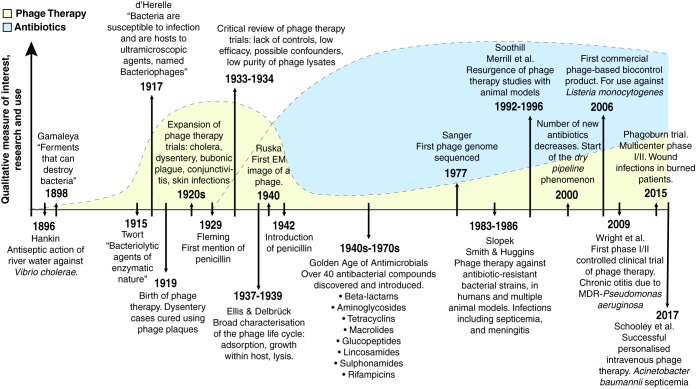
Timeline of major events in the history of research on phages, phage therapy, and antibiotics. Background curves represent a qualitative measure of the overall interest, research, and use of phage therapy (yellow) and antibiotics (blue), showing how the introduction of antibiotics and the critical review of the early phage therapy studies coincided to bring phage therapy research and development to an almost complete standstill around the 1940s. (3, 4, 63–65, 67–69, 72, 73, 78, 169–174).
FIG 2
FIG 2
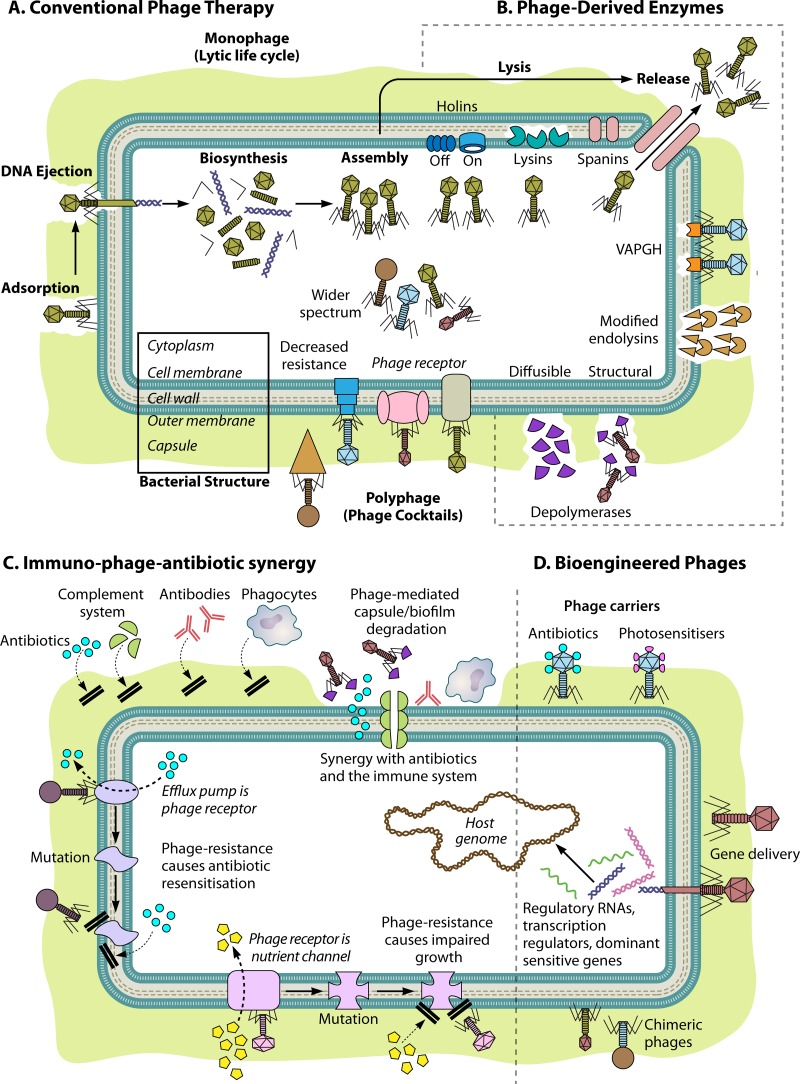
Approaches to phage therapy delivery. A schematic representation of a bacterial cell consisting of capsule, outer membrane, cell wall, inner membrane, and cytoplasm is shown. (A) Phage lytic life cycle as the basis for conventional monophage therapy, from adsorption to lysis of the host cell, and polyphage therapy, or use of phage cocktails targeting different receptors on the same host cell, limiting the occurrence of resistance and expanding the therapeutic spectrum. (B) Use of phage-derived enzymes such as depolymerases (to target capsules and biofilm structures) and cell wall-degrading endolysins. Holins, spanins, and virion-associated peptidoglycan hydrolases (VAPGH) are represented as components of the lytic life cycle, without current therapeutic applications. (C) Mechanisms for synergy between phages, antibiotics, and the immune response include phage-mediated capsule or biofilm degradation, which enables the action of antibiotics, antibodies, the complement system, and phagocytes, and the exploitation of the evolutionary trade-offs of phage resistance, such as antibiotic resensitization and impaired bacterial growth. (D) Bioengineering of phages for therapeutic purposes includes the attachment of antibiotics or photosensitizing agents to phage capsids for targeted release into bacterial cells, delivery of genes to reverse/cancel antibiotic resistance and virulence determinants, and use of chimeric phages. Labels in italic represent bacterial structures.

References

    1. Clokie MRJ, Millard AD, Letarov AV, Heaphy S. 2011. Phages in nature. Bacteriophage 1:31–45. doi:10.4161/bact.1.1.14942. - DOI - PMC - PubMed
    1. Golkar Z, Bagasra O, Pace DG. 2014. Bacteriophage therapy: a potential solution for the antibiotic resistance crisis. J Infect Dev Ctries 8:129–136. doi:10.3855/jidc.3573. - DOI - PubMed
    1. Chanishvili N. 2012. Phage therapy—history from Twort and d'Herelle through Soviet experience to current approaches. Adv Virus Res 83:3–40. doi:10.1016/B978-0-12-394438-2.00001-3. - DOI - PubMed
    1. Duckworth DH. 1976. Who discovered bacteriophage? Bacteriol Rev 40:793–802. - PMC - PubMed
    1. Viertel TM, Ritter K, Horz H-P. 2014. Viruses versus bacteria—novel approaches to phage therapy as a tool against multidrug-resistant pathogens. J Antimicrob Chemother 69:2326–2336. doi:10.1093/jac/dku173. - DOI - PubMed

Publication types