Vaccination of Icelandic Children with the 10-Valent Pneumococcal Vaccine Leads to a Significant Herd Effect among Adults in Iceland
- PMID: 30651396
- PMCID: PMC6440763
- DOI: 10.1128/JCM.01766-18
Vaccination of Icelandic Children with the 10-Valent Pneumococcal Vaccine Leads to a Significant Herd Effect among Adults in Iceland
Abstract
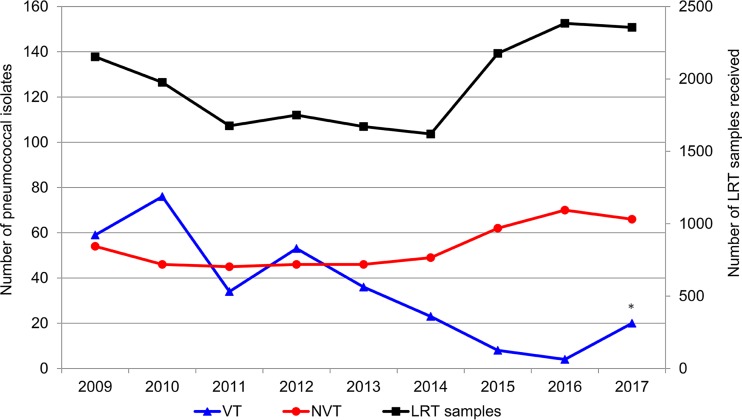
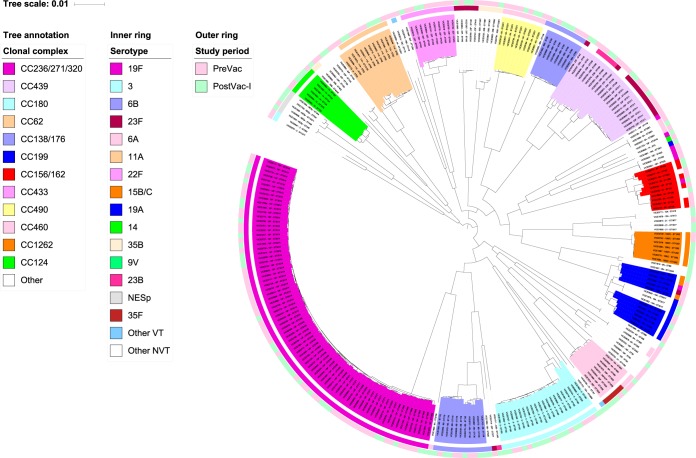
The introduction of pneumococcal conjugate vaccines (PCVs) into childhood vaccination programs has reduced carriage of vaccine serotypes and pneumococcal disease. The 10-valent PCV was introduced in Iceland in 2011. The aim of this study was to determine PCV impact on the prevalence of serotypes, genetic lineages, and antimicrobial-resistant pneumococci isolated from the lower respiratory tract (LRT) of adults. Pneumococci isolated between 2009 and 2017 at the Landspitali University Hospital were included (n = 797). The hospital serves almost three-quarters of the Icelandic population. Isolates were serotyped and tested for antimicrobial susceptibility, and the genome of every other isolate collected between 2009 and 2014 was sequenced (n = 275). Serotypes and multilocus sequence types (STs) were extracted from the genome data. Three study periods were defined, 2009 to 2011 (PreVac), 2012 to 2014 (PostVac-I), and 2015 to 2017 (PostVac-II). The total number of isolates and vaccine-type (VT) pneumococci decreased from PreVac to PostVac-II (n = 314 versus n = 230 [p = 0.002] and n = 170 versus n = 33 [p < 0.001], respectively), but non-vaccine-type (NVT) pneumococci increased among adults 18 to 64 years old (n = 56 versus n = 114 [p = 0.008]). Serotype 19F decreased in the PostVac-II period; these isolates were all multidrug resistant (MDR) and were members of the Taiwan19F-14 PMEN lineage. Serotype 6A decreased among adults ≥65 years old in the PostVac-II period (p = 0.037), while serotype 6C increased (p = 0.021) and most serotype 6C isolates were MDR. Nonencapsulated Streptococcus pneumoniae (NESp) isolates increased among adults 18 to 64 years old in the PostVac-II period, and the majority were MDR (p = 0.028). An overall reduction in the number of LRT samples and pneumococcus-positive cultures and significant changes in the serotype distribution became evident within 4 years, thereby demonstrating a significant herd effect.
Keywords: Iceland; Streptococcus pneumoniae; adults; epidemiology; lower respiratory tract; molecular epidemiology; pneumococcus; pneumonia; vaccination.
Copyright © 2019 Quirk et al.
Figures
References
-
- World Health Organization. 2018. Pneumococcal disease. World Health Organization, Geneva, Switzerland: http://www.who.int/ith/diseases/pneumococcal/en/.
Publication types
MeSH terms
Substances
Grants and funding
LinkOut - more resources
Full Text Sources
Medical