


Contribution of chronic diseases to educational disparity in disability in France: results from the cross-sectional "disability-health" survey
- PMID: 30651987
- PMCID: PMC6330417
- DOI: 10.1186/s13690-018-0326-9
Contribution of chronic diseases to educational disparity in disability in France: results from the cross-sectional "disability-health" survey
Abstract
Background: This study aimed 1) to assess whether the contribution of chronic conditions to disability varies according to the educational attainment, 2) to disentangle the contributions of the prevalence and of the disabling impact of chronic conditions to educational disparities.
Methods: Data of the 2008-09 Disability Health Survey were examined (N = 23,348). The disability indicator was the Global Activity Limitation Indicator (GALI). The attribution method based on an additive hazard model was used to estimate educational differences in disabling impacts and in the contributions of diseases to disability. Counterfactual analyses were used to disentangle the contribution of differences in disease prevalence vs. disabling impact.
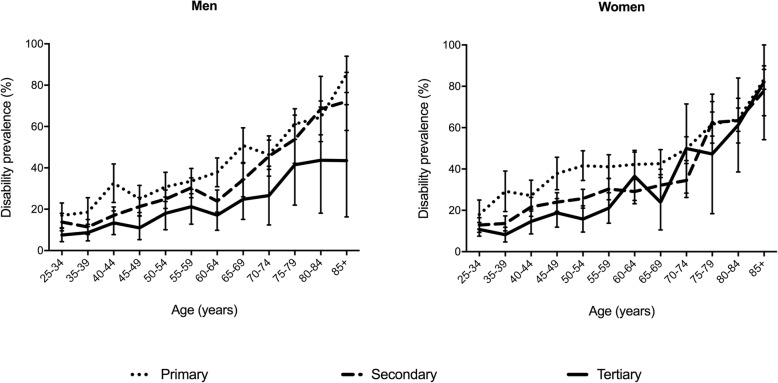
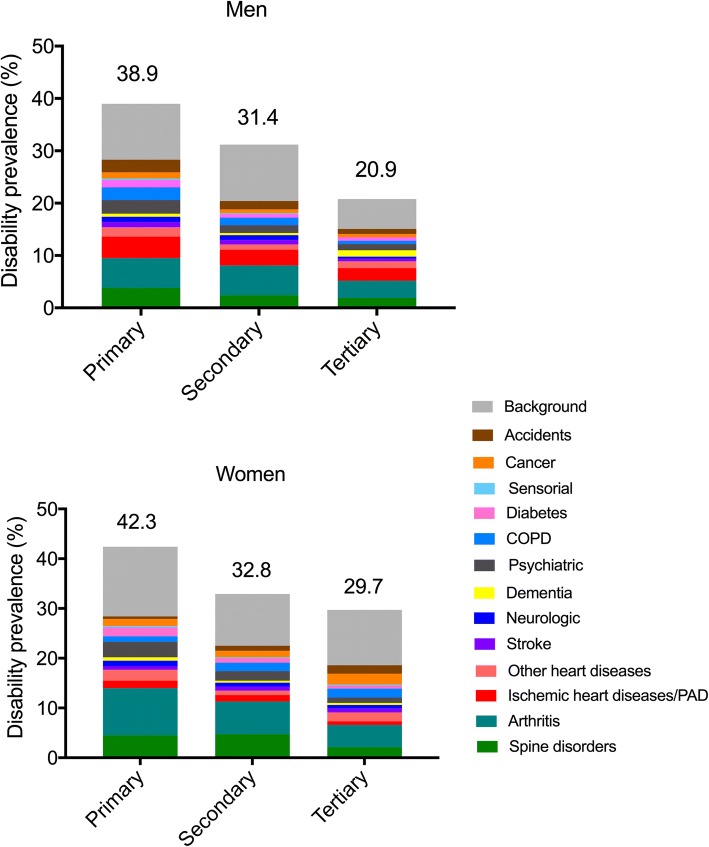
Results: In men, the main contributors to educational difference in disability prevalence were arthritis (contribution to disability prevalence: 5.7% (95% CI 5.4-6.0) for low-educated vs. 3.3% (3.0-3.9) for high-educated men), spine disorders (back/neck pain, deformity) (3.8% (3.6-4.0) vs. 1.9% (1.8-2.1)), chronic obstructive pulmonary diseases (2.4% (2.3-2.6) vs. 0.6% (0.5-0.7)) and ischemic heart /peripheral artery diseases (4.1% (3.9-4.3) vs. 2.4% (2.2-3.0)). In women, arthritis (9.5% (9.1-9.9) vs. 4.5%, (4.1-5.2)), spine disorders (4.5% (4.3-4.7) vs. 2.1% 1.9-2.3) and psychiatric diseases (3.1% (3.0-3.3) vs. 1.1% (1.0-1.3)) contributed most to education gap in disability. The educational differences were equally explained by differences in the disease prevalence and in their disabling impact.
Conclusions: Public health policies aiming to reduce existing socioeconomic disparities in disability should focus on musculoskeletal, pulmonary, psychiatric and ischemic heart diseases, reducing their prevalence as well as their disabling impact in lower socioeconomic groups.
Keywords: Chronic diseases; Disability; Educational attainment; Socioeconomic status.
Conflict of interest statement
HVO is the editor in chief of the journal but he was blinded of the submission process. No other competing interest was declared.This study was planned as a research project. It was performed in collaboration with the French National Institute of Statistics. This study was declared of public interest by the CNIS (Conseil National d’Information Statistique) and was approved by the CNIL (Commission Nationale de l’Informatique et des Liberte’s, French law no. 78–17). According to the French law, written informed consent was not required for this type of study.Not applicable.Springer Nature remains neutral with regard to jurisdictional claims in published maps and institutional affiliations.
Figures
References
-
- Cambois E, Solé-Auró A, Brønnum-Hansen H, Egidi V, Jagger C, Jeune B, et al. Educational differentials in disability vary across and within welfare regimes: a comparison of 26 European countries in 2009. J Epidemiol Community Health. 2016;70:331–338. - PubMed
LinkOut - more resources
Full Text Sources
Miscellaneous
