An Emerging Biothreat: Crimean-Congo Hemorrhagic Fever Virus in Southern and Western Asia
- PMID: 30652673
- PMCID: PMC6335890
- DOI: 10.4269/ajtmh.18-0553
An Emerging Biothreat: Crimean-Congo Hemorrhagic Fever Virus in Southern and Western Asia
Abstract
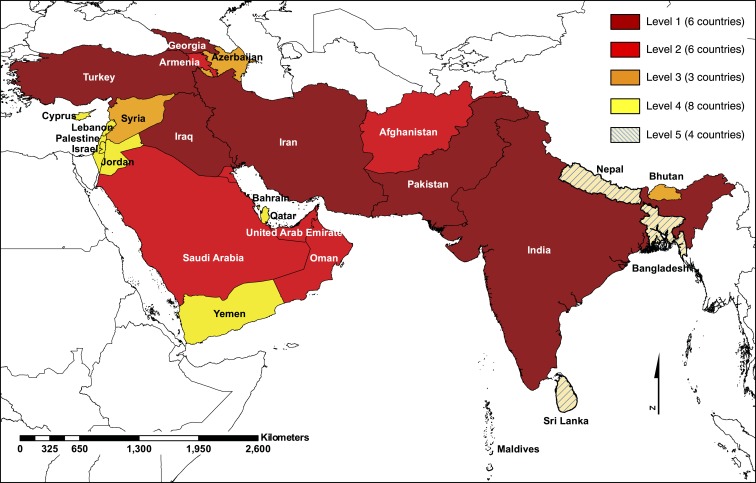
Tick-borne Crimean-Congo hemorrhagic fever virus (CCHFV) is endemic in numerous countries, but the epidemiology and epizoology of Crimean-Congo hemorrhagic fever (CCHF) remain to be defined for most regions of the world. Using a broad database search approach, we reviewed the literature on CCHF and CCHFV in Southern and Western Asia to better define the disease burden in these areas. We used a One Health approach, moving beyond a focus solely on human disease burden to more comprehensively define this burden by reviewing CCHF case reports, human and animal CCHFV seroprevalence studies, and human and animal CCHFV isolations. In addition, we used published literature to estimate the distribution of Hyalomma ticks and infection of these ticks by CCHFV. Using these data, we propose a new classification scheme for organizing the evaluated countries into five categories by level of evidence for CCHF endemicity. Twelve countries have reported CCHF cases, five from Southern Asia and seven from Western Asia. These were assigned to level 1 or 2. Eleven countries that have evidence of vector circulation but did not report confirmed CCHF cases were assigned to level 3 or 4. This classification scheme was developed to inform policy toward strengthening CCHF disease surveillance in the Southern and Western Asia regions. In particular, the goal of this review was to inform international organizations, local governments, and health-care professionals about current shortcomings in CCHFV surveillance in these two high-prevalence regions.
Figures
References
-
- ESRI , 2017. ArcGIS: Release 10.6. Redlands, CA: Environmental Systems Research Institute.
-
- Čumakov MP, 1945. Krymskaâ Gemorragičeskaâ Lihoradka (Ostryj Infekcionnyj Kapillârotoksikoz). Simferopol, USSR: Izdanie Otdel’noj Primorskoj Armii.
-
- Papa A, Weber F, Hewson R, Weidmann M, Koksal I, Korukluoglu G, Mirazimi A, 2015. Meeting report: first international conference on Crimean-Congo hemorrhagic fever. Antiviral Res 120: 57–65. - PubMed
-
- World Health Organization , 2016. ICD-10 Version: 2016. Available at: http://apps.who.int/classifications/icd10/browse/2016/en. Accessed February 3, 2018.
-
- Maes P, et al. 2018. Taxonomy of the family Arenaviridae and the order Bunyavirales: update 2018. Arch Virol 163: 2295–2310. - PubMed
Publication types
MeSH terms
Grants and funding
LinkOut - more resources
Full Text Sources