


Impact of midazolam vs. saline on effect size estimates in controlled trials of ketamine as a rapid-acting antidepressant
- PMID: 30653192
- PMCID: PMC6785710
- DOI: 10.1038/s41386-019-0317-8
Impact of midazolam vs. saline on effect size estimates in controlled trials of ketamine as a rapid-acting antidepressant
Abstract
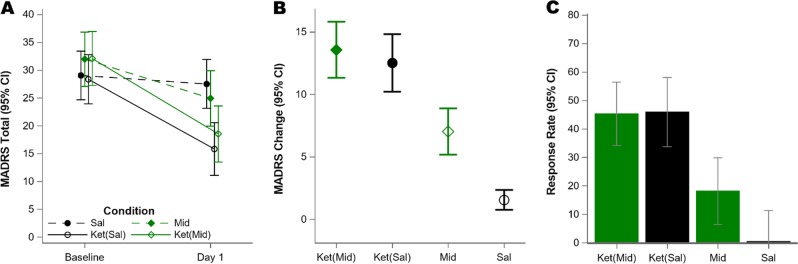
The goal of this study was to infer the effectiveness of midazolam as a comparator in preserving the blind in ketamine studies for mood disorders through patient-level analyses of efficacy trial outcomes. In this integrative data analysis (k = 9, N = 367 patients with mood disorders), clinical outcomes were compared across four groups: ketamine (midazolam-controlled), ketamine (saline-controlled), midazolam, and saline. Ketamine doses ranged from 0.5 to 0.54 mg/kg and midazolam doses ranged from 0.02 to 0.045 mg/kg. The baseline-to-Day 1 effect size was d = 0.7 (95% CI: 0.4-0.9) for ketamine (midazolam) versus midazolam and d = 1.8 (95% CI: 1.4-2.2) for ketamine (saline) versus saline. The effect of ketamine relative to control was larger in saline-controlled studies than in midazolam-controlled studies (t(276) = 2.32, p = 0.02). This was driven by a comparatively larger effect under midazolam than saline (t(111) = 5.40, p < 0.0001), whereas there was no difference between ketamine (midazolam) versus ketamine (saline) (t(177) = 0.65, p = 0.51). Model-estimated rates of response (with 95% CI) yielded similar results: ketamine (midazolam), 45% (34-56%); ketamine (saline), 46% (34-58%); midazolam, 18% (6-30%); saline, 1% (0-11%). The response rate for ketamine was higher than the control condition for both saline (t(353) = 7.41, p < 0.0001) and midazolam (t(353) = 4.59, p < 0.0001). Studies that used midazolam as a comparator yielded smaller effects of ketamine than those which used saline, which was accounted for by greater improvement following midazolam compared to saline.
Figures
References
-
- Wilkinson ST, Ballard ED, Bloch MH, Mathew SJ, Murrough JW, Feder A, et al. The effect of a single dose of intravenous ketamine on suicidal ideation: a systematic review and individual participant data meta-analysis. Am J Psychiatry. 2018;175:150–8. doi: 10.1176/appi.ajp.2017.17040472. - DOI - PMC - PubMed
Publication types
MeSH terms
Substances
Grants and funding
LinkOut - more resources
Full Text Sources
Other Literature Sources
Medical
