Epidemiology of Strongyloides stercoralis infection in Bolivian patients at high risk of complications
- PMID: 30653489
- PMCID: PMC6353209
- DOI: 10.1371/journal.pntd.0007028
Epidemiology of Strongyloides stercoralis infection in Bolivian patients at high risk of complications
Abstract
Background: Strongyloidiasis can be fatal in immunocompromised patients, but few epidemiological studies investigated the burden of this neglected tropical disease among these populations, particularly in low- and middle-income countries such as Bolivia. This study aimed to fill in this gap by estimating prevalence rate and risk factors associated with strongyloidiasis among patients at high risk of complications.
Methods: A cross-sectional study was carried out in Santa Cruz (elevation 400 meters, tropical climate) and Cochabamba (elevation 2,500 meters, temperate climate), among patients with cancer, HIV infection and rheumatic or hematologic disease, using four coproparasitological techniques and one serological (ELISA) test.
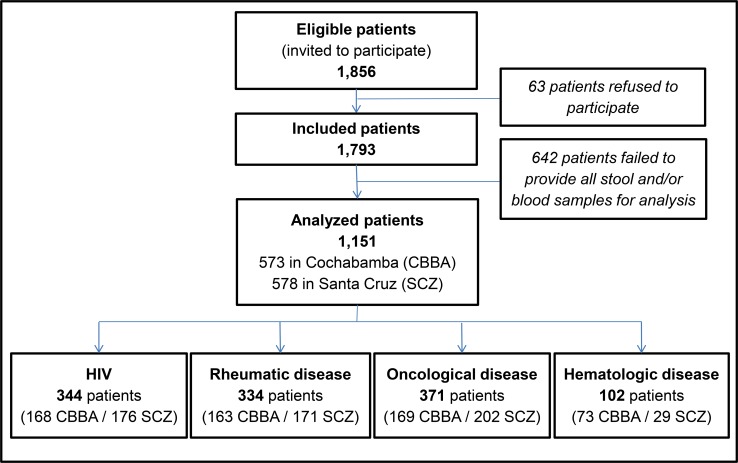
Results: In total, 1,151 patients participated in this study, including individuals who were HIV-positive (30%) or with rheumatic (29%), oncologic (32%) or hematologic (9%) diseases. The serological and coproparasitological prevalence was 23.0% (95% confidence interval [CI], 20.7-25.5; n = 265/1151) and 7.6% (95% CI, 6.2-9.3; n = 88/1151), respectively, with an estimated actual prevalence of 20.2% (95% CI, 17.9-22.5). Positive serology and positive coproparasitology were associated with younger age and lower education levels. There was no significant difference in prevalence between Cochabamba and Santa Cruz as defined by coproparasitology (6.4% vs. 8.9%; p = 0.11) or serology (24.0% vs. 22.0%; p = 0.4). Among 64 patients in Cochabamba who had never travelled to the tropical lowlands, 5 (7.8%) had a positive coproparasitology.
Conclusions: Strongyloidiasis is widely prevalent in Bolivia among vulnerable patients at increased risk of life-threatening complications. Transmission of the parasite occurs both in tropical lowlands and temperate elevation (≥ 2,500 m). Control strategies to prevent transmission and complications of this serious parasitic disease should be urgently reinforced.
Conflict of interest statement
The authors have declared that no competing interests exist.
Figures
References
Publication types
MeSH terms
LinkOut - more resources
Full Text Sources
Miscellaneous