


A body-fixed-sensor-based analysis of stair ascent and sit-to-stand to detect age-related differences in leg-extensor power
- PMID: 30653542
- PMCID: PMC6336282
- DOI: 10.1371/journal.pone.0210653
A body-fixed-sensor-based analysis of stair ascent and sit-to-stand to detect age-related differences in leg-extensor power
Abstract
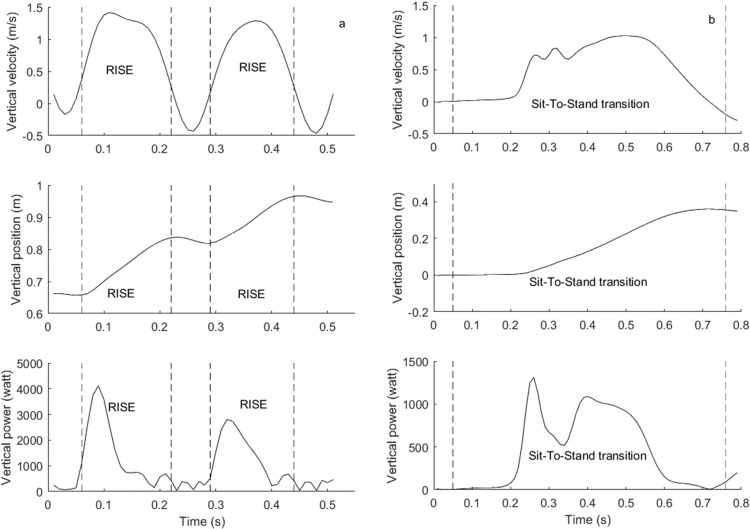
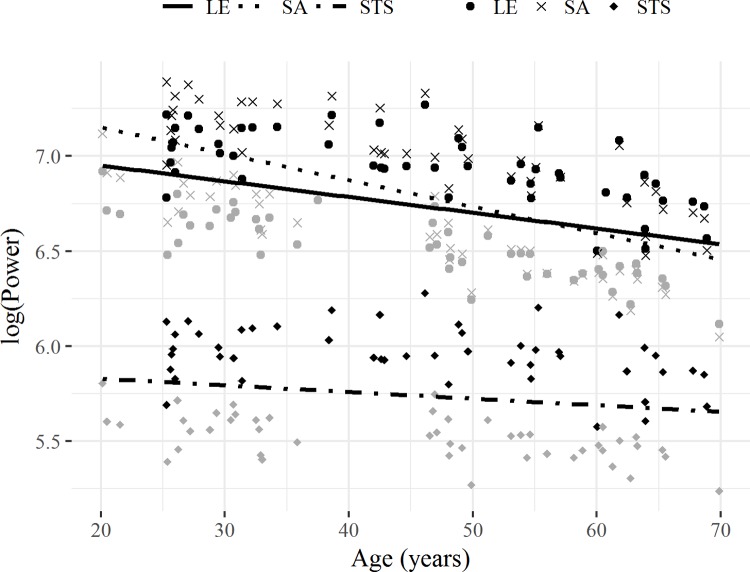
Human ageing is accompanied by a progressive decline in leg-extensor power (LEP). LEP is typically measured with specialized and expensive equipment, which limits the large-scale applicability. Previously, sensor-based trunk kinematics have been used to estimate the vertical power required to elevate the body's center of mass during functional tests, but the link with LEP and age remains to be investigated. Therefore, we investigated whether a body-fixed sensor-based analysis of power during stair ascent (SA) and sit-to-stand (STS) is positively related to LEP and whether its ability to detect age-related declines is similar. In addition, the effect of load during SA and STS was investigated. 98 adults (20-70 years) performed a leg press to assess LEP, SA and 5-repetition STS tests. In SA and STS, two conditions were tested: unloaded and loaded (+10% body mass). An inertial measurement unit was used to analyze (sub)-durations and vertical power. SA and STS power were more related to LEP than duration parameters (i.e. 0.80-0.81 for power and -0.41 --0.66 for duration parameters, p < 0.05). The average annual age-related percent change was higher in SA power (-1.38%) than in LEP (-0.86%) and STS power (-0.38%) (p < 0.05). Age explained 29% in SA power (p < 0.001), as opposed to 14% in LEP (p < 0.001) and a non-significant 2% in STS power (p = 0.102). The addition of 10% load did not influence the age-related decline of SA and STS power nor the relationship with LEP. These results demonstrate the potential of SA tests to detect age-related deterioration in neuromuscular function. SA seems more sensitive to detect age-related changes than LEP, probably because of the additional balance component and plantar- and dorsiflexor activity. On the contrary, STS is less sensitive to age-related changes because of a ceiling effect in well-functioning adults.
Conflict of interest statement
Bas Huijben is an employee and Rob C. van Lummel is founder and owner of McRoberts B.V. This company is the manufacturer of the DynaPort MoveTest used in this study. This does not alter the authors' adherence to the journal's policy.
Figures
References
-
- Vandervoort AA. Aging of the human neuromuscular system. Muscle Nerve. 2002;25(1):17–25. - PubMed
-
- Iannuzzi-Sucich M, Prestwood KM, Kenny AM. Prevalence of sarcopenia and predictors of skeletal muscle mass in healthy, older men and women. J Gerontol A Biol Sci Med Sci. 2002;57(12):M772–M7. - PubMed
-
- Narici MV, Maganaris CN, Reeves ND, Capodaglio P. Effect of aging on human muscle architecture. J Appl Physiol (1985). 2003;95(6):2229–34. - PubMed
Publication types
MeSH terms
LinkOut - more resources
Full Text Sources
Miscellaneous
